
Best Online Casino Payment Methods for Australian Players 2026
 Available in AU

Your bank declined the deposit. Again. The card you’ve used for years suddenly triggers a fraud alert the moment “online casino” appears in the transaction description. You try a different card—same result. Welcome to the Australian casino banking experience in 2026, where finding a payment method that actually works requires more research than picking the casino itself.
The friction is real. Major Australian banks flag or outright block gambling transactions using merchant category code 7995. Credit cards were banned for gambling at licensed operators in June 2024. And because online casinos are federally illegal to provide in Australia under the Interactive Gambling Act 2001, every casino accepting Aussie players operates offshore—usually licensed in Curaçao, Malta, or Anjouan. That offshore status amplifies banking friction. Your bank sees “international merchant, gambling category” and the algorithm decides for you.
This guide maps which payment methods bypass the blocks, which support withdrawals (many don’t), and how speed, fees, and privacy trade off across twelve options. No fluff about “convenient modern solutions.” Just the methods that work, the catches that matter, and the costs you’ll actually pay.
Why Australian Casino Players Need Payment Method Guidance in 2026
The Australian gambling market runs on a structural contradiction. Physical pokies are everywhere—pubs, clubs, RSLs. Sports betting is fully licensed and legal. But online casino games—pokies, blackjack, roulette, live dealer—are federally banned. The Interactive Gambling Act 2001 makes it illegal for operators to provide online casino services to anyone physically in Australia. The penalty: up to A$1.8 million per day for companies.
The ban targets providers, not players. No Australian has ever been prosecuted for playing at an offshore casino. So while no Australian-licensed online casino exists, millions of Australians access offshore sites licensed elsewhere. ACMA (Australian Communications and Media Authority) has blocked 1,455 illegal gambling sites as of December 2025, but operators respond with mirror domains faster than regulators can list them.
This creates the payment friction. You’re sending money to an offshore merchant in a banned category. Banks know this. Some automatically decline. Others require manual approval. A few reclassify gambling deposits as cash advances, triggering higher interest rates. The payment method you choose determines whether the transaction clears or fails before you place a single bet.
Why do Australian banks block casino deposits, and how can I get around it?
Australian banks use merchant category code 7995 to identify gambling transactions. Once flagged, the bank can decline the payment, require manual approval, or let it through with additional scrutiny. The June 2024 credit card ban formalized restrictions for Australian-licensed operators (sports betting), but most banks extended the block to all gambling merchants, licensed or not. Bypass methods: PayID (direct bank transfer, no card involved), e-wallets (casino never sees your bank), prepaid vouchers (retailer transaction, not gambling MCC), or cryptocurrency (blockchain transfer, no bank in the chain).
Credit cards are particularly problematic. The Interactive Gambling Amendment (Credit and Other Measures) Act 2023 banned credit cards and cryptocurrency for Australian-licensed wagering services from 12 June 2024. That law applies only to licensed sports betting operators like Sportsbet and TAB. Offshore casinos still accept credit cards technically, but Australian banks block them anyway under the gambling MCC. Debit cards work where credit fails, but they’re subject to the same MCC blocks. If your bank’s anti-gambling filter is aggressive, even debit deposits fail.
The workaround is picking a payment rail that doesn’t trigger MCC 7995 or bypasses the bank entirely. PayID registers as a standard bank transfer. E-wallets like Skrill or MuchBetter show the e-wallet company as the merchant, not the casino. Prepaid vouchers purchased at Coles show as a gift card sale. Cryptocurrency never touches the banking system. Each method trades one friction point for another—fees, speed, withdrawal support—but they all clear the initial banking hurdle.
Australian Bank Transfers — PayID and the POLi Story
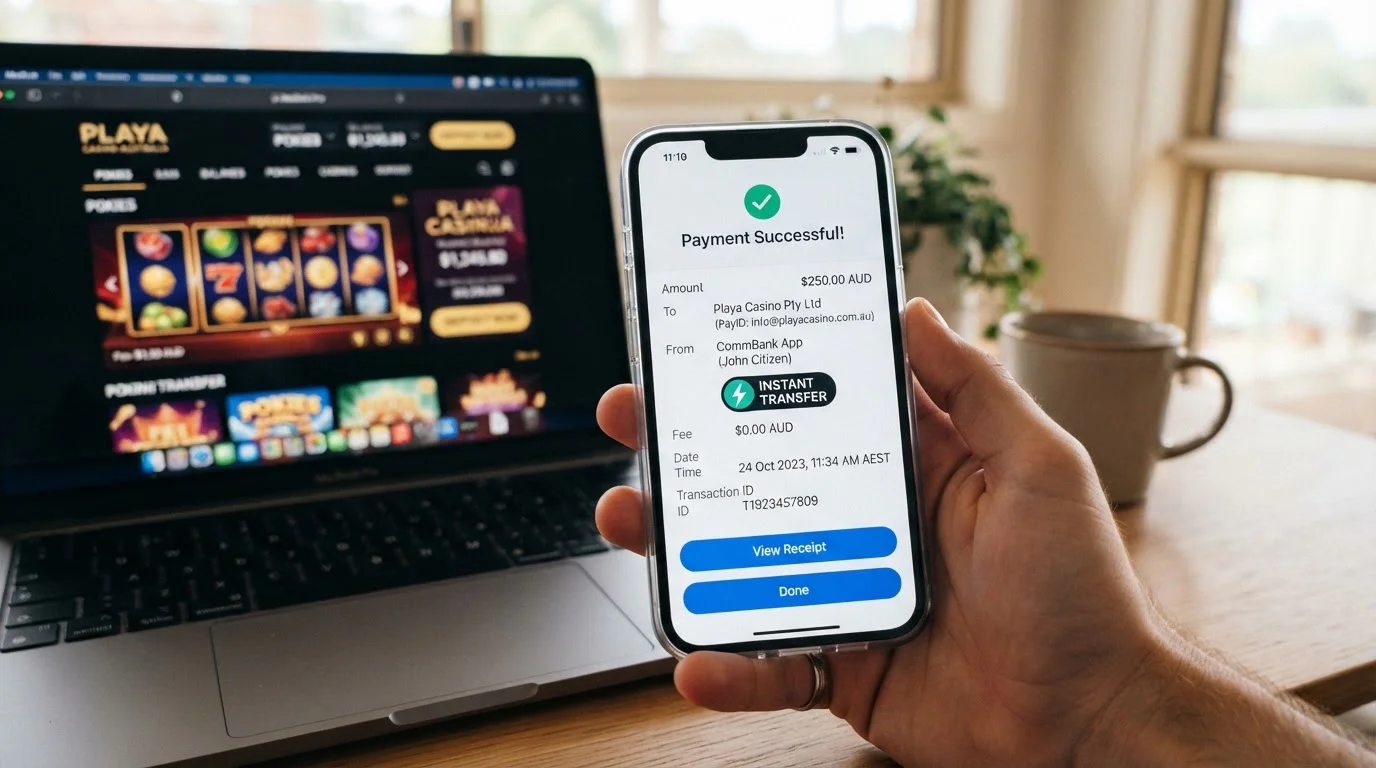
Bank transfers are the most familiar payment method, but not all bank transfers work the same. PayID is the instant option built on Australia’s New Payments Platform. POLi was the aggregator that preceded it. One is alive and growing. The other is dead.
PayID: Instant Bank Transfers via Mobile Number
PayID is not a company or a payment processor. It’s an addressing service managed by Australian Payments Plus, operating on the New Payments Platform infrastructure that launched in February 2018. The NPP is Australia’s real-time interbank network. PayID sits on top, letting you link a mobile number, email address, or ABN to your bank account so people can send you money without needing your BSB and account number.
When you deposit at an offshore casino via PayID, the casino displays their PayID handle—usually an email or mobile. You open your banking app, select Pay Anyone, enter the casino’s PayID handle and the exact amount, and confirm with Face ID, fingerprint, or PIN. The money leaves your account and lands in the casino’s account in under ten seconds. Your casino balance updates automatically. No card details, no third-party processor, no waiting.
All major Australian banks support PayID: Commonwealth Bank, Westpac, ANZ, NAB, ING, Macquarie, Suncorp, Bendigo, Bank Australia, Up Bank, Revolut Australia. As of mid-2024, 10.2 million PayIDs were registered. The NPP processed A$424.6 billion in the 2023-24 financial year. It’s Australian banking infrastructure, not a niche fintech app.
The casino never sees your BSB or account number. They see only the completed transfer—timestamp, amount, and your account name as it appears with your bank. You can’t be charged without initiating another transfer yourself. Your bank’s full authentication stack protects every payment. From a security standpoint, PayID is a direct bank transfer with the convenience of a simplified identifier.
Withdrawals via PayID are less universal. Not every offshore casino supports PayID for cashouts. Those that do typically process within one hour to same-day. Faster than e-wallets in most cases, and free. The limiting factor is the casino’s internal approval process, not the payment rail itself. Once the casino releases the funds, the NPP settles in seconds.
The one catch: PayID deposits show as bank transfers to the casino’s business account. If your bank’s fraud detection system is tuned to flag international gambling merchants, PayID doesn’t bypass that—it’s still a transfer to an offshore casino’s bank. In practice, PayID transfers clear more reliably than card deposits because there’s no MCC 7995 involved, just an account-to-account movement. But if your bank has explicitly restricted all gambling-related outbound transfers, PayID won’t save you.
Can I use PayID to deposit at online casinos in Australia?
Yes. PayID works at offshore casinos that display a PayID handle in their cashier. You send the exact deposit amount from your banking app to the casino’s PayID (email or mobile), and your casino balance updates in under 60 seconds. Deposits are free. Withdrawals via PayID are offered by some casinos (not all), typically processing within one hour to same-day once the casino approves the payout. PayID is a feature of Australia’s New Payments Platform, supported by all major banks. It’s faster than card deposits and doesn’t require sharing your BSB or account number with the casino.
What Happened to POLi? The 2023 Closure Explained
POLi was an online banking aggregator that launched in 2006. It let players log into their bank via POLi’s secure portal and authorize a transfer directly from their account to a merchant without sharing banking credentials with the merchant. For years, it was the Australian alternative to card deposits—instant, no card details required, accepted by most offshore casinos serving the AU market.
Australia Post closed POLi’s Australian service on 30 September 2023. The payment method now operates only in New Zealand under Merco Ltd. Any offshore casino claiming to offer POLi to Australian players in 2026 is either misrepresenting, offering the NZ-only version (which requires a New Zealand bank account), or using “POLi” as a generic label for bank transfer without actually connecting to the POLi system.
What happened to POLi? Can I still use it in 2026?
No. Australia Post shut down POLi for Australian users on 30 September 2023. The service now operates only in New Zealand under a company called Merco Ltd. If an offshore casino lists “POLi” in its cashier for Australian players in 2026, it’s either a legacy label that no longer works, or the casino hasn’t updated its payment options list. PayID replaced POLi as the Australian instant bank transfer method. POLi had a good run—2006 to 2023—but it’s gone. Any guide still listing POLi as an active Australian payment option is out of date.
The closure happened quietly. Many affiliates and casino information sites haven’t updated their pages, so POLi still appears in “best payment methods for Aussies” lists across the web. That creates confusion when a player selects POLi at a casino cashier and finds the deposit fails or the option redirects to a generic bank transfer form. The infrastructure is no longer live for Australian bank connections.
PayID absorbed most of POLi’s former market. Both offered instant bank-to-casino transfers without entering card details. PayID is faster (NPP settles in seconds vs POLi’s 2–5 minute typical clearing), supported by more banks, and integrated directly into banking apps rather than requiring a separate portal login. For players who relied on POLi to bypass card blocks, PayID is the functional replacement.
Debit Cards — Visa and Mastercard in the 2024 Ban Context
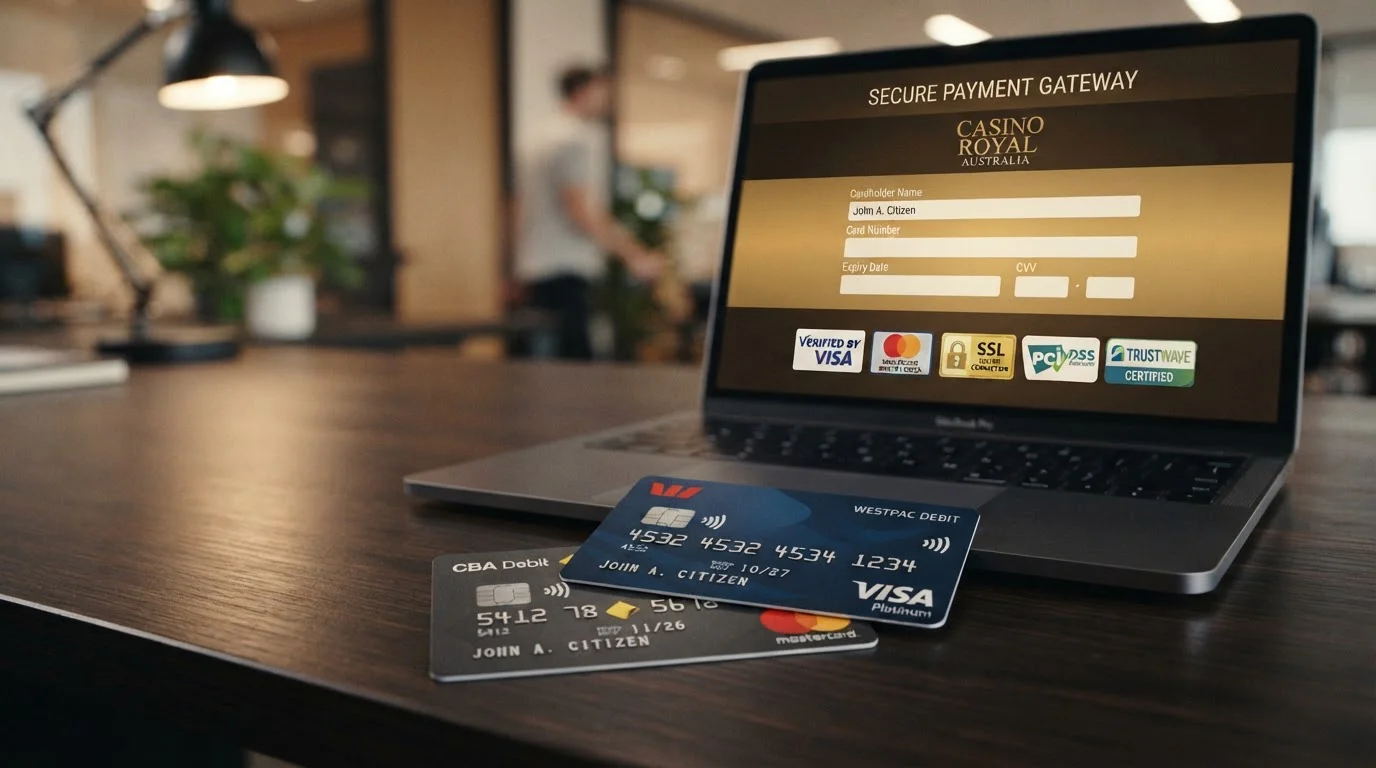
Debit cards remain the most familiar payment method. You already have one. It’s linked to your bank account. The process is identical to any online purchase: enter the card number, expiry, CVV, confirm. Offshore casinos accept Visa and Mastercard debit cards widely. The problem is not acceptance—it’s whether your bank lets the transaction through.
Visa Debit: Universal but Blockable
Visa is the most common card network in Australia. If you have a debit card, it’s probably Visa. Deposits are instant when they clear. The casino charges your card, your bank account balance drops, your casino balance updates. Minimum deposits typically start at A$20.
The friction: merchant category code 7995. When the casino processes the charge, the transaction metadata includes the gambling MCC. Your bank’s system sees it. Depending on the bank’s policy, one of three things happens. The transaction clears normally. The bank declines it automatically with a generic “transaction not permitted” error. Or the bank flags it for manual review, requiring you to confirm via SMS or app notification that you authorized the payment.
Commonwealth Bank, Westpac, NAB, and ANZ all offer customer-controlled gambling blocks. If you’ve enabled that feature, every MCC 7995 transaction fails. If you haven’t enabled it, the bank’s default policy applies—some banks are permissive, others restrictive. NAB’s StraightUp card blocks gambling by design with no override. International gambling transactions face stricter scrutiny than domestic ones, and since all Australian-facing online casinos are offshore, every deposit is international.
Withdrawals via Visa debit are rare. Most offshore casinos don’t support card withdrawals, and when they do, processing takes three to five business days. Cards are a deposit-first method. If you deposit with Visa, expect to withdraw via bank transfer, e-wallet, or crypto.
Credit cards are a separate story. The Interactive Gambling Amendment (Credit and Other Measures) Act 2023 banned credit card deposits at Australian-licensed gambling operators from 12 June 2024. That law applies to licensed sports betting sites—Sportsbet, TAB, bet365 Australia. It does not apply to offshore casinos because they operate outside Australian jurisdiction. Offshore casinos still accept credit cards. But Australian banks extend the block anyway. If you try depositing with a credit card at an offshore casino, most Australian banks decline it under their internal gambling restrictions, even though the legal ban technically doesn’t apply to that transaction. Debit cards face the same MCC block but clear slightly more often because they’re not credit.
Mastercard Debit: Same Story, Different Logo
Mastercard debit cards work identically to Visa in the casino context. Instant deposits where not blocked. Withdrawals rare, three to five days when offered. Minimum A$20 typical. Subject to the same MCC 7995 banking blocks. Acceptance at offshore casinos is marginally lower than Visa—some smaller operators only take Visa—but every major AU-facing casino accepts both.
The Mastercard network has no Australian-specific restrictions beyond what individual banks impose. If your bank allows gambling transactions on debit cards, Mastercard clears. If your bank blocks gambling MCCs, Mastercard fails. The card network is not the bottleneck; your bank’s policy is.
One practical advantage: if your Visa debit deposits keep failing, trying a Mastercard debit card from a different bank sometimes works. Banks apply MCC blocks inconsistently. A transaction declined by CommBank on a Visa debit might clear on a Macquarie Mastercard debit. There’s no logic you can predict in advance—it’s a function of each bank’s risk model and how aggressively they enforce gambling restrictions.
Are credit cards banned for online casino deposits in Australia?
Credit cards are banned for gambling at Australian-licensed operators (sports betting sites) since 12 June 2024 under the Interactive Gambling Amendment Act 2023. That ban does not legally apply to offshore casinos because they operate outside Australian jurisdiction. However, most Australian banks extend the block to all gambling merchants regardless of licence status, so credit card deposits at offshore casinos usually fail anyway. Debit cards are not banned, but they trigger the same merchant category code (7995) that banks use to identify gambling transactions, so deposits can still be declined. The credit ban is a regulatory rule for licensed operators; the broader card-deposit friction is a banking policy applied at the institution level.
E-Wallets — The Fast Withdrawal Category
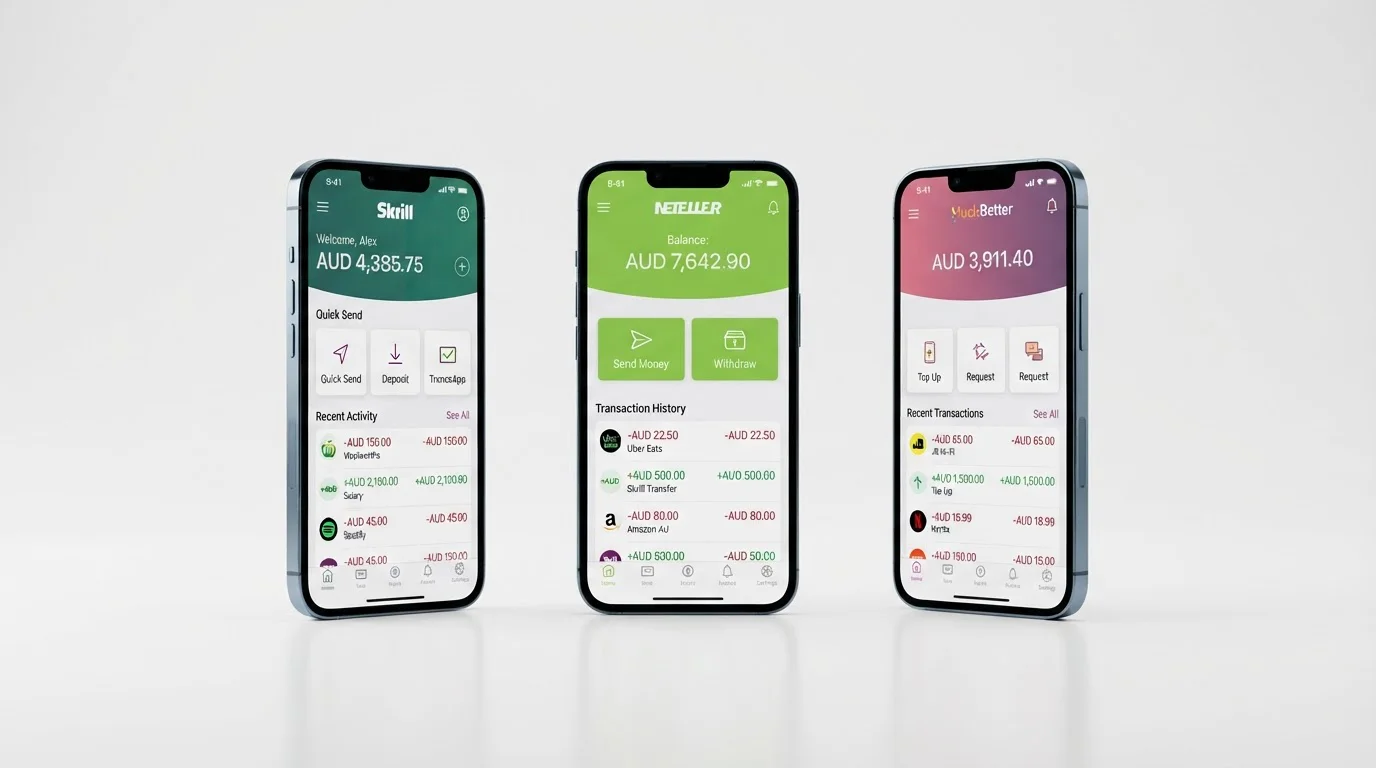
E-wallets sit between your bank and the casino. You load money into the wallet from your bank account or card. The wallet holds a balance in Australian dollars. When you deposit at a casino, the money moves from your wallet balance to the casino—instant, no bank involved in that transaction. The casino never sees your banking details. When you withdraw, the casino sends money to your wallet. You then transfer from the wallet to your bank account.
The advantage: speed and insulation. E-wallet withdrawals from casinos typically process in 12 to 48 hours, faster than bank transfers (which can take three to five days) and much faster than cards. The casino sees only your e-wallet account, not your card number or BSB. Your bank sees a transfer to Skrill or MuchBetter, not to an offshore casino. That reduces MCC friction.
The cost: top-up fees and idle account charges. Loading your e-wallet via card costs 1 to 5 percent depending on the provider. Bank transfers to the wallet are free but take one to three days. Withdrawing from your e-wallet to your bank account costs 2 percent at some providers, free at others. Leave the account dormant and some wallets charge monthly maintenance fees. The fees add up if you’re not careful.
Skrill: The Veteran Choice
Skrill launched in 2001 as Moneybookers, rebranded in 2011, and was acquired by Paysafe Group in 2015. It’s regulated by the UK Financial Conduct Authority. Skrill has been a gambling e-wallet since its founding—online poker players in the early 2000s used Moneybookers because few other options existed. That history means wide casino acceptance. Nearly every offshore casino serving Australian players lists Skrill in the cashier.
You open a Skrill account on their website or app, verify your identity (passport or driver’s licence plus proof of address), and link a funding source—bank account or card. The wallet supports Australian dollars, so you’re not forced into currency conversion. Deposits from your Skrill balance to a casino are instant. Withdrawals from the casino to Skrill typically clear within 12 to 24 hours once the casino processes the payout.
Top-up fees: loading Skrill from a debit or credit card costs roughly 1 to 2 percent. Bank transfer top-ups are free but take one to three business days to settle. Withdrawing from Skrill to your Australian bank account used to be free; recent updates vary by account tier. Skrill’s VIP program reduces fees for high-volume users—if you’re moving thousands monthly, the VIP tiers unlock lower fees and faster support.
Skrill’s main drawback is customer support. Response times are slow unless you’re VIP. Account verification can take several days. If your account gets flagged for review (common after large withdrawals), expect delays and frustrating email exchanges. The platform is solid for routine use but painful when something breaks.
Neteller: Skrill’s Sibling with VIP Perks
Neteller launched in 1999, two years before Skrill. Paysafe Group acquired it in 2015—the same year they bought Skrill—so both e-wallets are now siblings under the same corporate umbrella. Neteller is also FCA-regulated and supports Australian dollars. Functionally, Neteller and Skrill are nearly identical. Both offer instant casino deposits, 12- to 24-hour withdrawals, and VIP programs for frequent users.
The distinctions are minor. Neteller’s casino acceptance is slightly higher—some older operators that were slow to add Skrill still support Neteller from their early days. Neteller offers the Net+ prepaid Mastercard, a physical card linked to your Neteller balance that you can use for purchases or ATM withdrawals. Skrill has a similar card but availability varies by region. Neteller’s VIP program is marginally more generous with cashback and rakeback for regular gamblers.
Top-up fees mirror Skrill: card funding costs 1 to 2 percent, bank transfers are free but slow. Withdrawing to your Australian bank account is free at lower tiers, with fees varying based on account status. Neteller has over 20 million accounts globally according to Paysafe’s data, making it one of the largest e-wallets in the gambling space.
What’s the difference between Skrill and Neteller for casino payments?
Skrill and Neteller are owned by the same company (Paysafe Group), both are FCA-regulated, and both function identically for casino payments: instant deposits, 12- to 24-hour withdrawals, AUD support, card top-up fees around 1 to 2 percent. Neteller has marginally higher casino acceptance because it launched earlier (1999 vs 2001). Neteller offers the Net+ prepaid Mastercard. Skrill has a slightly cleaner app interface. Both have VIP programs that reduce fees for high-volume users. If you already have one, there’s no compelling reason to switch. If you’re choosing fresh, pick whichever the casino you’re using offers—acceptance is the only meaningful variable.
MuchBetter: Mobile-First and Built for Gambling
MuchBetter is the new generation. Founded in 2017 by MIR Limited UK, it’s FCA-regulated (licence number 900704) and designed specifically for mobile iGaming. No desktop wallet—everything happens in the iOS or Android app. That mobile-first design makes deposits faster. On a computer, you scan a QR code with your phone’s MuchBetter app and confirm. On mobile, the casino redirects to the app, you approve with Face ID or fingerprint, done. One or two taps instead of logging into a website.
MuchBetter wallets support Australian dollars. Deposits to casinos are instant from your wallet balance. Withdrawals from casinos to your MuchBetter wallet typically process within 24 to 48 hours, slightly slower than Skrill or Neteller but still faster than bank transfers. The app uses biometric authentication—Face ID, Touch ID, or PIN—so you’re not typing passwords.
The fee structure is less favorable than Skrill or Neteller. Loading MuchBetter from a debit or credit card costs 1.5 to 5 percent depending on the card and region. Bank transfers to MuchBetter are free but take one to three days. Withdrawing from MuchBetter to your Australian bank account costs 2 percent. Leave your MuchBetter account idle (no transactions for several months) and you get hit with a US$5 monthly management fee. The fees are higher, but the speed and mobile UX compensate for users who value convenience over cost.
Casino acceptance is growing. MuchBetter launched later than Skrill and Neteller, so not every offshore casino supports it yet. Most newer AU-facing operators do. If you’re choosing a casino based on payment options, check that MuchBetter is listed before opening an account. The app has over one million downloads across iOS and Android combined, indicating solid adoption in the Australian market.
Payz, MiFinity, AstroPay, Revolut: The Secondary Options
Several other e-wallets accept Australian casino players but with narrower acceptance or niche use cases.
Payz (formerly EcoPayz, rebranded 2023) is FCA-regulated and offers tiered accounts—Classic, Silver, Gold, Platinum, VIP. Higher tiers unlock lower fees and higher transaction limits. Payz supports AUD. Instant deposits, 24- to 48-hour withdrawals. Casino acceptance is lower than Skrill, Neteller, or MuchBetter. Payz works fine if the casino lists it, but it’s not common enough to rely on as your primary method.
MiFinity is a multi-currency e-wallet that lets you hold up to nine separate sub-wallets in different currencies. Instant deposits, 24- to 48-hour withdrawals. The multi-currency feature is useful if you play at casinos denominated in USD, EUR, or GBP and want to avoid repeated AUD conversion fees. Casino acceptance is niche—mostly European-facing operators.
AstroPay started as a prepaid virtual card service and evolved into an e-wallet hybrid. Popular in Latin America, growing acceptance in Australia. Instant deposits, three- to five-day withdrawals (slower than pure e-wallets). AstroPay’s main use case is regions where Skrill and Neteller aren’t available. In Australia, where Skrill and Neteller both work, AstroPay is redundant unless a specific casino only accepts AstroPay.
Revolut is a digital banking app, not a dedicated gambling e-wallet. It offers multi-currency accounts, instant card top-ups, and interbank FX rates. Some offshore casinos accept Revolut as a deposit method. Withdrawals take one to five days, slower than gambling-specific e-wallets. Revolut wasn’t built for casino payments, so acceptance is inconsistent. It works if the casino supports it, but you can’t rely on it across the board.
| E-Wallet | Deposit Speed | Withdrawal Speed | Top-Up Fees | Distinguishing Feature |
|---|---|---|---|---|
| Skrill | Instant | 12–24 hours | Card 1–2%, bank free | Widest casino acceptance, 2001 founding |
| Neteller | Instant | 12–24 hours | Card 1–2%, bank free | Net+ prepaid card, VIP rakeback |
| MuchBetter | Instant | 24–48 hours | Card 1.5–5%, bank free | Mobile-first app, biometric auth, FCA-licensed |
| Payz | Instant | 24–48 hours | Varies by tier | Tiered accounts, lower AU acceptance |
| MiFinity | Instant | 24–48 hours | Varies | Multi-currency sub-wallets (up to 9) |
| AstroPay | Instant | 3–5 days | Varies | Prepaid/e-wallet hybrid, niche AU acceptance |
| Revolut | Instant | 1–5 days | Low (interbank FX) | Digital banking app, inconsistent casino support |
Mobile Wallets — Apple Pay and Google Pay
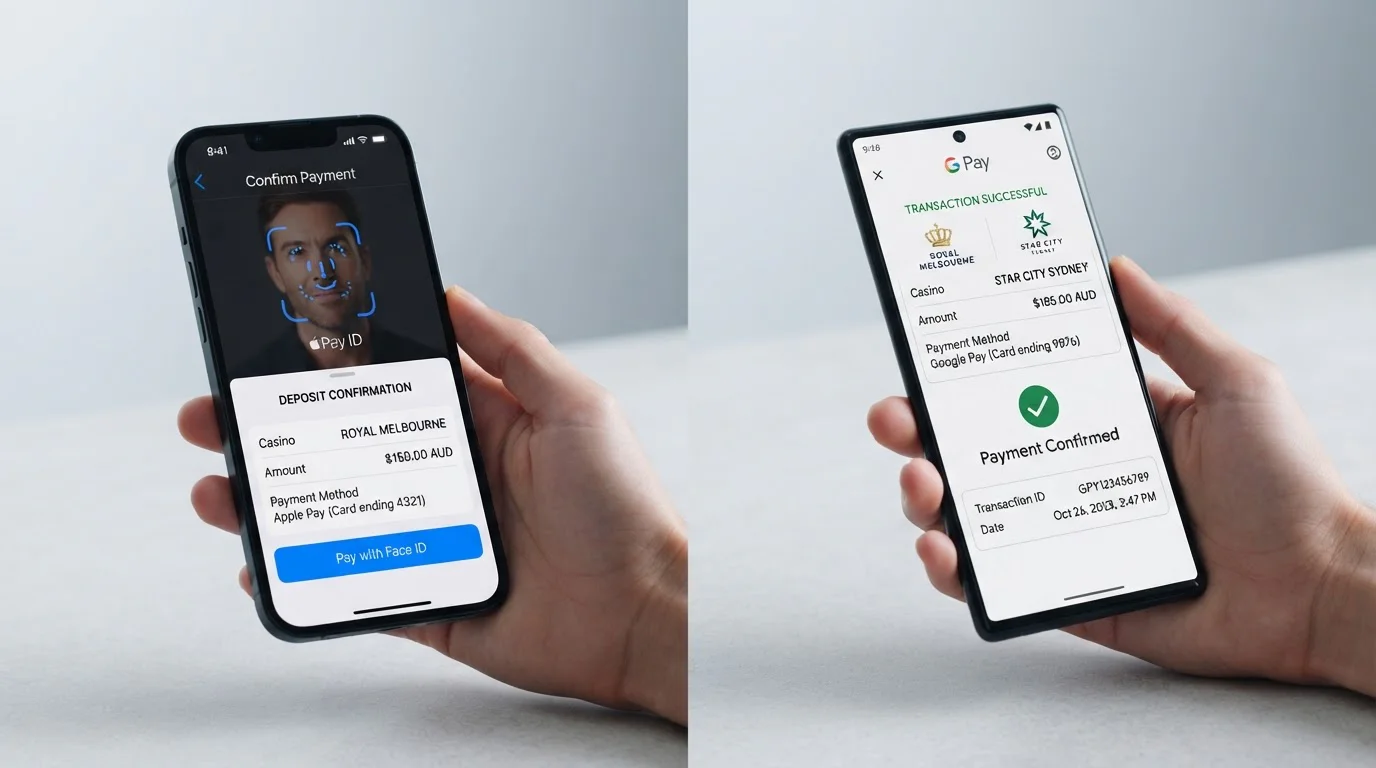
Mobile wallets link to the debit or credit card already in your phone’s wallet app. You’re not loading a separate balance or opening a new account. You’re using your existing card via a tokenized layer. Tokenization means the merchant never sees your actual card number—only a one-time-use token generated for that transaction. From a security standpoint, mobile wallets are safer than typing your card details into a website.
Apple Pay: Biometric Deposits in Two Taps
Apple Pay launched in 2014 and is built into every iPhone, iPad, and Mac. You add your Visa, Mastercard, or Amex card to Apple Wallet. At a casino cashier, you select Apple Pay, confirm the amount, authenticate with Face ID or Touch ID, and the deposit clears instantly. No typing card numbers. No remembering CVVs. Two taps and biometric confirmation.
The tokenization process happens automatically. When you authenticate, Apple Wallet generates a device-specific token that represents your card for that single transaction. The casino receives the token, processes the charge, and your bank account (or credit line) is debited. The casino’s system never sees your 16-digit card number, expiry date, or CVV. If the casino’s database gets breached, your card details aren’t in it.
Offshore casino acceptance of Apple Pay is growing but not universal. Newer operators are more likely to support it. Older casinos that built their cashier systems before mobile wallets became common often haven’t retrofitted support. Minimum deposits typically start at A$20, same as direct card deposits.
Apple Pay is subject to the underlying card’s banking blocks. If your bank declines gambling transactions on your Mastercard debit, the Apple Pay transaction using that Mastercard will also be declined. Apple Pay doesn’t bypass MCC 7995—it’s a convenience and security layer, not a different payment rail. The transaction still routes through your card issuer’s approval system.
Withdrawals via Apple Pay are almost never supported. Apple Pay is a payment initiation method, not a receiving account. When you win and request a cashout, the casino cannot send money “to your Apple Pay.” They’ll offer bank transfer, e-wallet, or crypto. Apple Pay is deposit-only.
Google Pay: Android’s Answer
Google Pay (rebranded from Android Pay in 2018) works identically to Apple Pay but for Android devices. Link your cards in Google Wallet, authenticate with fingerprint or PIN, deposit instantly. Tokenized security, same as Apple Pay. The merchant sees a one-time token, not your card. Minimum deposits A$20 typical. Subject to the same underlying card banking blocks. Deposit-only—no withdrawal support.
Casino acceptance mirrors Apple Pay. Not every offshore casino supports Google Pay, but newer operators increasingly do. If you’re using an Android phone and the casino lists Google Pay in the cashier, it’s a fast deposit method with better security than entering your card details directly.
Both Apple Pay and Google Pay benefit from 99.4 percent retail acceptance in Australia as of 2026. You can use them for transport, groceries, government services. The same convenience doesn’t fully extend to offshore casinos yet—acceptance is growing but patchy. Check the casino’s cashier before assuming mobile wallet support.
Prepaid Vouchers — Anonymous Deposits with a Price
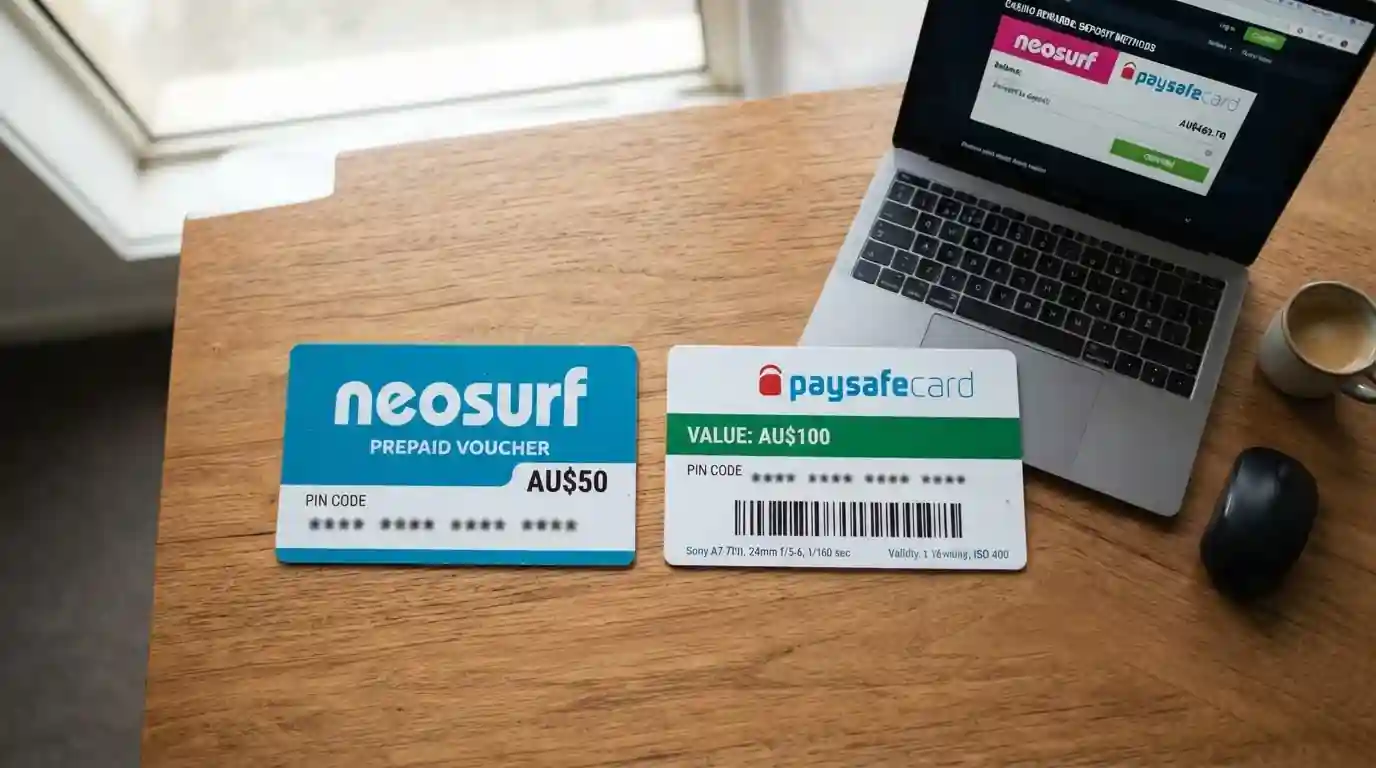
Prepaid vouchers are the cash-equivalent payment method. You walk into a Coles, 7-Eleven, or newsagent, buy a voucher with cash or card, and receive a printed receipt with a PIN. You redeem the PIN at the casino cashier by entering the digits. Your casino balance updates. No bank account linked, no card details entered, no digital trail connecting your name to the casino deposit.
The trade-off is cost. Prepaid vouchers carry purchase fees ranging from 3.5 to 15 percent of the voucher value, depending on denomination. A $10 Neosurf voucher costs you $11.50 at the register—15 percent markup. A $100 voucher costs $103.50—3.5 percent. The higher the face value, the lower the percentage fee. You’re paying for anonymity and the hard spending cap that comes with cash-like instruments.
Neosurf: Best Australian Retail Distribution
Neosurf is a French prepaid voucher system operated by Neosurf Cards SAS, a payment institution licensed by France’s ACPR. It launched in 2004 and expanded to Australia through retail partnerships. You buy a Neosurf voucher at the retailer, receive a 10-digit PIN on the receipt, and redeem it online. Face values in Australia range from A$10 to A$500.
Retail availability is the best among prepaid vouchers in Australia. Coles supermarkets stock Neosurf on the gift card wall alongside Netflix and Google Play cards. Around 800 Coles stores carry it. Select 7-Eleven outlets in metro Sydney, Melbourne, Brisbane, and Perth stock it. Australia Post outlets sell Neosurf as part of their prepaid card range, with best availability at major Post Office branches. Independent newsagents in most CBDs carry it via distributor networks. Neosurf’s store locator (neosurf.com) lets you filter by postcode to find nearby retailers.
Purchase fees vary by retailer and denomination. Typical structure as of 2026: A$10 voucher costs A$11.50 (15 percent), A$20 costs A$21.50 (7.5 percent), A$30 costs A$31.50 (5 percent), A$50 costs A$52 (4 percent), A$100 costs A$103.50 (3.5 percent). Buying one A$100 voucher is more fee-efficient than five A$20 vouchers. Exact fees vary slightly by retailer—Coles fees differ from newsagent fees—but the general pattern holds: higher denominations carry lower percentage fees.
Dormancy fees apply. If you don’t spend the voucher within 12 months, Neosurf starts deducting a monthly maintenance charge from the balance. The voucher doesn’t “expire,” but it loses value to fees if left unused. Buy it, spend it.
Redemption at offshore casinos is straightforward. Select Neosurf at the cashier, enter the 10-digit PIN exactly as printed (no spaces), specify the amount you want to deposit (you can use partial value if the voucher is worth more), and submit. The casino typically credits your balance within 2 to 15 minutes. Retain your receipt until the deposit clears—if the casino disputes the redemption, the receipt is your proof of purchase.
Neosurf is deposit-only. You can’t withdraw winnings to a Neosurf voucher. When you request a cashout, the casino will offer bank transfer, e-wallet, or crypto. That withdrawal asymmetry is inherent to voucher systems—they’re unidirectional by design.
Anonymity is the core selling point. When you buy a Neosurf voucher with cash at Coles, your bank statement shows nothing related to online casinos. When you redeem the PIN at the casino, your bank has no record of the transaction. The casino requires KYC (Know Your Customer) verification before your first withdrawal—Neosurf doesn’t exempt you from that—but the deposit itself is unlinked from your banking profile. Players who want to avoid any casino-related entries on their bank statement use Neosurf for exactly this reason.
Are prepaid vouchers like Neosurf really anonymous?
Partially. Buying a Neosurf voucher with cash at a retailer leaves no direct link between your bank account and the casino deposit. The retailer transaction shows as a gift card purchase, not a gambling payment. Redeeming the PIN at the casino doesn’t involve your bank at all. However, anonymity ends at withdrawal. Offshore casinos require KYC—typically a photo ID and proof of address—before processing your first cashout, regardless of deposit method. Neosurf anonymizes the deposit path from your bank, but it doesn’t anonymize your identity to the casino. If your goal is keeping casino transactions off your bank statement, Neosurf works. If your goal is gambling without providing ID to the casino, that’s not possible under AML regulations.
Paysafecard: The Veteran Voucher
Paysafecard is the older sibling in the prepaid voucher space, launched in Austria in 2000. It’s now part of Paysafe Group (which also owns Skrill and Neteller) and regulated by the UK Financial Conduct Authority. Paysafecard operates on a 16-digit PIN system. You buy a voucher at a retailer, receive the PIN, redeem it at the merchant. Face values in Australia typically range from A$10 to A$200.
Retail distribution in Australia is narrower than Neosurf. Paysafecard is available at select Australia Post outlets, some newsagents, and a few other retailers, but it’s not stocked at Coles or 7-Eleven as widely as Neosurf. If you live in a metro area, finding a Paysafecard retailer is feasible. Regional availability is spottier.
Purchase fees follow the same denomination-based structure as Neosurf: lower face values carry higher percentage fees, higher values are more efficient. Expect 3 to 15 percent depending on the voucher amount. Dormancy fees apply if the voucher sits unused for an extended period—specifics are in Paysafecard’s terms, but the principle is the same as Neosurf: use it or lose it to monthly charges.
Paysafecard’s single-voucher cap is A$200 in Australia. If you want to deposit more than A$200, you have two options: buy multiple vouchers and redeem them sequentially, or create a “My Paysafecard” account (requires registration and email verification) that lets you combine up to 10 PINs into one balance. The My Paysafecard account eliminates the single-voucher limit but sacrifices full anonymity—you’ve now created an account with your email and KYC data.
Casino acceptance of Paysafecard is very wide. Most offshore casinos that serve Australian players list Paysafecard alongside Neosurf. Redemption is instant once you enter the 16-digit PIN. Deposit-only, just like Neosurf. Withdrawals require an alternate method.
CashtoCode: The Niche Option
CashtoCode is a Malta-licensed prepaid voucher with lower retail distribution in Australia than Neosurf or Paysafecard. Denominations typically range from A$10 to A$200. Fee structure is similar: percentage fees decrease with higher face values. Redemption is instant. Deposit-only. Casino acceptance is growing but still niche compared to Neosurf and Paysafecard. CashtoCode works fine if the casino you’re using lists it, but it’s not common enough to rely on as your primary method unless you’ve already confirmed the casino supports it.
| Voucher | Where to Buy in AU | Purchase Fees | Face Values | Redemption Speed |
|---|---|---|---|---|
| Neosurf | Coles (~800 stores), 7-Eleven (select), Aus Post, newsagents | 3.5–15% by denomination | A$10–A$500 | 2–15 minutes |
| Paysafecard | Aus Post (select), newsagents | 3–15% by denomination | A$10–A$200 (max per PIN) | Instant |
| CashtoCode | Select retailers (limited AU network) | 3–15% by denomination | A$10–A$200 | Instant |
Cryptocurrency — Bypassing the Banking System Entirely

Cryptocurrency is the only payment method that removes Australian banks from the transaction entirely. No merchant category codes, no card issuer approval, no international transfer scrutiny. You own Bitcoin or USDT in a wallet, you send it to the casino’s blockchain address, the network confirms the transaction, the casino credits your balance. Your bank never sees it because your bank was never involved.
Bitcoin: The Original and Most Accepted
Bitcoin launched in 2009 as the first decentralized cryptocurrency. Australian players typically buy Bitcoin on AUSTRAC-registered exchanges—CoinSpot (Australia’s largest, 2.5 million users) or Swyftx (Brisbane-based, around 1.5 million users). Both exchanges support PayID for instant AUD deposits, so you can fund your exchange account in seconds. From there, you buy Bitcoin, send it to the casino’s deposit address, and wait for blockchain confirmation.
Bitcoin deposits take 10 to 30 minutes on average, depending on network congestion and the transaction fee you choose to pay. Higher fees incentivize miners to prioritise your transaction; lower fees mean slower confirmation. Most offshore casinos credit your balance after one or two blockchain confirmations. Withdrawals follow the same process in reverse: the casino sends Bitcoin to your exchange wallet address, confirmations happen, you sell the Bitcoin back to AUD on the exchange, withdraw to your Australian bank account.
Network fees for Bitcoin transactions typically run A$1 to A$5 per transfer, depending on network traffic. During periods of high blockchain activity, fees spike. During quiet periods, fees drop. USDT on the Tron network (TRC-20) costs under A$1 per transaction and confirms in under two minutes, making it a faster and cheaper alternative if the casino supports it.
Price volatility is Bitcoin’s main friction point. BTC/AUD fluctuates. If you buy $500 AUD worth of Bitcoin, send it to a casino, and the price moves 3 percent in the ten minutes it takes to confirm, your casino balance ends up with $485 or $515 AUD equivalent. For small deposits, the variance is noise. For large deposits, the swing matters. USDT (Tether stablecoin) solves this—it’s pegged 1:1 to USD, so volatility is minimal.
Australian crypto adoption is high. The Independent Reserve Cryptocurrency Index 2026 survey found that 33 percent of Australian adults own cryptocurrency, up from 31 percent in 2025. That’s roughly 6.6 million Australians. Among crypto owners, 70 percent hold Bitcoin—approximately 4.3 million people. The infrastructure to use Bitcoin at a casino (an exchange account, a bit of BTC, a wallet address) is already in place for a third of the adult population.
Is it legal to use cryptocurrency at online casinos in Australia?
Yes, for players. The Interactive Gambling Amendment Act 2023 banned cryptocurrency deposits at Australian-licensed operators (sports betting sites) from 12 June 2024. That ban does not apply to offshore casinos because they operate outside Australian jurisdiction. The IGA targets providers, not players—no Australian has ever been prosecuted for gambling online. Using Bitcoin or USDT at an offshore casino is not illegal under Australian law. Your bank has no visibility into blockchain transactions, and ACMA’s site-blocking powers don’t extend to cryptocurrency networks. The 2024 crypto ban is a restriction on licensed operators like Sportsbet and TAB; it doesn’t affect offshore casino crypto deposits.
USDT (Tether): The Stablecoin Alternative
USDT is a stablecoin issued by Tether Limited, pegged 1:1 to the US dollar. One USDT equals one USD in value (with minor fluctuations during extreme market stress). For casino payments, USDT eliminates Bitcoin’s price volatility. You buy USDT on CoinSpot or Swyftx, send it to the casino, and the AUD-equivalent value stays stable because USDT tracks USD, not a volatile crypto asset.
USDT runs on multiple blockchain networks. The two most common for casino use are ERC-20 (Ethereum network) and TRC-20 (Tron network). TRC-20 is faster and cheaper: transactions confirm in under two minutes, and network fees are under A$1. ERC-20 is slower (several minutes) and more expensive (fees vary with Ethereum gas prices, often A$5 to A$20). Most offshore casinos that accept USDT support TRC-20 specifically because of the speed and cost advantage.
When depositing USDT, double-check the network. Sending USDT on TRC-20 to an ERC-20 address will lose the funds permanently—they’re incompatible networks. The casino’s cashier displays the correct network alongside the deposit address. Match it exactly.
Crypto-native offshore casinos widely accept USDT. Older casinos that only added crypto recently may support Bitcoin but not USDT. Newer operators built from 2020 onward almost always support both. Withdrawals via USDT are typically faster than Bitcoin because confirmation times are shorter. Under one hour is common once the casino approves the payout.
The regulatory context for USDT is identical to Bitcoin. The June 2024 crypto ban applies to licensed Australian operators, not offshore casinos. Players using USDT at offshore sites face no legal risk. Stablecoins are treated the same as other cryptocurrencies under Australian AML/CTF rules—exchanges are required to verify your identity, but using USDT for gambling is not prohibited.
Deposits vs Withdrawals — The Asymmetry Problem
Not all payment methods work in both directions. Several are deposit-only: you can send money to the casino, but you can’t receive winnings back the same way. Understanding which methods support withdrawals and which don’t is critical before you choose a deposit method. Winning with a deposit-only method forces you to set up a second payment rail just to cash out.
The deposit-only methods:
- Prepaid vouchers (Neosurf, Paysafecard, CashtoCode) are unidirectional by design. You can’t “withdraw to a voucher.” The casino has no mechanism to load value onto a Neosurf PIN and send it to you. When you request a cashout after depositing with a voucher, the casino offers bank transfer, e-wallet, or crypto.
- Mobile wallets (Apple Pay, Google Pay) are payment initiation tools, not receiving accounts. The casino can charge your linked card via Apple Pay, but they can’t send money back to “your Apple Pay.” Withdrawals require bank transfer, e-wallet, or crypto.
- Some debit cards support deposits but not withdrawals. Visa and Mastercard technically allow casino withdrawals, but most offshore operators don’t support it because the card networks impose strict conditions on gambling-related refunds. When a casino does offer card withdrawals, processing takes three to five business days.
The two-way methods:
- PayID supports withdrawals at casinos that offer it (not all do). Where available, PayID cashouts process within one hour to same-day.
- E-wallets (Skrill, Neteller, MuchBetter, Payz, MiFinity) all support deposits and withdrawals. Cashouts typically process in 12 to 48 hours.
- Cryptocurrency (Bitcoin, USDT) supports deposits and withdrawals. Cashouts process in under one hour once the casino approves them.
If you deposit with a prepaid voucher or mobile wallet, you’ll need to set up an e-wallet, link your bank account for direct transfer, or create a crypto exchange account before you can withdraw. That adds friction. Many players don’t realise this until they try to cash out their first win and discover the deposit method they used isn’t listed in the withdrawal menu.
Can I withdraw my winnings using the same method I deposited with?
Sometimes. PayID, e-wallets (Skrill, Neteller, MuchBetter), and cryptocurrency (Bitcoin, USDT) support both deposits and withdrawals—you can cash out the same way you funded your account. Prepaid vouchers (Neosurf, Paysafecard, CashtoCode), mobile wallets (Apple Pay, Google Pay), and most debit card deposits are one-way—you can deposit but not withdraw. If you deposit with a one-way method, the casino will require you to set up an alternate withdrawal option: bank transfer, e-wallet, or crypto. Some casinos enforce “withdrawal to the deposit method” as an anti-money-laundering rule, but that only applies when the method actually supports withdrawals.
| Payment Method | Deposit Speed | Withdrawal Speed | Withdrawal Support | Fees | Best For |
|---|---|---|---|---|---|
| PayID | < 10 seconds | < 1 hour to same-day | Yes (where offered) | Free | Speed, convenience, no fees |
| Visa debit | Instant | 3–5 days (rare) | Rarely offered | Free (subject to bank blocks) | Familiarity, if bank allows |
| Mastercard debit | Instant | 3–5 days (rare) | Rarely offered | Free (subject to bank blocks) | Familiarity, if bank allows |
| Neosurf | 2–15 minutes | — | No (deposit-only) | Purchase fee 3.5–15% | Anonymity, budget control |
| Paysafecard | Instant | — | No (deposit-only) | Purchase fee 3–15% | Anonymity, budget control |
| Skrill | Instant | 12–24 hours | Yes | Card top-up 1–2% | Fast withdrawals, wide acceptance |
| Neteller | Instant | 12–24 hours | Yes | Card top-up 1–2% | Fast withdrawals, VIP perks |
| MuchBetter | Instant | 24–48 hours | Yes | Card top-up 1.5–5%, idle fee $5/mo | Mobile-first, biometric security |
| Apple Pay | Instant | — | No (deposit-only) | Free (subject to underlying card blocks) | Biometric security, convenience |
| Google Pay | Instant | — | No (deposit-only) | Free (subject to underlying card blocks) | Biometric security, convenience |
| Bitcoin | 10–30 minutes | < 1 hour typical | Yes | Network fee $1–5 | Bank bypass, fast withdrawals, volatility |
| USDT (TRC-20) | < 2 minutes | < 1 hour typical | Yes | Network fee < $1 | Bank bypass, stable value, fast |
How to Choose the Right Payment Method for Your Situation
You now have twelve options. Which one suits depends on what matters most: speed, fees, privacy, or convenience. No single method wins across all dimensions. You trade one thing for another.
If Speed Matters Most
Fastest deposits: PayID (under 10 seconds), USDT TRC-20 (under 2 minutes), Apple Pay or Google Pay (instant). PayID is the fastest bank-based method. USDT is the fastest overall once you have crypto on an exchange. Mobile wallets are instant but deposit-only.
Fastest withdrawals: USDT TRC-20 or Bitcoin (under 1 hour once casino approves), PayID (under 1 hour to same-day where offered), Skrill or Neteller (12 to 24 hours). Crypto withdrawals are consistently fastest because blockchain confirmation doesn’t depend on the casino’s banking partner. E-wallets are the fastest non-crypto option.
If Fees Matter Most
Lowest fees: PayID (free), crypto if you already own it (network fees $1–5), debit cards (free, but subject to banking blocks). PayID has zero fees for deposits and withdrawals. Crypto fees are low if you’re not converting AUD to BTC repeatedly—the exchange charges a spread on buy/sell, and the blockchain charges a network fee, but there’s no ongoing percentage cut.
Highest fees: Prepaid vouchers (3.5 to 15 percent purchase fee), MuchBetter (1.5 to 5 percent card top-up, 2 percent wallet-to-bank withdrawal, $5 monthly idle fee). Neosurf and Paysafecard are the most expensive per transaction. The fee is paid upfront at the retailer, not by the casino, so it’s easy to overlook until you calculate total cost.
If Privacy Matters Most
Most anonymous: Prepaid vouchers purchased with cash (Neosurf, Paysafecard). The retailer transaction shows as a gift card purchase. The casino deposit is unlinked from your bank. You still need to provide KYC to the casino before withdrawing, but your bank statement never shows a casino-related entry.
Least anonymous: PayID, debit cards. These are direct bank transactions. Your bank sees the recipient (offshore casino’s business account). If anonymity from your bank is the goal, vouchers or crypto are better.
If Convenience Matters Most
Most convenient: PayID (if your bank and the casino both support it), mobile wallets (if your phone has the card already linked), e-wallets (if you already have an account funded). PayID requires no separate registration—you use your existing banking app. Apple Pay and Google Pay require no separate account either, just the card in your phone’s wallet. E-wallets require one-time setup, but once funded, deposits are one or two taps.
Least convenient: Prepaid vouchers (requires physical trip to retailer), crypto if you don’t already own it (requires exchange account, identity verification, learning curve). Vouchers demand leaving your house. Crypto demands familiarity with wallets, addresses, and networks—fine once you’re set up, friction if you’re starting from zero.
The Australian Regulatory Context — What’s Legal, What’s Not
Australian gambling law is a patchwork. Physical pokies are everywhere. Sports betting is licensed and legal. But online casinos are federally banned, even though millions of Australians play at offshore sites. Understanding the legal status of your deposits and winnings matters less for criminal risk (there is none for players) and more for knowing why payment friction exists in the first place.
The Interactive Gambling Act 2001 is the federal statute. It prohibits providing online casino games—pokies, table games, live dealer, poker—to persons physically in Australia. The target is operators, not players. The Act makes it an offence to “provide” or “advertise” interactive gambling services to Australian residents. Penalties are up to A$1.8 million per day for companies, A$360,000 per day for individuals. No provision in the IGA criminalizes playing. The Department of Infrastructure’s official guidance states explicitly: “It targets the providers of interactive gambling, not their potential or actual customers.”
No Australian has ever been prosecuted for playing at an offshore casino. The legal risk is theoretical only—the statute provides no enforcement mechanism against players, and the government has shown no interest in creating one. The practical consequence is that online casino provision is illegal, but online casino play is not.
ACMA enforces the IGA by issuing blocking orders to Australian ISPs. Since the first order in November 2019, ACMA has blocked 1,455 illegal gambling and affiliate websites as of December 2025. ISPs block at the DNS level—typing the domain returns an ACMA notice page. Operators respond by launching mirror domains, so the game of whack-a-mole continues. Blocks are effective enough to annoy, but not effective enough to eliminate access.
Licensed operators do exist, but they’re limited to sports and race betting. ACMA maintains a register of roughly 130 licensed interactive gambling providers at acma.gov.au/check-if-gambling-operator-legal. Every licence on that register is for wagering services (sports, racing), not casino games. Sportsbet, TAB, bet365 Australia, Ladbrokes, Neds—these are the licensed operators, and none of them offer pokies or table games because the IGA forbids it.
The June 2024 amendments tightened restrictions on licensed operators. The Interactive Gambling Amendment (Credit and Other Measures) Act 2023, in force from 12 June 2024, banned Australian-licensed wagering services from accepting credit cards, credit-related products, and cryptocurrency. That ban applies only to the licensed sports betting operators. Offshore casinos are outside Australian jurisdiction, so the ban doesn’t restrict them legally. In practice, Australian banks extend credit card blocks to offshore casinos anyway as an internal policy, not because the law requires it.
The crypto ban operates the same way. Licensed operators can’t accept Bitcoin or USDT as of June 2024. Offshore casinos still accept crypto because the law doesn’t bind them. Players depositing crypto at an offshore casino aren’t violating Australian law—the IGA targets the operator providing the service, not the player using it.
ACMA’s regulatory reach is limited to Australia-based providers and ISP-level blocking. Offshore operators licensed in Curaçao, Malta, Anjouan, or other jurisdictions fall outside ACMA’s direct authority. The regulator can block their domains, but it can’t prosecute them, fine them, or seize their assets. That’s why offshore casinos continue operating despite the federal prohibition.
Casino Deposit Methods Australia 2026 — Compared
Content created by the «Bankroll» team