
Instant PayID withdrawals in Australia: which casinos actually pay in minutes, 2026 edition
 Available in AU

Twenty-five minutes. That is the fastest verified PayID payout recorded across Australian-facing casinos in 2026, measured from the moment the withdrawal request landed to the moment the money showed up in an Australian bank account. Hell Spin holds that number. Most of its competitors sit somewhere between one and five hours, and a handful still take a full day or two while advertising the word “instant” in a font size that would embarrass a used-car yard.
The gap matters because PayID itself is not the bottleneck. Osko, the settlement layer sitting on top of Australia’s New Payments Platform, moves money between bank accounts in seconds, around the clock, weekends and public holidays included. When a payout takes eleven hours, the delay lives entirely inside the casino’s approval queue. Understanding that split — casino review time versus bank rail time — is the difference between choosing an operator on marketing copy and choosing one on evidence.
Top 10 Instant PayID Withdrawal Casinos Australia 2026
Ten operators below accept PayID for both directions, deposits and cash-outs, and process real money in Australian dollars without conversion charges. Ranking runs by observed or stated PayID payout speed, fastest first. Times marked as verified were clocked in 2026 testing with real deposits; the rest are operator-stated processing windows, which tend to be optimistic by an hour or two.
How long does a PayID withdrawal take at Australian online casinos?
At a verified account with no active bonus, expect 5 to 15 minutes of casino approval followed by a near-instant Osko transfer. Total real-world time runs 25 minutes to 4 hours at the better operators. Slower sites stretch to 24 or 48 hours because of manual review queues, not PayID.
| Operator | Licence | PayID payout time | Standout detail |
|---|---|---|---|
| Hell Spin | Curaçao, TechOptions Group B.V. | 25 min, verified | Fastest clocked payout in 2026; working self-imposed limits |
| Goldenbet | Curaçao, licence number not published | 28 min, verified | AU$100 cash across first three deposits, zero wagering |
| Lucky7 | Curaçao, licence number not published | 35 min, verified | 168 game studios; USDT alternative clocked at 14 min |
| LuckyVibe | Curaçao Gaming Authority + Anjouan | Within 1 hour, stated | Six major cryptocurrencies beside PayID in one cashier |
| Wintino | Curaçao, licence number not published | 2 to 3 hours, stated | Daily reload offers for returning players |
| Mino Casino | Curaçao, licence number not published | Around 4 hours, stated | 35x wagering on bonus only, not deposit plus bonus |
| Joe Fortune | Curaçao, licence number not published | 2 to 6 hours, stated | Mobile cashier built for phone-first players |
| Playmojo | Curaçao, licence number not published | Around 5 hours, stated | AU$5,000 plus 300 free spins weighted to spins |
| VegasNow | Curaçao, licence number not published | 1 to 24 hours, stated | Elevated table limits in the live rooms |
| King Johnnie | Curaçao eGaming #8048/JAZ2020-013 | 24 to 48 hours, stated | Operating since 2020, AU$12M+ paid out |
Two things jump out of that table. First, the three fastest operators are also the three with independently clocked times rather than self-reported windows — draw your own conclusion about the reliability of unverified claims. Second, King Johnnie sits last on speed while being the most established name on the list, which is a genuine trade-off rather than a flaw.
Hell Spin — 25-Minute Verified Payout (Fastest Tested)
TechOptions Group B.V. runs Hell Spin under a Curaçao licence issued in 2021 or 2022. The twenty-five-minute withdrawal clocked in 2026 testing stands as the fastest PayID cash-out recorded among Australian-facing operators this year — request submitted, manual approval processed, Osko transfer landed, money available. That time was not a fluke or an off-peak anomaly; it reflects how Hell Spin structures its payments team, with enough staff depth to clear withdrawals without multi-hour queues building up.
The games library runs north of seven thousand titles sourced from eighty-plus studios, pokies-heavy but with live dealer rooms from Evolution and Pragmatic Live in the mix. Pragmatic Play, BGaming, Play’n GO and 3 Oaks handle the bulk of the slot catalogue. The welcome offer splits across four deposits and caps at AU$5,200 plus 150 free spins, wagering around forty times the bonus. Hell Spin also surfaces working responsible gambling controls — deposit caps, loss limits, session timers, wager ceilings — configurable through live chat rather than buried in account settings or missing entirely. That feature set is rare among offshore operators, most of whom treat harm minimisation as an inconvenient compliance box rather than a retention tool.
Goldenbet — 28-Minute Payout + Zero-Wagering Cash Bonus
Goldenbet operates offshore under Curaçao licensing. Public ownership details and the specific licence number remain unpublished, which is not unusual for smaller-scale operations but does limit independent verification of regulatory standing. The twenty-eight-minute PayID withdrawal clocked in 2026 testing slots in just behind Hell Spin and ahead of the rest of the field.
What sets Goldenbet apart on paper is the welcome structure: AU$100 in cash distributed across the first three deposits with zero wagering attached. Most offshore operators dress up their bonuses in fifty-times rollover and withdrawal caps that effectively turn a “gift” into a marketing line with fine print longer than a suburban lease. Goldenbet’s cash offer lands as actual withdrawable money the moment it credits, which is either confidence in player retention or a short-term acquisition play depending on how cynical your read is. Either way, it beats the usual bonus theatre. Banking covers PayID, USDT and Visa, keeping the cashier lean rather than cluttered with nineteen redundant e-wallet options.
Lucky7 — 35-Minute PayID, 14-Minute Crypto Alternative
Lucky7 sits offshore under Curaçao licensing without a published licence number or ownership entity in the public domain. The thirty-five-minute PayID withdrawal verified in 2026 testing makes it the third-fastest clocked option on this list. An AU$50 deposit via PayID credited instantly in the same test, and a USDT withdrawal on the Tron network cleared in fourteen minutes total, which underlines the speed gap between fiat rails and cryptocurrency settlement when both are handled competently.
The game count runs past six thousand titles drawn from 168 providers. NetEnt, Nolimit City, Playtech and Play’n GO anchor the provider roster, though with that many studios involved the quality distribution skews toward the usual: a few hundred strong releases and a few thousand forgettable filler slots that exist to pad catalogue numbers on comparison sites. The welcome package offers AU$3,000 and 200 free spins with thirty-five-times wagering applied to the bonus only, not the bonus plus the deposit, which is marginally more player-friendly than the industry median. The cashier supports PayID, USDT, Visa, Apple Pay, Neosurf, MiFinity, Skrill, Neteller and Bitcoin, giving Australian players a clean split between instant fiat methods and faster crypto alternatives depending on whether they want to deal with exchange onboarding.
LuckyVibe — 1-Hour Processing + 6-Crypto Cashier
LuckyVibe operates under dual offshore licensing from the Curaçao Gaming Authority and the Anjouan iGaming Authority. Dual licensing is more about jurisdictional flexibility for the operator than substantive player protection, but it does signal a willingness to maintain compliance paperwork in multiple registers rather than running on a single low-rent permit. PayID withdrawals process within one hour according to stated timelines, which has not been independently clocked but sits in the plausible range for a well-staffed offshore operation.
Seven thousand games fill the lobby, sourced from studios including Booming Games, Popiplay, NetGame, VoltEnt and 1spin4win. The catalogue spans pokies, blackjack, live tables, game shows, bingo, scratch cards and instant-win formats, which is a broader mix than the pokies-and-live duopoly that most operators settle for. The welcome package reaches AU$5,000 and 300 free spins with forty-times wagering and a three-day expiry, so players who claim it need to clear the rollover inside seventy-two hours or forfeit the balance — a tight window that favours high-volume play over casual sessions.
LuckyVibe’s cashier combines PayID and traditional fiat methods with six major cryptocurrencies: Bitcoin, Ethereum, Litecoin, Bitcoin Cash, Binance Coin and Dogecoin. That crypto depth gives players a same-account option to test PayID for deposits and switch to a faster coin for withdrawals without juggling multiple operator accounts. The site runs as a progressive web app on iOS and Android, meaning phone and tablet access works through the browser without needing a native app download or the associated app store approval delays when payment structures change.
King Johnnie — Established Operator, 24–48 Hour Window
King Johnnie launched in 2020 and operates under Curaçao eGaming licence number 8048/JAZ2020-013, which is verifiable on the Curaçao Gaming Control Board register. Since launch the operator has processed over 25,000 withdrawals and paid out more than AU$12 million to a player base exceeding 50,000 accounts. Those are self-reported figures, but they align with an operator that has been trading for four years rather than popping up last month under a rebrand. The average payout time sits at thirty-six hours, and PayID withdrawals fall into a twenty-four to forty-eight hour window, which makes King Johnnie the slowest option on this list by a comfortable margin.
That slower processing time reflects manual review depth rather than understaffing. King Johnnie claims zero failed PayID transactions across 18,000-plus PayID deposits and withdrawals, which suggests conservative approval workflows rather than aggressive automation. Verification checks run heavier on first withdrawals, and larger cash-outs above a few thousand dollars trigger additional review steps. Players prioritising speed over operational track record will find faster operators further up this list. Players who value a four-year payout history and a verifiable licence number over shaving twelve hours off a withdrawal might weigh the trade-off differently.
The games library holds 3,500-plus titles from thirty-five providers including Relax Gaming, BetSoft, iSoftBet, NetEnt and Microgaming. Pokies dominate with over 2,500 slots in the catalogue, including progressive jackpots where the largest recorded win reached AU$287,000 on Mega Moolah. Around forty live dealer tables run at any given time, covering blackjack, roulette, baccarat and poker variants with betting limits spanning AU$1 to AU$10,000 per hand. The welcome structure spreads across three deposits: 100 percent up to AU$500 on the first, 50 percent up to AU$300 on the second, 25 percent up to AU$200 on the third, with 100 free spins bundled in. Total package caps at AU$1,000 plus spins, with wagering at thirty-five to forty times over thirty days.
King Johnnie runs a five-tier VIP programme starting at Bronze and climbing through Silver, Gold, Platinum and Diamond. Weekly cashback scales from 5 percent at Bronze to 20 percent at Diamond, credited every Monday as real cash with no wagering attached. Higher tiers unlock personal account managers, faster withdrawal processing and access to exclusive tournaments. Tier status holds as long as the account remains active, with no monthly wagering floors to maintain rank.
Joe Fortune — 2–6 Hours, Mobile-Optimised
Joe Fortune targets the Australian market with PayID support and an offshore Curaçao licence, though the specific licence number and operating entity remain unpublished in accessible sources. The operator has been serving Australian players since the early 2020s and maintains a mobile-first design philosophy, meaning the cashier, game lobby and account management panels are built for phone screens rather than retrofitted from a desktop layout.
PayID withdrawals process in a two-to-six hour window according to stated timelines. That range is operator-reported rather than independently verified, but the six-hour upper bound still beats the multi-day waits common at slower offshore sites. Banking covers PayID, crypto and card deposits, keeping the method list practical rather than exhaustive. The games library and bonus specifics are less publicly documented than the operators above, which limits substantive comparison on catalogue depth or rollover fairness. Joe Fortune’s core selling point is the mobile experience combined with reliable Australian-dollar PayID processing for players who do most of their casino sessions from a phone during a commute or a lunch break.
VegasNow — High Roller Limits, 1–24 Hours
VegasNow operates under offshore Curaçao licensing without a published licence number in the public domain. PayID withdrawals process in a one-to-twenty-four hour window according to the operator, which is a broad range that suggests variance in manual approval speed depending on withdrawal size and account verification status. The upper bound of twenty-four hours still clears faster than traditional bank transfers but lags behind the sub-hour operators at the top of this list.
The welcome package scales up to AU$8,000 plus 500 free spins, which is among the larger headline offers in the Australian offshore market. Large bonuses typically come with proportionally strict wagering requirements or withdrawal caps, so players considering the offer should verify the specific rollover multiple and maximum cash-out ceiling in the bonus terms before opting in. VegasNow positions itself toward players comfortable with larger deposits and higher per-hand or per-spin stakes, particularly in the live casino where betting limits run above the AU$500 to AU$1,000 caps common at mid-tier operators. That high-roller slant suits bankrolled players but offers little advantage to casual depositors working with AU$50 or AU$100 sessions.
Playmojo — Free-Spins Focus, Around 5 Hours
Playmojo runs offshore under Curaçao licensing without detailed ownership or licence number disclosure. PayID withdrawals process in approximately five hours based on stated timelines, which has not been independently verified but falls within the realistic range for a mid-tier offshore operation. The cashier covers PayID, Visa and Mastercard, keeping banking options straightforward.
The welcome offer reaches AU$5,000 and 300 free spins, with the spin count weighted more heavily than the cash match compared to operators offering AU$5,000 and fifty spins or AU$3,000 and two hundred spins. Free-spins-heavy packages suit players who prefer extended slot sessions over table game or live dealer play, since spins typically lock to specific pokies and contribute nothing toward wagering when used on blackjack or roulette. The games library spans pokies, table games and live dealer formats, though specific provider details and catalogue size remain less documented than competitors with more aggressive marketing presences. Playmojo’s positioning targets Australian players who value a larger spin allotment in the welcome package and can tolerate a five-hour payout window rather than chasing sub-hour speed.
Wintino — Daily Rewards, 2–3 Hours
Wintino operates as an established Australian-focused offshore platform under Curaçao licensing, though the specific licence number and operating entity are not published in accessible sources. PayID withdrawals process in two to three hours according to stated timelines, which slots Wintino into the middle of the speed distribution on this list — faster than King Johnnie’s day-or-two window but slower than the verified sub-hour performers.
The welcome structure offers up to AU$1,325 and 250 free spins, a more modest headline figure than the AU$5,000-plus packages elsewhere but paired with daily reload bonuses and rewards for returning players rather than front-loading everything into the first deposit. That retention-focused bonus calendar suits players who make regular smaller deposits over weeks or months rather than one large initial buy-in. The cashier supports PayID, Visa, Mastercard, USDT and Tether, giving Australian players a choice between instant fiat deposits via PayID and faster crypto withdrawals if they are willing to set up an exchange account. Wintino’s daily bonus structure and multi-hour PayID processing position it as a mid-speed, mid-incentive option for players who prefer ongoing smaller promotions over chasing the single largest welcome package.
Mino Casino — Crypto Hybrid, Around 4 Hours
Mino Casino operates offshore under Curaçao licensing without public disclosure of the specific licence number or legal entity. PayID withdrawals process in approximately four hours based on operator-stated timelines, which has not been independently clocked but sits in the plausible middle range for offshore operators with manual approval workflows. The hybrid PayID and crypto banking model positions Mino Casino for players who want the option to deposit in Australian dollars via PayID and switch to cryptocurrency for faster withdrawals without maintaining accounts at separate operators.
The welcome bonus scales to 250 percent up to AU$4,140 plus 400 free spins, with wagering at thirty-five times the bonus only rather than the bonus plus deposit. Bonus-only wagering structures are more player-friendly than deposit-plus-bonus rollover because the base deposit remains withdrawable immediately and only the bonus funds carry the playthrough requirement. That structure matters most for players who deposit AU$100, receive AU$250 in bonus, and want the freedom to cash out their initial AU$100 if the session goes poorly without forfeiting the entire balance to rollover.
Mino Casino runs daily reload offers for active accounts, layering ongoing promotions on top of the welcome package rather than treating the first deposit as the only meaningful incentive. The banking mix covers PayID, multiple cryptocurrencies and Mastercard, though Visa support is not listed. The four-hour PayID processing window and the bonus-only wagering structure make Mino Casino a mid-tier choice for players who value flexibility in rollover terms and the option to toggle between fiat and crypto banking within one account.

How PayID Works at Online Casinos — Deposits and Withdrawals
PayID connects to your Australian bank account via the New Payments Platform, which is the infrastructure layer the major banks built to enable instant settlement between accounts at competing institutions. Before NPP launched in 2018, moving money between a Commonwealth account and a Westpac account meant waiting for overnight batch processing through the old BECS clearing system. NPP and its instant-settlement layer Osko bypass that queue entirely, settling transfers in seconds regardless of which bank holds the sending account and which bank holds the receiving account.
What Is PayID and How Does It Connect to Your Bank?
PayID is an addressing system that lets you attach a mobile number, email address or Australian Business Number to your bank account as an alias. Instead of sharing your BSB and account number when receiving money, you share your PayID — the mobile or email you registered — and the sender’s bank uses NPP’s directory to route the payment to your actual account behind the scenes. Every transfer generates a unique reference code that both parties can track.
For casino deposits, the workflow flips: the casino publishes its PayID identifier and a unique reference code in the cashier, you initiate the transfer from your banking app to that PayID using the reference code in the description field, and the casino’s system auto-matches the incoming payment to your account via that reference. Without the correct reference code in the transfer description, the payment arrives at the casino’s bank but cannot credit to your account automatically, forcing manual reconciliation that adds hours or days to what should be an instant deposit.
Can I use PayID for both deposits and withdrawals at online casinos?
Yes, at the operators listed above. Deposits via PayID credit in under sixty seconds once you send the transfer. Withdrawals reverse the flow: the casino sends the payout to the PayID linked to your verified bank account, and Osko settles it within seconds of the casino releasing the payment.
How to Deposit Using PayID (Step-by-Step)
Open the casino’s cashier and select PayID as the deposit method. The system generates a PayID identifier, usually an email or alphanumeric string, and a unique reference code specific to your account and this transaction. Write down or copy both.
Open your banking app and initiate a new payment or transfer. Some banks label the PayID option as “Pay anyone” or “New payee,” others nest it under “Osko” or “NPP transfer.” Enter the casino’s PayID identifier in the recipient field. Your bank will resolve it and display the registered name, which should match the casino’s legal entity or payment processor — if the name looks unrelated or suspicious, stop and contact the casino’s support before sending money.
Enter the deposit amount you want to transfer. The casino’s cashier usually shows a minimum, commonly twenty to thirty dollars. Paste or type the unique reference code into the payment description or message field. This step is not optional — without the reference code, the casino cannot auto-credit the deposit to your account.
Confirm and send the payment. Your bank will deduct the amount immediately. The casino’s account receives it within seconds, and the funds credit to your casino balance in under a minute in most cases. If the deposit does not appear within two minutes, check that you included the reference code exactly as the cashier displayed it. A missing or incorrect reference forces the casino to manually match your payment, which can take hours.
Are there fees for PayID deposits or withdrawals at casinos?
Reputable offshore operators charge nothing for PayID deposits or withdrawals. The NPP and Osko infrastructure is free for person-to-business transfers in Australia. If a casino lists a processing fee for PayID, that is a red flag — legitimate operators absorb payment processing costs as part of their business model, not as a per-transaction surcharge on players.
How to Withdraw Using PayID (Step-by-Step)
Log into the casino and navigate to the cashier or withdrawal section. Select PayID as the payout method. The system will prompt you to confirm the bank account details attached to your casino profile, or to register a PayID if this is your first withdrawal. Enter the PayID linked to your Australian bank account — typically your mobile number or email. The PayID must resolve to a bank account in your legal name, exactly as it appears on your casino registration and identity verification documents. A mismatch between the casino profile name and the bank account name will trigger a manual review and delay or block the withdrawal.
Enter the amount you want to withdraw. Most operators set a minimum at twenty to thirty dollars and a maximum per transaction, commonly five thousand dollars for PayID. If you need to withdraw more than the single-transaction cap, you will need to submit multiple withdrawal requests or switch to a method with a higher ceiling, usually cryptocurrency.
Submit the withdrawal request. The casino’s system runs an automated check against your account status, verifying that your identity documents are approved, that you have no active bonus with unmet wagering, and that the withdrawal amount does not exceed your verified limits. This check completes in under a minute at well-configured operators. Once the automated check passes, the request enters the manual approval queue.
Wait for casino approval. This is where the five-minute to twenty-four-hour variance lives. Fast operators like Hell Spin clear approvals in five to fifteen minutes during normal load. Slower operators take hours or a full day because of understaffing, risk-review protocols, or intentional friction designed to increase the chance a player cancels the withdrawal and gambles the balance instead. Once the casino approves the withdrawal, the payment fires via Osko and lands in your bank account within seconds. You will receive a push notification from your banking app when the money arrives.
Do I need to verify my identity before withdrawing via PayID?
Yes, on your first withdrawal or once your cumulative withdrawals cross a threshold set by the casino, commonly between one hundred fifty and five hundred dollars. Verification requires uploading a government-issued photo ID such as a passport or driver’s licence, and proof of address dated within the last ninety days such as a utility bill or bank statement. Some operators also request a selfie holding your ID or a screenshot of your banking app showing your name and the PayID you registered.
Submitting clear, legible documents in the formats the casino specifies — usually JPEG or PDF under five megabytes — speeds the process. Most offshore operators complete verification within twenty-four to forty-eight hours of receiving complete documents, and some clear it in under an hour. Once verified, future withdrawals skip this step entirely unless you change your registered bank account or PayID.
First Withdrawal Requirements (KYC Verification)
Know Your Customer verification is not optional at licensed offshore operators. Every Curaçao, Malta or other jurisdictional licence requires the operator to confirm player identities before releasing withdrawals above a nominal threshold. This is anti-money-laundering compliance, not arbitrary obstruction. Operators that do not verify identities are either unlicensed or operating in breach of their licence terms, which is a larger red flag than the inconvenience of uploading two documents.
The verification workflow triggers in one of three scenarios: your first withdrawal regardless of amount, your first withdrawal above a set threshold such as one hundred fifty dollars, or a cumulative withdrawal total crossing a threshold even if individual payouts stayed small. The third trigger catches structuring behaviour, where a player makes repeated small withdrawals to avoid hitting the verification threshold in a single request.
Documents typically required include a government-issued photo ID, proof of residential address, and occasionally proof of payment method ownership such as a bank statement showing your name and the PayID or account number you are using to withdraw. Upload clear photos or scans with all four corners of the document visible and text legible. Blurry images, cropped documents missing edges, or files over the size limit will bounce back for resubmission and add days to the approval timeline.
Proactive verification beats reactive verification. Submitting your documents immediately after registration, before making any deposits, means your first withdrawal request clears instantly once the casino approves the payout. Waiting until you want to cash out forces you to sit through the verification lag while your withdrawal is stuck in pending status, which is frustrating when you expected instant PayID processing.
PayID vs. Crypto, E-Wallets, and Bank Transfers — Speed Comparison
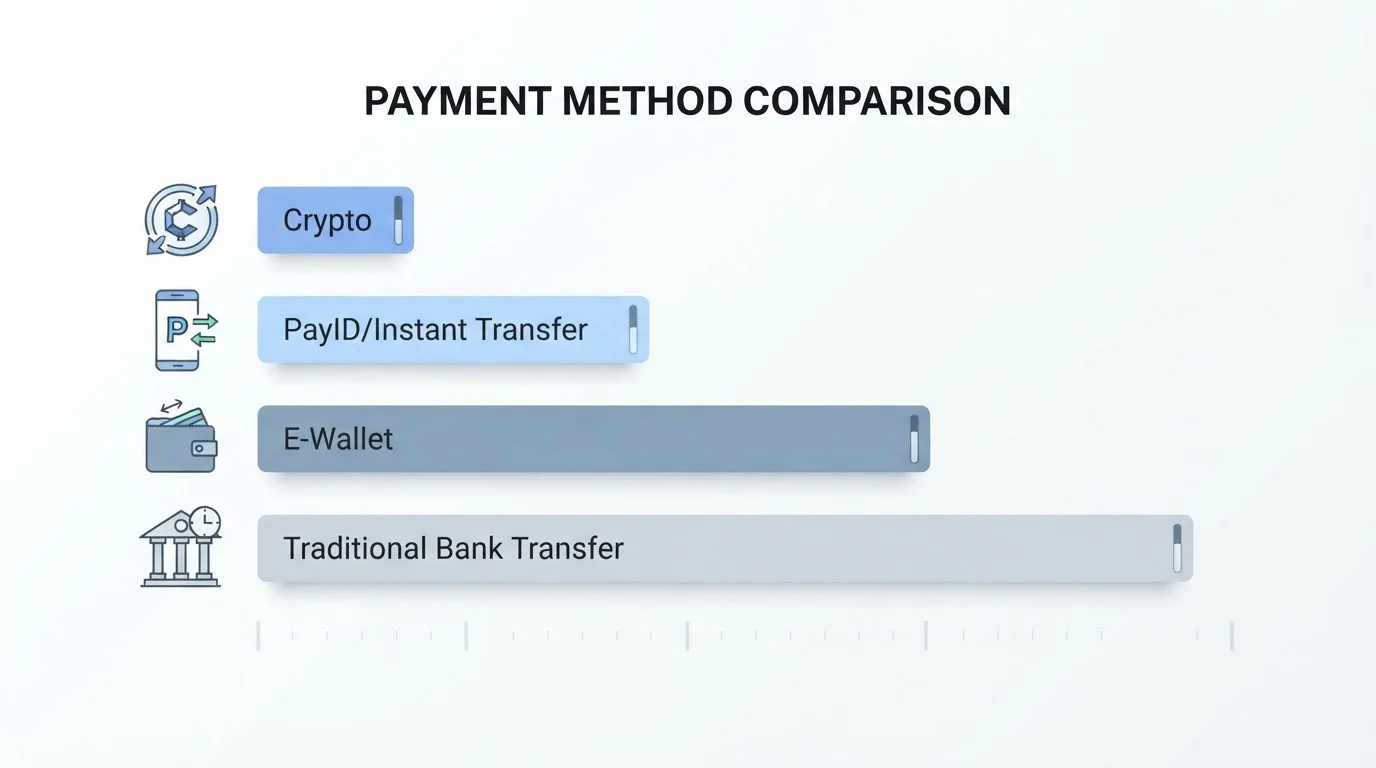
Payment method choice determines whether your withdrawal clears in fifteen minutes or three business days. The casino’s internal approval queue adds the first layer of delay, but the payment rail itself — PayID, cryptocurrency, e-wallet, traditional bank transfer or debit card — controls the second and often larger component of total wait time.
What is the fastest withdrawal method at Australian online casinos?
Cryptocurrency is fastest overall, with payouts landing in ten to sixty minutes once the casino approves the withdrawal. PayID is the fastest fiat option at one to four hours total. E-wallets match PayID on speed but require separate account setup. Traditional bank transfers take one to three business days, and debit cards stretch to three to five days when withdrawal support exists at all.
| Payment Method | Deposit Speed | Withdrawal Speed | Fees | Max Per Transaction | Best For |
|---|---|---|---|---|---|
| Crypto (BTC, USDT, ETH) | Under 60 seconds | 10 to 60 minutes after approval | Network fees under AU$0.50 | AU$20,000 | Fastest possible payout, privacy |
| PayID / Osko | Under 60 seconds | 1 to 4 hours after approval | Zero | AU$5,000 | Fast AUD payouts, no exchange setup |
| E-Wallets (Skrill, Neteller) | Instant | 1 to 4 hours after approval | Sometimes 1 to 3 percent | Varies by operator | Speed without crypto complexity |
| Bank Transfer (BSB) | 1 to 24 hours | 1 to 3 business days after approval | Zero | AU$5,000 or higher | Large withdrawals, less speed priority |
| Debit Cards (Visa, Mastercard) | Instant | 3 to 5 business days after approval | 1 to 3 percent | Varies, often deposit-only | Convenience for deposits only |
The table splits deposit speed, which is largely uniform across modern methods, from withdrawal speed, where the gaps widen to days. That asymmetry exists because deposits are automated and irreversible once confirmed, while withdrawals require manual approval by the casino before the payment method even begins processing.
Crypto Withdrawals (Fastest Overall, 10–60 Minutes)
Cryptocurrency withdrawals clear faster than any fiat method because blockchain settlement is peer-to-peer and operates outside banking hours, weekends and public holidays. Bitcoin, Ethereum, Tether and Litecoin are the most commonly supported coins at Australian-facing offshore casinos. Once the casino approves a crypto withdrawal and broadcasts the transaction to the blockchain, settlement time depends on network congestion and the fee rate attached to the transaction.
Tether on the Tron network typically clears in under fifteen minutes with fees below fifty cents in Australian dollar equivalent. Bitcoin withdrawals take fifteen to sixty minutes depending on fee priority and mempool congestion. Ethereum sits somewhere in between, usually twenty to forty minutes. The casino handles the blockchain broadcast; the player just needs a wallet address to receive the coins.
The trade-off for speed is setup friction. Players new to cryptocurrency need to create an account on an Australian exchange such as CoinSpot, Swyftx or Independent Reserve, complete exchange-level identity verification, generate a receiving wallet address, and understand how to move coins from the casino to the exchange and from the exchange to their bank account. That onboarding process takes an hour or two the first time. Once in place, crypto becomes the fastest method by a wide margin, but players who only want to deposit fifty dollars and cash out eighty are unlikely to consider the setup worthwhile.
PayID Withdrawals (Fastest Fiat Option, 1–4 Hours)
PayID withdrawals combine instant bank-to-bank settlement via Osko with zero setup beyond linking a mobile number or email to an existing Australian bank account. Total time from withdrawal request to funds available runs one to four hours at the faster operators on this list, which makes PayID the fastest fiat method available to Australian players. Deposits credit in under sixty seconds, and there are no fees on either end.
The upper bound of four hours reflects casino approval time, not PayID or Osko processing. The Osko transfer itself completes in seconds once the casino releases the payment. Players at faster operators like Hell Spin or Goldenbet will see total payout times closer to the half-hour mark, while those at slower operators will wait several hours regardless of how fast PayID itself operates.
PayID works in Australian dollars without currency conversion, so the amount requested in the cashier matches the amount landing in the bank account. Maximum per-transaction limits typically sit at five thousand dollars for PayID, which is lower than crypto maximums of twenty thousand dollars but sufficient for most player withdrawals. Players needing to move larger sums will either submit multiple PayID requests or switch to crypto for the higher ceiling.
E-Wallets (Skrill, Neteller, MuchBetter — 1–4 Hours)
E-wallets like Skrill, Neteller and MuchBetter settle casino withdrawals in one to four hours once approved, matching PayID on speed. The distinction is that e-wallets require creating a separate account with the e-wallet provider, funding that account separately for deposits, and then transferring e-wallet balances back to an Australian bank account as a second step after cashing out from the casino.
That extra layer adds friction compared to PayID, which moves money directly between the casino and a player’s bank account in one hop. E-wallets also charge fees on some transactions, commonly one to three percent on currency conversion or withdrawal to a bank account, though deposit and casino-to-e-wallet transfers are often free. Maximum transaction amounts vary by operator and by e-wallet, with some supporting higher limits than PayID and others capping lower.
E-wallets served a purpose before PayID and Osko became widely adopted by offshore casinos around 2021 and 2022. Players who already maintain Skrill or Neteller accounts for non-casino purposes might find them convenient, but Australian players starting fresh have little reason to choose an e-wallet over PayID when both deliver the same speed and PayID eliminates account setup and fee exposure.
Traditional Bank Transfers (1–3 Business Days)
Traditional bank transfers using BSB and account number rely on the old BECS batch-clearing system, which processes payments overnight on business days only. A withdrawal approved by the casino on Friday afternoon will not land in a player’s account until Tuesday at the earliest, assuming no public holidays interrupt the clearing schedule. Weekends and public holidays extend that window further.
BECS transfers carry no fees when sending between Australian bank accounts, and maximum transaction amounts are typically higher than PayID limits, making traditional transfers viable for large withdrawals where speed is less important than per-transaction ceiling. The three-day settlement window makes BECS a poor fit for players who want fast access to winnings, but players cashing out five-figure sums might accept the delay to avoid splitting the withdrawal across multiple PayID transactions capped at five thousand dollars each.
What’s the difference between PayID and a regular bank transfer?
PayID uses the NPP and Osko for instant settlement in seconds, twenty-four hours a day. Regular bank transfers use the BECS system, which batches payments overnight on business days only. A PayID withdrawal clears in hours; a BECS withdrawal takes one to three business days.
Debit Cards (3–5 Business Days, Often Deposit-Only)
Debit cards branded Visa or Mastercard process deposits instantly at most offshore casinos, but withdrawal support is inconsistent. Many card issuers and offshore operators restrict casino withdrawals back to debit cards due to chargeback fraud risk or issuer policy, forcing players to choose an alternative method like PayID or crypto for cash-outs even if the card worked fine for deposits.
When debit card withdrawals are supported, processing takes three to five business days after the casino approves the payout. That lag comes from the card network’s settlement process, not the casino. Fees of one to three percent are common on card transactions, applied either by the casino or by the card issuer as a foreign transaction fee if the casino’s payment processor sits outside Australia.
The deposit-only restriction makes debit cards a poor choice for players prioritising withdrawal speed. PayID or crypto deposits take the same amount of time as card deposits — under a minute — and both support fast withdrawals, so the card’s convenience advantage disappears once you factor in the payout leg of the transaction.

Are PayID Casinos Legal in Australia? The Offshore Reality
Every casino listed above operates offshore under Curaçao, Malta or similar licensing jurisdictions. Zero Australian-licensed online casinos exist in 2026, and none have existed since online gambling laws were consolidated under federal oversight. That absence is not a temporary gap or a licensing backlog — it is a structural feature of Australian gambling regulation, and understanding why requires looking at what the Interactive Gambling Act 2001 actually prohibits.
Are PayID casinos legal in Australia?
Playing at offshore PayID casinos carries no legal penalty for Australian players. The Interactive Gambling Act 2001 targets operators, not players. No Australian law criminalises depositing at an offshore casino, and winnings are not taxed as income for recreational players.
Why Zero Australian-Licensed Online Casinos Exist
The Interactive Gambling Act 2001 governs all online gambling offered to Australian residents. Section 15(2A) makes it an offence to provide an online casino service — pokies, blackjack, roulette, baccarat, any game traditionally played in a land-based casino — to a person physically located in Australia without holding an appropriate licence. The Act then establishes a licensing framework for interactive gambling services and delegates licensing authority to state and territory regulators.
Here is where the structure matters: the licensing framework created by the IGA covers sports betting, racing wagering and lotteries. It does not extend to casino games. State and territory regulators issue licences for online sports betting and racing under their respective jurisdictions, which is why approximately 150 licensed wagering providers appear on the Australian Communications and Media Authority register. None of those licences permit offering pokies or table games. The federal law prohibits offering casino games without a licence, and the licensing framework does not issue casino licences. The result is a regulatory void where no legal pathway exists for an operator to offer licensed online casino games to Australian residents.
Land-based casinos operate under state licences that govern physical venues. Those licences do not extend to online operations serving the general public from remote locations. The prohibition is not about the games themselves being illegal — Australians can walk into a Crown or Star property and play roulette legally — but about the delivery method. Online provision to customers in their homes falls under federal jurisdiction via the IGA, and that framework blocks it.
What the Interactive Gambling Act 2001 Actually Says
Section 15(2A) of the IGA prohibits providing, or offering to provide, an interactive gambling service to customers in Australia. An interactive gambling service is defined to include online casino games but excludes sports betting, racing and lotteries when conducted under an Australian licence. The penalty structure scales by the offender: individuals face civil penalties up to three hundred sixty thousand dollars per day of operation, and bodies corporate face up to one point eight million dollars per day, with penalties compounding daily for ongoing breaches.
The offence targets the provider, not the customer. No section of the IGA creates an offence for an Australian resident accessing an offshore gambling site, depositing money, or withdrawing winnings. The legal risk sits entirely on the operator’s side. An offshore operator offering pokies to Australian players is technically in breach of Section 15(2A) regardless of where the operator is based or licensed, because the Act applies extraterritorially to services provided to persons in Australia. Enforcement of that extraterritorial reach is limited by jurisdiction — the Australian government cannot prosecute a Curaçao-licensed operator in Curaçao courts — but ACMA can and does block access to offshore sites via ISP-level disruption notices.
Players vs. Operators — Who Takes the Legal Risk?
Players take no legal risk under the IGA. The Act contains no provision criminalising the act of playing at an offshore casino, and no Australian has been prosecuted or fined for depositing at an offshore site. Gambling winnings are treated as windfalls by the Australian Taxation Office and are not assessed as taxable income for recreational players, so there is no tax reporting obligation on cash-outs from offshore operators.
Operators take substantial legal risk. An offshore casino offering services to Australian players is in breach of Section 15(2A) regardless of its licensing status in another jurisdiction. That breach exposes the operator to ACMA enforcement action, which takes the form of site blocking via ISP disruption notices rather than direct legal action in most cases. Since November 2019, ACMA has blocked over 1,750 gambling websites and affiliate pages targeting the Australian market. Another 230-plus operators voluntarily exited the Australian market between 2017 and the present after ACMA contact, preferring to walk away rather than face blocking or escalated enforcement.
Direct penalties do land occasionally. On 6 July 2026, the Federal Court ordered penalties totalling twenty-four point two four million dollars against an operator and a director over three poker brands that breached Section 15(2A). That figure sits on top of an earlier five-million-dollar penalty against a related company in 2023. The case demonstrates that ACMA will pursue high-value targets through the courts when blocking alone is insufficient, and that directors face personal liability alongside the corporate entity.
ACMA Enforcement — Site Blocking and Penalties
ACMA administers the IGA and holds enforcement authority over offshore operators breaching Section 15(2A). The primary enforcement mechanism is the site-blocking programme, which began in November 2019 and operates by issuing disruption notices to Australian internet service providers. When ACMA identifies an offshore gambling site breaching the Act, it issues a notice requiring ISPs to block access to that domain within a specified timeframe, typically a few business days.
Blocking works at the DNS and IP level, meaning players attempting to access a blocked domain from an Australian internet connection will see an error page or a redirect rather than the casino site. Operators respond by registering new domains and mirror sites, which ACMA then blocks in subsequent rounds. The programme has removed over 1,750 domains from Australian accessibility since launch, though the offshore market adapts by cycling through new domains faster than ACMA can issue notices.
ACMA also targets affiliates and influencers promoting offshore operators. An individual earning income from promoting an unlicensed gambling service faces civil penalties up to fifty-nine thousand four hundred dollars. Individuals or entities actively facilitating access, such as posting referral links or bonus codes, face penalties up to two point four seven five million dollars. Those penalties reflect a 2026 legislative update increasing enforcement reach beyond operators to the marketing ecosystem driving player acquisition.
What Offshore Licensing Means for Australian Players
The operators listed in this guide hold licences from Curaçao, Malta or other offshore jurisdictions. Those licences are real regulatory instruments issued by recognised authorities, but they provide no legal cover under Australian law. A Curaçao eGaming licence permits the operator to conduct online gambling under Curaçao jurisdiction and provides a regulatory framework for dispute resolution, game fairness auditing, and player fund segregation within that jurisdiction. It does not authorise offering services to Australian residents under the IGA.
For players, offshore licensing is a quality signal rather than a legality signal. A Curaçao or Malta licence indicates the operator maintains some level of regulatory oversight, files compliance reports, and operates under a framework that can revoke the licence for serious breaches. An unlicensed operator or an operator holding a low-tier licence from a jurisdiction with no enforcement history offers no such assurance. Neither licensing scenario changes the player’s legal position under Australian law — playing at an offshore casino is not illegal for Australian residents — but licensing status affects operational reliability, payout integrity and recourse in disputes.
Players who deposit at a Curaçao-licensed operator and encounter a dispute can escalate to the Curaçao licensing authority if the operator’s internal complaint process fails. Players who deposit at an unlicensed site have no third-party recourse beyond public forums and chargeback attempts, which rarely succeed for gambling transactions. Offshore licensing matters not because it makes the activity legal under Australian law, but because it provides a dispute resolution pathway when the operator is the source of the problem.

Common PayID Withdrawal Problems and How to Avoid Them
Most PayID withdrawals that stall for hours or days trace back to four fixable causes: incomplete identity verification, unmet bonus wagering requirements, bank-side holds on first transfers from new payees, or a rogue operator that never intended to pay. Knowing which problem applies tells you whether the delay is temporary friction or a sign to walk away.
Why is my PayID casino withdrawal delayed?
Delays longer than a few hours usually stem from incomplete identity verification, unmet bonus wagering, or a bank hold on the first transfer from a new payee. Check your account’s verification status, confirm bonus rollover is complete, and allow twenty-four hours for CommBank to release first-time Osko transfers.
Incomplete KYC Verification
Every licensed offshore operator must verify player identities before processing withdrawals above a threshold, commonly one hundred fifty to five hundred dollars. This requirement flows from anti-money-laundering regulations tied to the operator’s licence, not arbitrary obstruction. Verification triggers on your first withdrawal, your first withdrawal above the threshold, or when cumulative withdrawals cross a set total even if individual requests stayed small.
Documents required typically include government-issued photo identification such as a passport or driver’s licence, proof of address dated within ninety days such as a utility bill or bank statement, and occasionally a selfie holding your ID or a screenshot of your banking app showing your name and the registered PayID. Uploading clear, unobstructed images in the specified formats — usually JPEG or PDF under five megabytes — speeds processing. Blurry photos, cropped documents missing corners, or files exceeding size limits bounce back for resubmission and add days to approval.
The fix is straightforward: submit complete, legible documents as soon as the verification request arrives. Most operators clear verification within twenty-four to forty-eight hours of receiving acceptable documents, and some process it in under an hour. Once verified, future withdrawals skip this step unless you change your registered payment details. Proactive players submit verification documents immediately after registration, before depositing, so their first withdrawal clears without delay.
Unmet Bonus Wagering Requirements
Bonus money comes with rollover requirements, typically thirty to fifty times the bonus amount, that must be cleared before any winnings derived from bonus funds become withdrawable. If you claimed a welcome bonus — say, a one hundred percent match up to five hundred dollars — and the attached wagering is forty times, you must wager twenty thousand dollars on eligible games before the bonus and its winnings convert to withdrawable cash.
Requesting a withdrawal while bonus wagering is incomplete will either trigger an automatic rejection or place the request in pending status until you clear the rollover. Most casino account dashboards display real-time wagering progress, showing how much of the requirement you have completed and how much remains. Games contribute to wagering at different rates: pokies usually count one hundred percent per dollar wagered, while table games like blackjack and roulette contribute ten percent or nothing.
The fix depends on whether you want to complete the bonus or forfeit it. Completing the rollover means continuing to play on eligible games until the wagering bar reaches one hundred percent, at which point the withdrawal will process. Forfeiting the bonus means contacting support to remove the bonus and its winnings from your account, leaving only your original deposit and any winnings generated before claiming the bonus. Most operators allow forfeit, though some charge a penalty or void all winnings tied to the bonus period.
Avoiding this problem means reading bonus terms before opting in. If the wagering requirement exceeds forty times, the time limit is under fourteen days, or the maximum cash-out is capped below the bonus amount, declining the bonus and depositing without it keeps your funds withdrawable from the start.
Bank-Side Holds on First Transfers (CommBank 24-Hour Hold)
Several Australian banks place temporary holds on the first Osko transfer received from a new payee, meaning the first PayID withdrawal from a casino you have never cashed out from before may be held up to twenty-four hours even though the casino approved and sent the payment instantly. Commonwealth Bank is the most commonly reported bank for this behaviour. The hold applies only to the first transfer from each unique payee; subsequent transfers from the same casino arrive instantly without delay.
ANZ, Westpac, NAB and ING generally process incoming Osko transfers instantly even from new payees, though individual account settings and transaction histories can trigger holds on any bank. Daily transfer limits also apply: your bank sets a daily PayID or Osko receiving limit, commonly one thousand to five thousand dollars. If your withdrawal exceeds your bank’s daily limit, the bank may hold or reject the transfer, forcing you to contact the bank to raise the limit before resubmitting the withdrawal.
The fix for a first-transfer hold is patience. If CommBank is holding a payment, it will release automatically within twenty-four hours without any action required on your part. Check your banking app for pending or held transaction notifications. For future withdrawals from the same casino, the hold will not apply again. If you need to adjust your daily receiving limit, do it inside your banking app under transfer or payment limits, not by contacting the casino.
Why do some casinos not support PayID withdrawals?
Some offshore operators support PayID deposits but block PayID withdrawals due to payment processor restrictions, higher fraud risk on payouts, or deliberate friction to reduce cash-out rates. Operators that accept PayID in one direction only are showing you their priorities.
Name Mismatch Between Casino Profile and Bank Account
PayID transfers automatically pass the registered bank account name to the receiver. If the name on your casino profile does not match the name on your Australian bank account exactly, the withdrawal will flag during the casino’s compliance check and either be rejected outright or held in manual review until you provide additional documentation proving both accounts belong to you. This is the single most common avoidable delay in PayID withdrawals.
The name match must be exact. If your bank account is registered under Jonathan Michael Smith and your casino profile says John Smith, that is a mismatch. If your bank account is under a legal name and your casino profile uses a nickname or preferred name, that is a mismatch. Joint accounts present additional complications: if the bank account is in two names, the casino profile must list the same two names in the same order, which many casino registration forms do not support.
The fix is to register your casino account using your full legal name exactly as it appears on your bank statement and government ID from the start. If you have already registered under a shortened or incorrect name, contact the casino’s support to update your profile name before submitting a withdrawal. Most operators allow name corrections with proof of identity, but the process adds hours or days to the payout. Married players using a new surname should ensure their bank account, government ID and casino profile all reflect the updated name, or use an account still registered under the previous name and update the casino profile accordingly.
What should I do if my PayID withdrawal doesn’t arrive?
Check your account verification status and bonus wagering progress first. If both are clear, allow twenty-four hours for a bank hold to release if this is your first withdrawal from this casino. Contact the casino’s support with your withdrawal transaction ID if the delay exceeds forty-eight hours with no explanation.
Rogue or Slow-Pay Operators
The most serious cause of withdrawal delays is an operator that routinely denies or delays payouts through manufactured obstacles: sudden requests for documents you already submitted, vague security reviews that never resolve, or outright ghosting where support stops responding. This is less a technical problem and more a business model where acquisition spend is funded by non-payment of winning players.
Red flags that predict this problem before depositing include no verifiable licence from a recognised jurisdiction, a PayID processing fee charged on withdrawals when legitimate operators charge nothing, no live chat or a chat that goes unanswered for hours, withdrawal limits so low that cashing out a modest win would take weeks of daily requests, and bonus terms with wagering above fifty times or clauses that void winnings on trivial technicalities.
If you are already stuck with a rogue operator, escalate through every support channel simultaneously: live chat, email, and any complaints process listed in the terms. If the casino holds a legitimate licence, file a complaint with the licensing authority via their official portal. If the casino is unlicensed or holds a licence from a jurisdiction with no enforcement mechanism, your options narrow to public complaint on forums and social media, and disputing the deposit with your bank if it occurred recently via card or PayID. Success rates on disputes are low for gambling transactions, but it is sometimes the only recourse left.
Prevention is everything. The operators listed at the top of this guide hold licences, process verifiable payouts, and maintain active support channels. Chasing a fifty-dollar bonus at an unknown operator with no licence and no reviews is a decision that might save five dollars on wagering and cost five hundred dollars in unrecoverable deposits.

| Problem | Root Cause | Fix |
|---|---|---|
| Withdrawal stuck in pending 24 to 48 hours | KYC documents not submitted or incomplete | Upload ID and proof of address; follow up via live chat |
| Withdrawal rejected outright | Wagering requirement not met on bonus funds | Check bonus progress bar; complete playthrough on eligible games |
| Casino approved but funds not arrived | Bank hold on first transfer from new payee | Wait up to 24 hours, particularly for CommBank; check banking app for held transaction |
| Daily limit exceeded | Bank’s daily Osko limit too low for withdrawal amount | Increase limit in banking app before requesting payout |
| Withdrawal delayed indefinitely with excuses | Rogue or slow-pay operator | Escalate all channels; file licence complaint if applicable; avoid in future |
| Unexpected fee deducted | Operator charging a processing fee | Dispute with support; note this as a scam indicator for future |
Bonuses at PayID Casinos — What to Watch For
Welcome bonuses at the operators above range from modest cash-back structures with zero wagering to five-figure packages with rollover multiples that take weeks to clear. The headline number matters less than the terms attached: a three-thousand-dollar bonus with thirty-five-times wagering on the bonus only is more achievable than a six-thousand-dollar bonus with fifty-times wagering on the deposit plus bonus, even though the second offer sounds twice as generous.
Wagering requirements specify how many times you must play through the bonus amount before converting it to withdrawable cash. Thirty to forty times is standard across offshore operators. Below thirty times is player-friendly; above fifty times is punitive. The base for the calculation matters: bonus-only wagering applies the multiple to the bonus alone, while deposit-plus-bonus wagering applies it to the combined total of your deposit and the bonus. A one-hundred-dollar deposit with a one-hundred-dollar bonus at forty times bonus-only requires four thousand dollars in wagers to clear. The same scenario at forty times deposit-plus-bonus requires eight thousand dollars, doubling the effective rollover.
Game contribution rates determine which games count toward clearing wagering. Pokies contribute one hundred percent of each dollar wagered. Blackjack, roulette and other table games contribute ten to twenty percent or nothing at all, depending on the operator. Live dealer games typically contribute zero. Playing a thousand dollars on blackjack might clear only one hundred dollars of wagering, meaning table game players need to wager ten times the nominal rollover to actually clear a bonus compared to pokies players. Reading the bonus terms and checking game contribution rates before claiming saves players from discovering halfway through that their preferred game does not count.
Time limits on bonuses range from seven to thirty days. A bonus that expires in seven days forces high-volume play or forfeiture. Thirty-day windows are more forgiving for recreational players who deposit fifty or a hundred dollars and play a few sessions per week. Maximum cash-out caps, common on free spins and no-deposit bonuses, limit how much you can withdraw even if you win large while clearing the rollover. A bonus with a one-hundred-dollar cash-out cap becomes worthless the moment your balance exceeds that ceiling, so spinning a jackpot while clearing wagering costs you everything above the cap.
Declining bonuses is always an option. Depositing without claiming a welcome offer means your funds remain fully withdrawable from the start, with no wagering requirements, no game restrictions, and no time limits. Players who value fast access to winnings over bonus padding often skip promotions entirely and deposit clean. The trade-off is starting with a smaller effective bankroll, but the freedom to cash out anytime with no strings attached makes that trade worthwhile for many.

Games Available at PayID Casinos
The operators above focus heavily on pokies, which aligns with Australian player preference and the offshore market’s revenue structure. Pokies generate higher hold percentages than table games and carry simpler rules, making them easier to scale across thousands of titles. Live dealer games and table games receive secondary treatment in most offshore catalogues, with pokies dominating by title count and promotional focus.
Pokies libraries at these operators range from three thousand to seven thousand titles, sourced from studios including Pragmatic Play, NetEnt, Play’n GO, Microgaming, Relax Gaming, BGaming, Nolimit City, Playtech, iSoftBet and dozens of smaller providers. Popular titles like Book of Dead, Gates of Olympus, Sweet Bonanza, Wolf Gold, Mega Moolah and Starburst appear across most catalogues. Progressive jackpots pool prize money across multiple casinos, with Mega Moolah and Divine Fortune reaching six- and occasionally seven-figure payouts.
Live dealer games run from Evolution, Pragmatic Live, and Ezugi in most cases, covering blackjack, roulette, baccarat and poker variants streamed from professional studios. Table limits range from one dollar to ten thousand dollars per hand, though higher limits often require VIP status or preapproval. The live experience replicates land-based play more closely than RNG table games, with real dealers, physical cards and wheels, and the option to interact via chat. Betting windows are shorter than solo RNG games, and connection quality affects playability, so live dealer games demand stable internet.
RNG table games — blackjack, roulette, baccarat, craps, video poker — fill out the non-pokies section of most lobbies. These games run on random number generators rather than live dealers, offering faster play and lower minimum bets. Return-to-player percentages on RNG table games typically run between ninety-seven and ninety-nine percent, higher than most pokies, but bonus wagering contributions are lower or zero, making them impractical for clearing promotions.
Responsible Gambling and Player Safety
Offshore operators serving Australian players operate outside the reach of BetStop, Australia’s National Self-Exclusion Register, which covers only locally licensed wagering providers. That gap means players needing to exclude themselves from offshore casinos must contact each operator individually through their responsible gambling tools rather than registering once on a national platform.
Most of the operators above offer account limits configurable through settings or live chat: deposit limits, loss limits, session timers, and wager caps. These tools work when players set them proactively before problems develop, not reactively after losing more than intended. Setting a weekly deposit limit at the start of each month removes the decision-making burden during play and prevents chasing losses beyond a preset threshold. Session timers log players out automatically after a set duration, breaking extended sessions that tend to spiral.
Self-exclusion options at offshore operators range from twenty-four-hour cooling-off periods to permanent account closure. Temporary exclusions lock the account for a fixed period with no option to reverse early, giving players distance from impulsive re-entry. Permanent exclusions close the account indefinitely, though enforcement depends on the player not creating a new account under a different email. Offshore operators lack the infrastructure to cross-check multiple accounts against a central register, so determined players can bypass self-exclusion by re-registering, which underscores the importance of addressing the underlying behaviour rather than relying on operator controls alone.
Australian players experiencing gambling harm can access support through Gambling Help Online at 1800 858 858, available twenty-four hours a day, or through online chat at gamblinghelponline.org.au. Lifeline provides crisis support at 13 11 14. These services are free, confidential, and staffed by counsellors trained in gambling-related harm. Financial counselling for gambling debt is available through the National Debt Helpline at 1800 007 007.
The legal position of offshore casinos under Australian law creates a gap in harm-minimisation infrastructure. Locally licensed operators in sports betting and racing integrate with BetStop and report activity to state regulators, creating a framework where problem gambling can trigger intervention. Offshore operators operate outside that framework, placing full responsibility on players to recognise harm, set limits, and seek help. That structure works when players engage proactively with responsible gambling tools but fails when harm develops unnoticed or when denial prevents help-seeking.
Fast Withdrawal Casinos Australia 2026 — Instant Payouts Compared
Content created by the «Bankroll» team