
Casino Sites That Accept Credit Card in Australia 2026: Offshore Options, Bank Blocks, and What Actually Works
 Available in AU

Credit Cards at Australian Online Casinos: The 2026 Reality
Credit cards used to be the default deposit method at online casinos worldwide. Fast, familiar, no separate account to set up. Australian players typed in their Visa or Mastercard details and started playing within seconds. That convenience disappeared on 11 June 2024 when the Interactive Gambling Amendment Act banned licensed Australian operators from accepting credit cards entirely.
The ban closed a loophole. Land-based casinos in Australia had prohibited credit card gambling for years, preventing punters from betting with borrowed money at the pokies floor or the roulette table. Online wagering ran under different rules until mid-2024. The amendment brought the two sectors into line, and licensed Australian gambling operators — sports wagering services like TAB, Sportsbet, Ladbrokes AU — can no longer process a credit card deposit without facing fines up to $234,750 per breach.
Offshore casinos accepting Australian players sit outside that licensing framework. Curacao-licensed operators, Kahnawake-licensed sites, and other international brands technically remain free to accept credit cards from Australians because the June 2024 law targets licensed domestic operators, not offshore entities beyond ACMA’s jurisdiction. That’s the theory. The practice involves bank blocks, cash advance fees, and high decline rates that make credit cards the least reliable deposit method in 2026, even where they’re “technically” allowed.
Can I still use my credit card at online casinos in Australia in 2026?
Yes at offshore casinos, no at licensed Australian operators. The June 2024 ban applies only to operators licensed under the Interactive Gambling Act. Offshore casinos (Curacao, Kahnawake, Malta, Tobique) accept Australian players and can process credit card deposits, but most Australian banks block gambling-coded credit card transactions regardless of the casino’s jurisdiction, and transactions that do succeed are often treated as cash advances with immediate interest charges and 2–3% fees.
The June 2024 Credit Card Ban — What Changed and Who It Applies To

The Interactive Gambling Amendment (Credit and Other Measures) Act 2023 came into force on 11 June 2024. It prohibits licensed Australian gambling operators from accepting credit cards, credit-related products, and digital currency for online wagering. The Australian Communications and Media Authority (ACMA) enforces the ban. Operators who fail to comply face penalties up to $234,750.
The ban targets financial harm. Gambling with borrowed money amplifies losses and pushes vulnerable players into debt spirals. The UK implemented a similar ban in April 2020; follow-up research found 76% of former credit card gamblers stopped borrowing to gamble entirely after the restriction took effect. Australian policymakers adopted the same logic: if credit cards are banned at Crown Casino’s pokies floor, they should be banned at online wagering platforms too.
“You can’t use your credit card to place a bet for land-based gambling and now the same rules apply for online gambling,” said Amanda Rishworth, then Minister of Communications, when the amendment passed. The law closed an online loophole, not a land-based one. Physical casinos in Australia already prohibited credit card use. Online operators simply caught up.
Is it illegal to use a credit card at an offshore casino from Australia?
No. The June 2024 ban is an operator-side restriction. It makes it illegal for licensed Australian gambling operators to accept credit card deposits, not illegal for players to attempt them. Offshore casinos sit outside Australian licensing jurisdiction, so the ban does not reach them as operators. Australian law does not criminalise depositing at an offshore casino with a credit card, but the practical barriers (bank blocks, cash advance treatment) mean most transactions fail or cost significantly more than alternatives.
The law targets the supply side, not the demand side. ACMA enforces the ban by fining non-compliant licensed operators, not by prosecuting individual players. A two-year effectiveness review is scheduled after June 2026, examining whether the ban reduced financial harm and whether it pushed players toward unlicensed offshore sites. Early indications from the UK’s parallel ban suggest most former credit card users simply switched to debit cards or bank transfers rather than seeking offshore workarounds.
Cryptocurrency fell under the same ban for licensed Australian operators. Digital currency deposits — Bitcoin, Ethereum, Tether, any token — are prohibited alongside credit cards and credit-related products. This restriction applies only to licensed domestic operators; offshore casinos still accept crypto from Australian players without regulatory barrier.
The June 2024 amendment sits within a broader tightening of gambling advertising and harm-reduction measures. New advertising reforms announced for January 2027 will ban gambling promotions during live sports broadcasts between 6am and 8:30pm, reducing exposure for children and vulnerable populations. The regulatory direction is consistent: reduce financial risk, limit borrowed-money gambling, and bring online rules closer to land-based norms.
Why Your Credit Card Gets Declined at Offshore Casinos
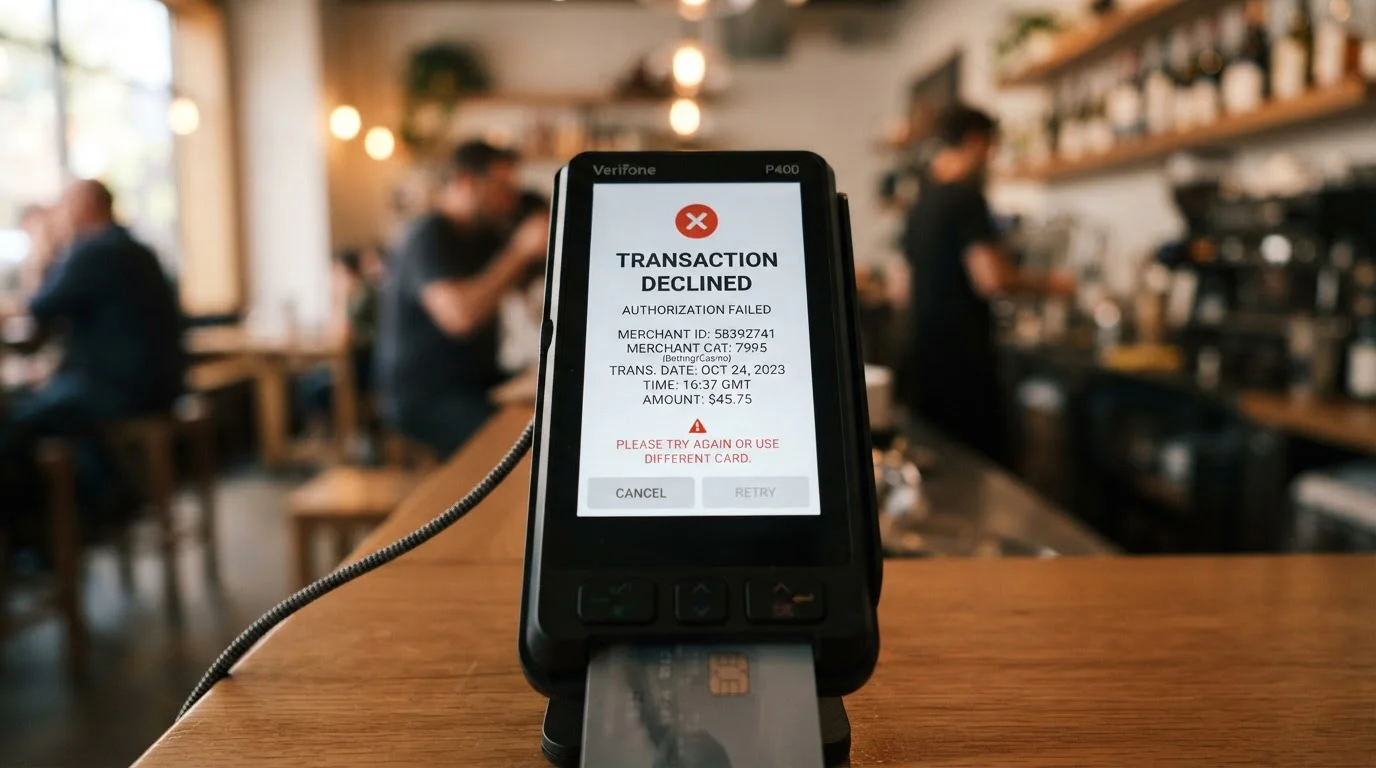
Offshore casinos might accept credit cards from Australian players in their terms and conditions, but Australian banks frequently decline the transactions before they reach the casino’s payment processor. The rejection happens at the bank’s end, not the casino’s.
All gambling transactions carry Merchant Category Code 7995. MCC 7995 flags a payment as gambling-related in the card network’s routing system. Australian banks use this code to identify and block credit card gambling transactions, applying their own policies on top of the June 2024 legislative ban. The law prohibits licensed Australian operators from accepting credit cards; banks extend that block to offshore operators regardless of jurisdiction.
CommBank and Westpac are the most aggressive. Both banks decline the majority of credit card transactions to merchants flagged with MCC 7995, whether the merchant is a licensed Australian wagering service or a Curacao-licensed offshore casino. The bank’s fraud prevention system doesn’t distinguish between the two. It sees “gambling” and “credit card” in the same transaction and stops it.
ANZ and NAB apply medium-level blocking. They decline many credit card gambling transactions but not all. Success depends on the specific merchant, the payment processor routing the transaction, and whether the casino’s processor routes payments under a non-gambling MCC code (a practice that sits in a legal grey zone and occasionally bypasses bank filters).
Neobanks like UP and Revolut AU apply the fewest restrictions. Both have fewer reported credit card gambling blocks than the Big Four, though neither guarantees transaction success. UP’s terms of service allow gambling transactions; Revolut AU treats them case-by-case. Decline rates are lower but not zero.
Why does my bank decline credit card deposits to offshore casinos?
Your bank declines the transaction because it’s coded as MCC 7995 (gambling). Australian banks apply transaction screening to credit cards for gambling merchants, blocking most attempts regardless of whether the casino is licensed in Australia or offshore. CommBank and Westpac block most gambling credit transactions; ANZ and NAB block many; neobanks block fewer but still screen. The bank’s system flags the merchant category, not the casino’s legal jurisdiction.
MCC 7995 and How Australian Banks Use It
MCC 7995 is the international merchant category code for gambling transactions. Every online casino, sports betting site, and poker room processes payments tagged with this code. Card networks (Visa, Mastercard) route the transaction, the merchant’s bank (the acquiring bank) receives it, and your bank (the issuing bank) sees the MCC 7995 flag before authorising payment.
Australian issuing banks — CommBank, Westpac, ANZ, NAB — run their own screening rules on top of the card network’s standard authorisation flow. When a credit card transaction arrives flagged MCC 7995, the bank’s fraud and compliance systems evaluate it against internal policies. Since mid-2024, those policies treat gambling credit card transactions with heightened scrutiny.
The screening is not mandated by the June 2024 law for all gambling transactions universally. The law bans licensed Australian operators from accepting credit cards; it does not legally require banks to block every offshore gambling transaction. Banks implement MCC 7995 blocking as a risk management and compliance measure. Blocking gambling credit transactions reduces chargeback risk (players disputing losses), lowers exposure to problem gambling complaints, and aligns with the spirit of the amendment even where the letter of the law doesn’t reach.
The result: a transaction to Wild Tokyo or Rolling Slots coded MCC 7995 and charged to a CommBank Visa credit card will almost certainly be declined, not because Wild Tokyo is illegal but because CommBank’s internal policy stops credit card gambling transactions at the authorisation stage.
Some offshore casino payment processors attempt to bypass MCC 7995 by routing transactions under alternative codes — retail, digital goods, software purchase. This practice (sometimes called “transaction laundering” in payment industry jargon) occasionally succeeds in bypassing bank filters, but it introduces legal and operational risk. If the bank later identifies the transaction as gambling-related, it may trigger a chargeback, account review, or block on future payments.
Bank-by-Bank Blocking: CommBank, Westpac, ANZ, NAB, and Neobanks
| Bank | Credit card block severity | Debit card block | Notes |
|---|---|---|---|
| CommBank | Very high | Medium | Blocks most MCC 7995 credit transactions; debit cards have medium decline rates; some gambling blocks extend to PayID flagging |
| Westpac | Very high | Medium | Similar to CommBank; aggressive on credit, medium on debit; reported blocks on some NPP payments to known gambling merchants |
| ANZ | High | Low–Medium | Blocks many but not all credit card gambling transactions; debit card decline rates lower than CommBank/Westpac |
| NAB | High | Low–Medium | Similar profile to ANZ; fewer reported credit card gambling blocks than CommBank/Westpac but still substantial |
| UP | Low | Very low | Neobank with permissive gambling transaction policy; credit card gambling transactions have low reported decline rates |
| Revolut AU | Low–Medium | Very low | Handles gambling transactions case-by-case; lower block rates than Big Four; crypto deposits via Revolut also work |
Which Australian banks block credit card gambling transactions?
All major Australian banks block some credit card gambling transactions. CommBank and Westpac block most (very high severity); ANZ and NAB block many (high severity); neobanks UP and Revolut AU block fewer (low severity). The blocking applies to MCC 7995 merchants regardless of whether the casino is licensed in Australia or offshore. Debit card blocking is less aggressive across all banks, with CommBank and Westpac applying medium debit blocks and ANZ, NAB, UP, and Revolut AU applying low to very low debit blocks.
If your credit card is declined at an offshore casino, try a different bank’s card (especially a neobank), switch to a debit card from the same account, or use PayID or cryptocurrency, both of which bypass MCC 7995 entirely.
The Cash Advance Trap — What It Costs When Your Credit Card Does Go Through

When a credit card transaction to an offshore casino succeeds — bypassing bank blocks through processor routing or less aggressive bank policies — Australian banks frequently treat the payment as a cash advance instead of a standard purchase. Cash advances on credit cards trigger three costly differences from normal purchases: no interest-free period, a cash advance fee, and a higher interest rate.
A standard credit card purchase in Australia carries an interest-free period of up to 55 days if you pay the balance in full by the due date. You buy something on 1 March, the statement closes on 31 March, payment is due 25 April, and if you pay the full balance by 25 April, you pay zero interest. Cash advances eliminate that grace period. Interest accrues from the day the transaction posts, not from the statement due date.
The cash advance fee is typically 2–3% of the transaction amount, with a minimum of $3–5. A $200 casino deposit treated as a cash advance at CommBank incurs a $4 fee (2% of $200). A $50 deposit incurs the $5 minimum fee because 2% of $50 is only $1, below the floor. The fee appears on your statement as a separate line item, not rolled into the deposit amount.
Cash advance interest rates run higher than purchase rates. Purchase APRs on Australian credit cards typically range from 12% to 20%. Cash advance APRs sit between 20% and 25%, sometimes higher. CommBank’s standard credit cards charge around 21.99% on cash advances; ANZ sits near 22.74%; Westpac around 21.49%. Those rates compound daily.
What is a cash advance and why do gambling deposits trigger it?
A cash advance is a credit card transaction treated as borrowing cash rather than purchasing goods or services. Credit card issuers classify certain transactions as cash advances — ATM withdrawals, foreign currency purchases, money transfers, and often gambling deposits — because they involve immediate liquidity rather than a merchant sale. Gambling deposits trigger cash advance treatment because Australian banks code them as high-risk, debt-amplifying transactions. Cash advances carry no interest-free period, a 2–3% upfront fee, and higher interest rates (20–25% vs 12–20% for purchases).
How much does a credit card cash advance cost for gambling?
A $200 casino deposit treated as a cash advance costs $4–6 upfront (2–3% fee) plus daily interest from day one. At 22% APR, $200 accrues roughly $0.12 per day in interest. Over 30 days, that’s $3.60 in interest plus the $4 fee, totalling $7.60 in costs for a $200 deposit. If you leave the balance unpaid for 60 days, interest compounds to around $14.40 total. A $200 debit card or PayID deposit costs $0.
The cost scales with the deposit amount and the time until you pay off the balance. A $500 deposit at 22% APR accrues $0.30/day, or $9 over 30 days, plus a $10–15 cash advance fee (2–3% of $500). That’s roughly $20–24 in total cost for a $500 deposit held 30 days.
Compare that to alternatives: a $500 debit card deposit costs nothing extra. A $500 PayID deposit costs nothing extra and credits in under 60 seconds. A $500 Bitcoin deposit costs a blockchain network fee (usually $1–5 depending on network congestion) and credits within 10–30 minutes after confirmations. The credit card is the most expensive option by a wide margin when it’s treated as a cash advance.
You can’t reliably avoid cash advance treatment. Whether a gambling transaction is coded as a purchase or a cash advance depends on your bank’s internal policies and the merchant’s payment processor. Some offshore casinos route payments through processors that occasionally code transactions as purchases, avoiding cash advance fees, but there’s no way to know in advance. Attempting a $50 test deposit to check how your bank codes it still incurs the cash advance fee and interest if it’s treated as such, and a declined test deposit tells you nothing about whether a larger amount would succeed.
The safest assumption: if you deposit with a credit card at an offshore casino and the transaction succeeds, expect it to be treated as a cash advance. Budget for the fee and the interest cost, or switch to a debit card or PayID before depositing.
Casino Sites That Accept Credit Cards from Australia in 2026

Ten offshore casinos accepting Australian players in 2026 continue to process Visa and Mastercard credit card deposits despite the June 2024 ban on licensed operators. All sit outside Australian licensing jurisdiction — Curacao eGaming, Malta Gaming Authority, or similar offshore regulators — and all face the same practical barriers: Australian bank blocking via MCC 7995 and cash advance treatment when transactions succeed. Every casino listed below also supports debit cards, PayID, and cryptocurrency as alternatives.
| Operator | Licence | Credit card deposit min | PayID payout time | Distinguishing feature |
|---|---|---|---|---|
| Wild Tokyo | Curacao eGaming | $20 AUD | 1–4 hours | 15,000+ game library, fast PayID withdrawals |
| Rolling Slots | Curacao | €10 (~$16 AUD) | Not specified | Sports betting integrated, 3D Secure required |
| Need for Spin | Curacao | $30 AUD | 24h–3 days | Formula 1 theme, five-deposit welcome package |
| Goldenbet | Offshore (unspecified) | Not specified | ~4 hours | Ranked in multiple 2026 AU lists |
| Skycrown Casino | Malta Gaming Authority | Not specified | 1–3 days | MGA licence (stronger oversight), launched 2024 |
| Zotabet | Offshore (unspecified) | Not specified | Not specified | 19 deposit methods, daily 20% cashback |
| N1 Bet | Offshore (unspecified) | Not specified | Not specified | Native iOS/Android app, 4,500+ games |
| King Billy | Curacao | $10–30 AUD | 1–3 days (cards) | Card withdrawals supported, medieval theme |
| Nova Jackpot | Offshore (unspecified) | Not specified | Not specified | 9,680+ games, 25% live cashback |
| Casombie | Offshore (unspecified) | Not specified | Not specified | Seven flexible welcome bonus structures |
The table shows what’s on paper. Practical credit card deposit success depends on your Australian bank’s MCC 7995 blocking policy, the casino’s payment processor, and whether your transaction is routed under a gambling code or an alternative MCC. Expect declines with CommBank and Westpac credit cards at most of these operators. ANZ, NAB, and neobank credit cards have better (but not guaranteed) success rates. Debit cards from any issuer work more reliably.
Wild Tokyo
Wild Tokyo operates under a Curacao eGaming licence and targets Australian and New Zealand players with AUD currency support and localised payment methods. The casino launched in 2022 and runs a library of 15,000+ pokies, table games, and live dealer options from providers including Pragmatic Play, Evolution Gaming, and NetEnt. Payment methods span Visa, Mastercard, PayID, Bitcoin, Ethereum, Tether (USDT), Neosurf, and MiFinity. Minimum deposit sits at $20 AUD across most methods.
Wild Tokyo accepts credit card deposits but suffers the same bank blocking issues as every offshore operator in 2026. CommBank and Westpac credit cards are declined more often than not; ANZ and NAB have medium success rates. The casino’s PayID integration is the standout feature for Australian players. Deposits credit in under 60 seconds, and withdrawals return to your bank account within 1–4 hours in most cases, based on reported player experiences. That payout speed beats the 1–3 business days typical for card withdrawals and the 10–30 minutes for crypto.
The welcome bonus scales up to $5,300 AUD across multiple deposits. Wagering requirements apply (typically 30x–40x), and terms exclude certain payment methods from bonus eligibility. Credit card withdrawals are not supported; winnings are paid via PayID, bank transfer, or cryptocurrency. If you deposit with a credit card and want to cash out, you’ll withdraw via a different method. That mismatch adds friction but reflects industry-wide banking restrictions, not a Wild Tokyo quirk.
Rolling Slots
Rolling Slots holds a Curacao licence and operates a hybrid casino-sportsbook platform with 5,000–13,000 games depending on which source you check and whether sports betting markets are counted. The site accepts Visa and Mastercard credit and debit cards, PayID, Bitcoin, Neosurf, Skrill, and Neteller. Minimum deposit is €10 (roughly $16 AUD); maximum card deposit sits at €5,000 (around $8,000 AUD).
Card payments at Rolling Slots require 3D Secure authentication — the two-factor verification step where your bank sends a one-time code via SMS or app notification. 3D Secure reduces fraud but introduces an additional failure point. If your bank’s 3D Secure system times out or the code doesn’t arrive, the deposit fails even if the bank didn’t actively block the transaction. CommBank and Westpac users report frequent 3DS failures on top of MCC 7995 blocks, making credit card deposits at Rolling Slots unreliable for Big Four cardholders.
The casino supports card withdrawals, a rarity among offshore operators in 2026. Payouts to Visa or Mastercard take 1–3 business days. PayID withdrawals are faster where supported, though Rolling Slots doesn’t publish specific payout timing for PayID on its banking page. The welcome bonus ranges from 260% to 300% up to $4,500–5,000 AUD depending on the deposit tier, with standard wagering requirements. Sports betting is integrated into the same account balance, so casino funds and sports wagers draw from a single wallet.
Need for Spin
Need for Spin runs under a Curacao licence and leans into a Formula 1 racing theme across its branding, promotions, and game categorisation. The library spans 8,000–15,000 titles depending on whether live dealer tables and sports betting markets are counted separately. Payment methods include Visa, Mastercard, Neteller, Skrill, Bitcoin, and Paysafecard. Minimum deposit is $30 AUD; minimum withdrawal $20 AUD.
The welcome package is structured across five deposits, delivering a cumulative 350% bonus plus 300 free spins. The first deposit typically carries the largest match percentage (often 250%), with subsequent deposits adding smaller bonuses and spin allocations. Wagering requirements apply to both bonus funds and free spin winnings. Weekend reload promotions (40% bonus) and Wednesday incentives (30% bonus) run regularly for existing players.
Credit card deposits are accepted but face the usual Australian bank blocking. The casino’s payment processor appears to route some transactions under non-gambling MCC codes, leading to occasional success with CommBank and Westpac cards where other operators fail, but this routing is inconsistent and not guaranteed. Debit cards and PayID work more reliably. Withdrawals take 24 hours to 3 business days depending on the method. Credit card withdrawals are not supported; payouts go via bank transfer, e-wallet, or cryptocurrency.
Goldenbet
Goldenbet appears in multiple 2026 Australian casino rankings but publishes limited operational detail on its public-facing pages. The licence jurisdiction is not specified on the homepage or terms of service; typical practice suggests Curacao or a similar offshore regulator. The casino accepts credit and debit cards, PayID, and cryptocurrency. Specific deposit minimums, game library size, and maximum transaction limits are not disclosed in readily accessible sources.
PayID payout time is reported at roughly 4 hours, positioning Goldenbet in the midrange for Australian-friendly offshore casinos. That’s faster than the 1–3 business days for card or e-wallet withdrawals but slower than Wild Tokyo’s 1–4 hour range and crypto’s 10–60 minute window. Credit card deposits are accepted in principle but subject to the same bank blocking and cash advance risks as all offshore operators.
The lack of detailed public information makes hands-on testing the most reliable way to assess Goldenbet’s credit card deposit success rate, game selection, and bonus terms. The casino’s presence in multiple AU rankings suggests it meets baseline criteria for payment processing and game library, but specifics remain sparse in 2026 public sources.
Skycrown Casino
Skycrown operates under a Malta Gaming Authority (MGA) licence, a step up in regulatory oversight compared to generic Curacao licences. The MGA is an EU-based regulator with stricter player protection standards, mandatory segregated player funds, and independent dispute resolution mechanisms. Skycrown launched in early 2024, making it one of the newer entrants on this list.
The platform is mobile-first, optimised for smartphone and tablet play without requiring an app download. Payment methods include Visa, Mastercard, POLi (Australia-specific bank transfer service), PayID, PayPal, Bitcoin, Ethereum, BPAY, and Neosurf. That range covers nearly every payment preference an Australian player might have, from traditional cards to instant bank rails to cryptocurrency.
POLi and BPAY are worth flagging. Both are Australian-native payment methods rarely supported at offshore casinos. POLi connects directly to your online banking and initiates a bank transfer in real time, bypassing card networks and MCC 7995 blocking entirely. BPAY works through biller codes and reference numbers, also routing outside card networks. Both methods dodge credit card blocking but require familiarity with Australian banking interfaces.
Skycrown’s welcome bonus reaches $8,000 AUD plus 400 free spins across multiple deposits. Wagering requirements and game contribution percentages apply as standard. Card deposits are instant when they succeed, but credit cards from CommBank and Westpac face the usual high decline rates. Debit cards work better. Card withdrawals take 1–3 business days; PayID and crypto are faster. The MGA licence doesn’t eliminate bank blocking — that’s a bank-side policy, not a regulator decision — but it does mean Skycrown operates under stronger player protection standards than most offshore competitors.
Zotabet Casino
Zotabet lists 19 deposit methods, one of the widest ranges among Australian-friendly offshore casinos in 2026. The lineup includes Visa credit and debit, Apple Pay, Neosurf, and nine separate cryptocurrencies. That breadth reflects a payment processor capable of routing multiple rails, though it doesn’t improve credit card success rates where bank blocking applies.
The game library sits at 3,000+ titles. Daily cashback runs at 20%, a strong rate compared to the 10–15% typical at most operators. The cashback applies to net losses recalculated daily and usually carries low or no wagering requirements, making it one of the more player-friendly retention promotions in the offshore market. A five-tier VIP program adds escalating perks: higher withdrawal limits, dedicated account managers, birthday bonuses, and faster payout processing at the top tiers.
The welcome bonus is $1,800 AUD plus 300 free spins across multiple deposits. Credit card deposits are accepted but unreliable with Big Four Australian banks. Apple Pay deposits via Visa or Mastercard debit work more consistently because they bypass some traditional card network friction. Zotabet does not publish specific PayID or crypto payout times, but standard offshore timelines apply: 1–4 hours for PayID, 10–60 minutes for crypto, 1–3 business days for card or e-wallet.
N1 Bet Casino
N1 Bet operates a library of 4,500+ games and offers native iOS and Android apps, not just a mobile-optimised website. Native apps deliver smoother performance on older devices and work offline for game demos, though real-money play still requires an internet connection. Payment methods include Visa, Mastercard, debit cards, cryptocurrency, and e-wallets. Specific credit card deposit minimums and maximums are not published on the main banking page.
The welcome package spans four deposits and totals $10,000 AUD plus 200 free spins. Wagering requirements apply to both bonus funds and spin winnings. Monday reload bonuses and weekend promotions run regularly for existing players. The app’s presence on both iOS and Android suggests N1 Bet has invested in long-term platform development rather than relying solely on web-based play.
Credit cards are accepted but face standard Australian bank blocking. The app doesn’t bypass MCC 7995; payment authorisation still routes through the same card networks and bank screening systems. Debit cards, PayID, and crypto work more reliably. Withdrawal times follow industry norms: 1–3 days for cards, faster for bank transfer and crypto.
King Billy Casino
King Billy has operated since before 2024, giving it a longer track record than most casinos on this list. The medieval royalty theme carries through the site’s design, bonus naming (e.g., “King’s Treasure” promotions), and VIP program tiers. The game library spans 4,000–5,000+ pokies, table games, and live dealer options from providers including Pragmatic Play, NetEnt, Play’n GO, and Evolution Gaming.
Payment methods include Visa, Mastercard, Neosurf, MiFinity, Bitcoin, Ethereum, Litecoin, and Tether. Minimum deposit varies by method: $10 AUD on Neosurf, $15–30 AUD on Visa and Mastercard depending on the payment processor. Crypto deposits credit within minutes of blockchain confirmation, typically 10–30 minutes for Bitcoin and Ethereum, faster for Litecoin and Tether.
King Billy is one of the few offshore casinos in 2026 that supports credit card withdrawals. Most operators restrict card payouts due to chargeback risk and banking compliance, but King Billy allows withdrawals back to the original Visa or Mastercard used for deposit. Payout time is 1–3 business days, slower than PayID (hours) or crypto (minutes), but the option exists. That convenience matters if you deposited with a credit card and prefer to receive winnings the same way rather than setting up a separate PayID or crypto wallet.
The welcome bonus reaches $3,000 AUD plus 300 free spins. Credit card deposits face the same Australian bank blocking as every offshore operator. CommBank and Westpac cards are frequently declined; ANZ, NAB, and neobank cards have better success rates. Debit cards bypass most blocking. All deposits process instantly with no operator-side fees for Australian players.
Nova Jackpot Casino
Nova Jackpot runs a library of 9,680+ games, one of the largest among Australian-friendly offshore casinos in 2026. That count includes pokies, table games, live dealer, and likely some overlap with game variants and regional versions, but the raw number is substantial. Payment methods include Visa credit and debit cards, cryptocurrency, and e-wallets. Specific deposit minimums are not published on the main cashier page.
Live cashback at Nova Jackpot hits 25%, the highest rate on this list. Cashback recalculates in real time based on net losses and typically carries no wagering requirement, crediting as withdrawable funds rather than bonus balance. Weekend reload promotions add $1,050 plus 50 free spins on top of standard deposit bonuses. The welcome package delivers 250% up to $3,750 AUD plus 250 free spins across multiple deposits.
Credit cards are accepted but blocked by most Big Four Australian banks. The casino’s large game library and high cashback rate make it attractive for high-frequency players, but the payment friction from credit card blocking tilts the value proposition toward debit, PayID, or crypto users. Withdrawal times are not specified on the banking page; standard offshore timelines (1–3 days for cards, faster for bank transfer and crypto) likely apply.
Casombie
Casombie leans into a zombie-horror theme across its branding, game categorisation, and promotional names. The library includes 3,000–4,000+ games from providers like Pragmatic Play, NetEnt, and Evolution Gaming. Payment methods span Visa, Mastercard, debit cards, cryptocurrency, and e-wallets. Deposit minimums and maximums are not published prominently.
The welcome bonus offers seven different structures, letting players choose between high match percentages with high wagering requirements, lower matches with lower wagering, or free spin-heavy packages. That flexibility is rare; most offshore casinos lock new players into a single bonus tier. Weekly cashback runs at 25% with minimal wagering, and daily tournaments add prize pools and leaderboard competition.
Credit card deposits are accepted in principle but blocked frequently by Australian banks. The zombie theme differentiates Casombie visually from the generic tropical or luxury branding common in offshore casinos, but it doesn’t improve credit card success rates. Debit cards, PayID, and crypto remain the reliable deposit methods for Australian players.
Credit Card Withdrawals — Why They Rarely Work

Most offshore casinos accepting Australian players in 2026 do not support withdrawals to credit cards. Visa and Mastercard allow refunds to the original card for up to 180 days after deposit, but full withdrawal of winnings to a credit card is restricted by banking rules, chargeback risk, and anti-money-laundering (AML) compliance.
The 180-day refund window works like this: you deposit $200 with a Visa credit card on 1 March. You play, lose $50, and request a withdrawal of $150 on 15 March. The casino can process that $150 as a refund to the original Visa because it’s within 180 days and doesn’t exceed the original deposit amount. That $150 returns to your credit card as a statement credit, reducing your balance by $150. It doesn’t arrive as cash in your bank account; it offsets the original $200 charge.
If you win more than you deposited, the excess can’t be refunded to the credit card. Deposit $200, win $1,000, request a $1,000 withdrawal, and the casino can refund the original $200 to your Visa as a statement credit. The remaining $800 in winnings must be paid via an alternative method: bank transfer, PayID, cryptocurrency, or e-wallet. You’ll need to provide bank account details or a crypto wallet address for the casino to process the withdrawal.
Can I withdraw winnings back to my credit card?
Rarely. Most offshore casinos do not support credit card withdrawals beyond refunding the original deposit amount within 180 days. Visa and Mastercard rules allow refunds but restrict full payouts to credit cards due to chargeback risk and AML compliance. If you deposit $200 with a credit card and win $1,000, the casino can refund the $200 to your card as a statement credit. The remaining $800 in winnings must be withdrawn via bank transfer, PayID, crypto, or e-wallet. King Billy is one of the few offshore operators in 2026 that supports credit card withdrawals beyond refunds, but payout time is 1–3 business days, slower than PayID or crypto.
Chargeback abuse is a major reason casinos avoid credit card withdrawals. A player deposits $200 with a credit card, gambles, requests a $200 withdrawal back to the card, receives the payout, then disputes the original deposit with their bank as “unauthorised” or “fraud.” The bank reverses the $200 charge, the player keeps the $200 withdrawal, and the casino loses $400. Restricting credit card withdrawals cuts that vector.
AML rules require casinos to verify the source of funds for large withdrawals. Paying out to a credit card — a credit facility rather than a bank account — doesn’t satisfy the AML requirement to return funds to a verified financial account. Paying to a bank account via wire transfer or PayID creates a clear audit trail linking the payout to the player’s verified identity. Credit card payouts obscure that trail.
Practical advice: if you deposit with a credit card, set up a PayID or link a crypto wallet before you win. Requesting a large withdrawal and scrambling to set up a payout method at that moment adds verification delays. Most offshore casinos require 24–72 hours to verify a new withdrawal method (uploading bank statements, confirming account ownership, processing identity documents). Setting up the withdrawal method in advance, even before you deposit, speeds up payout when you need it.
Better Alternatives to Credit Cards for Australian Players

Credit cards are the least reliable deposit method for Australian players at offshore casinos in 2026. Bank blocks, cash advance fees, and no withdrawal support make them a last resort. Three alternatives work better: debit cards, PayID, and cryptocurrency. All three bypass credit card blocking, cost less, and support faster withdrawals.
Debit Cards — Same Interface, Zero Cash Advance Risk
Visa and Mastercard debit cards work identically to credit cards in the deposit interface. You enter the 16-digit card number, expiry date, CVV, and cardholder name, the casino processes the payment instantly, and your account is credited. The difference: debit cards draw directly from your bank account balance, not a credit facility.
The June 2024 ban does not apply to debit cards. The Interactive Gambling Amendment prohibits licensed Australian operators from accepting credit cards and credit-related products. Debit cards are not credit products. They’re legal at licensed Australian wagering operators and accepted at offshore casinos without restriction.
Bank blocking still applies but less aggressively. CommBank and Westpac apply medium-level MCC 7995 blocking to debit cards, lower than their very high credit card blocking. ANZ and NAB apply low to medium debit blocking. Neobanks apply very low debit blocking. A CommBank debit card has better odds of success at an offshore casino than a CommBank credit card.
Debit cards eliminate cash advance treatment. Every debit card transaction is a purchase, not a cash advance, so there’s no 2–3% fee, no immediate interest charges, and no 20–25% APR compounding daily. A $200 debit card deposit costs $0 beyond the $200 itself. A $200 credit card deposit treated as a cash advance costs $4 upfront plus $0.12/day in interest.
Are debit cards better than credit cards for casino deposits?
Yes. Debit cards face lower bank blocking (medium severity vs very high for credit cards), cost nothing beyond the deposit amount (no cash advance fees or interest), and are legal at both licensed Australian operators and offshore casinos under the June 2024 amendment. The deposit interface is identical to credit cards, so there’s no learning curve. The only downside: debit cards draw from your bank account balance, so you need available funds. Credit cards let you gamble with borrowed money, but that’s precisely the financial harm the June 2024 ban was designed to prevent.
Debit card withdrawals work the same way as credit card withdrawals: refunds to the original card are allowed within 180 days up to the deposit amount, but winnings beyond the deposit must be paid via bank transfer, PayID, or crypto. Payout time is 1–3 business days for card refunds, faster for alternatives.
If you currently use a credit card for casino deposits and face frequent declines, switch to a debit card from the same bank. Same Visa or Mastercard logo, same deposit flow, lower decline rate, zero cash advance cost.
PayID — The Fastest Deposit and Withdrawal Option
PayID is Australia’s real-time bank transfer system, built on the New Payments Platform (NPP). It links your mobile number or email address to your bank account, letting you send and receive payments in under 60 seconds without sharing BSB or account numbers. PayID deposits credit instantly at offshore casinos; PayID withdrawals return to your bank account within 1–4 hours in most cases.
PayID bypasses MCC 7995 entirely. The payment doesn’t route through Visa or Mastercard networks; it’s a direct bank-to-bank transfer. No merchant category codes, no card network screening, no bank blocking based on gambling flags. CommBank, Westpac, ANZ, NAB, and neobanks all support PayID, and none apply systematic blocks to PayID casino deposits the way they do for credit card MCC 7995 transactions.
Some banks flag specific PayID recipients if they’ve been reported as gambling-related merchants, but this flagging is inconsistent and far less aggressive than credit card blocking. If a PayID transfer is flagged, the bank typically shows a warning rather than declining the transaction outright, letting you confirm and proceed.
PayID withdrawals are the fastest non-crypto payout method at offshore casinos. Wild Tokyo reports 1–4 hour payout times; Goldenbet around 4 hours; Skycrown 1–3 hours. Compare that to 1–3 business days for card or e-wallet withdrawals. Crypto is faster (10–60 minutes) but requires setting up a wallet and understanding blockchain confirmations. PayID works with your existing bank account and mobile number, no separate setup.
Setting up PayID takes five minutes. Log into your bank’s app, navigate to the PayID section (usually under “Payments” or “Settings”), link your mobile number or email to your account, and confirm via SMS or app notification. Once linked, that mobile number becomes your PayID. Give it to the casino, they initiate the transfer, funds arrive in your account within seconds.
Cryptocurrency — For Privacy and Speed
Bitcoin, Ethereum, Tether (USDT), and Litecoin work at most offshore casinos accepting Australian players in 2026. Crypto deposits credit after blockchain confirmations — 10–30 minutes for Bitcoin and Ethereum, under 5 minutes for Litecoin and Tether on the Tron (TRC-20) network. Crypto withdrawals process in 10–60 minutes, faster than any fiat method.
Crypto bypasses bank blocking, MCC 7995, cash advance treatment, and the June 2024 credit card ban. Licensed Australian operators are prohibited from accepting cryptocurrency under the Interactive Gambling Amendment, but offshore casinos face no such restriction. Australian banks can’t block a Bitcoin or Tether transfer because the payment doesn’t route through their systems at all. It’s a peer-to-peer transaction on a blockchain, settled by network validators, not card issuers or acquiring banks.
Privacy is the secondary benefit. Crypto deposits and withdrawals don’t appear on your bank statement as casino transactions. Your bank sees a fiat-to-crypto exchange purchase (if you buy Bitcoin through an exchange like Coinbase or Binance) or a crypto wallet transfer (if you already hold crypto). The casino connection isn’t visible in traditional banking records.
Setting up crypto is more involved than debit cards or PayID. You create an account at a cryptocurrency exchange (Coinbase, Binance, Independent Reserve, Swyftx, CoinSpot — all serve Australian users), complete identity verification by uploading ID and proof of address, deposit AUD via bank transfer or debit card to fund your exchange account, buy Bitcoin, Ethereum, Tether, or Litecoin on the exchange, then transfer the crypto from the exchange to your personal wallet or directly to the casino’s wallet address.
That process takes 30–60 minutes the first time, longer if the exchange’s KYC verification queue is slow. Once set up, subsequent deposits are fast. Most offshore casinos display a QR code for the deposit wallet address; scan it with your exchange or wallet app, enter the amount, confirm, and the transaction broadcasts to the blockchain within seconds.
Network fees apply. Bitcoin fees range from $1 to $10 depending on network congestion. Ethereum fees (“gas”) vary widely, from $2 to $50+ during peak congestion. Tether on the Tron network (TRC-20) charges under $1 in fees, making it the cheapest crypto option for casino deposits. Litecoin sits around $0.10–0.50 per transaction. The casino doesn’t charge a deposit fee, but the blockchain network does, and you pay it from your wallet balance when sending.
Crypto withdrawals are just as fast as deposits. The casino processes the payout within minutes to a few hours, then sends the crypto to your wallet address. From there, you can hold it as crypto, transfer it back to an exchange and sell it for AUD, or transfer it to another casino. Withdrawal fees are typically fixed or percentage-based depending on the casino’s policy; many offshore operators charge 0–1% for crypto withdrawals, lower than the 2–5% common for card or e-wallet payouts.
| Method | Deposit speed | Withdrawal speed | Bank blocking risk | Cost |
|---|---|---|---|---|
| Credit card | Instant (if not declined) | Not supported or 1–3 days (refunds only) | Very high (CommBank/Westpac), high (ANZ/NAB), low (neobanks) | 2–3% cash advance fee + 20–25% APR interest from day one |
| Debit card | Instant | 1–3 days (refunds only) | Medium (CommBank/Westpac), low–medium (ANZ/NAB), very low (neobanks) | $0 |
| PayID | Under 60 seconds | 1–4 hours | Very low (some flagging, no systematic blocking) | $0 |
| Cryptocurrency | 10–60 minutes (after blockchain confirmations) | 10–60 minutes | None (bypasses banks entirely) | $0.10–10 (blockchain network fees, varies by coin and congestion) |
What are the safest alternatives to credit cards for Australian players?
Debit cards and PayID are the safest alternatives. Debit cards work identically to credit cards in the deposit interface but face lower bank blocking, cost nothing beyond the deposit amount, and eliminate cash advance risk. PayID is faster (deposits in under 60 seconds, withdrawals in 1–4 hours), bypasses MCC 7995 entirely, and works with your existing bank account. Cryptocurrency is the fastest option (10–60 minutes for deposits and withdrawals) and offers privacy, but requires setting up an exchange account and wallet. All three cost significantly less than credit cards and work more reliably at offshore casinos in 2026.
If you’re switching from credit cards, start with a debit card — zero learning curve, instant familiarity, lower decline rates. Once comfortable, set up PayID for faster withdrawals. Add crypto later if withdrawal speed or privacy matters to you.
How to Deposit with a Credit Card at an Offshore Casino (If You Insist)
If you’re determined to deposit with a credit card despite the bank blocking, cash advance costs, and lack of withdrawal support, here’s the process and what to expect.
Log into the offshore casino’s cashier or banking section. Select “Deposit” and choose “Visa” or “Mastercard” from the payment method list. Enter your 16-digit card number, expiry date (MM/YY format), three-digit CVV code from the back of the card, and cardholder name exactly as it appears on the card. Enter the deposit amount in AUD (or the casino’s base currency if AUD isn’t supported, in which case currency conversion fees apply).
Click “Deposit” or “Submit.” The casino’s payment processor attempts to authorise the transaction with your bank. If 3D Secure is required, you’ll be redirected to your bank’s authentication page. Enter the one-time code sent via SMS or approve the transaction in your bank’s app. The authorisation process takes 5–30 seconds.
Three outcomes:
1. Transaction approved. The deposit amount appears in your casino account balance instantly. Check your bank’s transaction list or pending charges. If the transaction is labelled “cash advance” or shows immediate interest accrual with no grace period, it’s been treated as a cash advance. Budget for the 2–3% fee plus daily interest.
2. Transaction declined. The error message usually says “Payment declined by issuer” or “Transaction not authorised.” Your bank blocked the transaction via MCC 7995 screening. Try a debit card from the same account, or switch to PayID or crypto.
3. 3D Secure failure. The authentication page times out, the SMS code doesn’t arrive, or the bank’s app doesn’t respond. Retry the deposit; if it fails again, contact your bank’s support to confirm 3D Secure is active on your card.
What happens if I use a VPN to deposit with a credit card?
Using a VPN doesn’t bypass bank blocking. MCC 7995 screening happens at the payment authorisation stage between your bank (the card issuer) and the casino’s payment processor, not at the IP or geo-location level. Your bank sees the merchant category code and the transaction amount, not your IP address or the VPN server’s location. A VPN might let you access a geo-blocked casino website, but it won’t make your CommBank credit card succeed at an offshore casino if CommBank blocks MCC 7995 transactions. The decline happens server-side in the banking network, not client-side on your device. Switch to a debit card, PayID, or crypto instead.
If the deposit succeeds, gamble as usual. If you win and request a withdrawal, you’ll be asked to verify your identity (uploading ID, proof of address, sometimes a selfie holding your ID and a handwritten note). Verification takes 24–72 hours for first-time withdrawals. Once verified, the casino processes the payout. Credit card withdrawals are rare; you’ll likely need to provide bank account details for a wire transfer, a PayID, or a crypto wallet address.
Budget for the cash advance cost if the transaction succeeded. A $200 deposit at 22% APR costs roughly $0.12/day in interest plus the $4 upfront fee. Pay the credit card balance in full as soon as possible to minimise interest accrual. Leaving the balance unpaid for 30 days adds $3.60 in interest; 60 days adds $7.20; 90 days adds $10.80. Those costs add up faster than losing the $200 at the pokies.
Don’t attempt chargebacks to recover gambling losses. Disputing a legitimate deposit as “fraud” or “unauthorised” violates the casino’s terms of service and is fraud under Australian law. If the chargeback succeeds, the casino will close your account, blacklist your identity across operator networks, and potentially pursue legal recovery. Chargebacks are for genuinely unauthorised transactions (stolen card, duplicate charge), not buyer’s remorse after losing.
If you deposited $200 with a credit card and it was treated as a cash advance, you’ve paid $4 upfront and are accruing $0.12/day in interest. That’s $7.60 total over 30 days. A $200 PayID deposit would have cost $0 and withdrawn in 1–4 hours. That’s the cost of insisting on credit cards in 2026.
Casino Deposit Methods Australia 2026 — Compared
Content created by the «Bankroll» team