
Casinos That Accept Ethereum in Australia: The Honest Operator Map for 2026
 Available in AU

Ethereum isn’t some niche payment rail anymore. For Australian punters looking to fund a casino account without the sluggish dance of bank transfers or the scrutiny of card processors, ETH has become the default alternative. Fifteen-second deposits, crypto-to-crypto withdrawals in under an hour, and fees measured in cents rather than percentages.
The catch? Every casino accepting Ethereum for Australian players sits offshore. No local licences, no ACMA approval, no consumer protection beyond what the operator’s Curacao or Anjouan licence enforces. The Interactive Gambling Act made domestic online casino licensing impossible, so the entire ETH casino landscape operates in international waters.
This guide maps the concrete options. Which specific casinos take ETH, how they differ on speed and fees, what the actual gas-cost numbers look like in 2026, and where the Curacao licensing reform leaves players who value transparency over marketing fluff.
What Are Ethereum Casinos and Why Use Them?
An Ethereum casino accepts ETH — and usually other ERC-20 tokens — for deposits and withdrawals. You send from your wallet to the casino’s address, the balance credits in minutes, and you’re in the same lobby as fiat players. The difference is the payment rail: everything clears peer-to-peer on the blockchain, no bank intermediary.
The practical edges are real. ETH deposits confirm in 15–30 seconds on mainnet, under 5 seconds on Layer 2 rollups like Arbitrum or Polygon. Withdrawals run the same way in reverse — most crypto payouts clear in 10 minutes to 2 hours, compared to 1–5 business days for cards or bank transfers. Transaction fees post-Fusaka sit between one cent and ten cents for a simple mainnet send during normal congestion; Layer 2 networks push that down to fractions of a cent.
Smart contracts enable provably fair games — every round’s outcome is verifiable on-chain. BC.Game and Stake both run proprietary provably fair suites where you can crack open the hash of any spin and confirm the RNG wasn’t cooked after the fact. That kind of cryptographic transparency doesn’t exist when you’re swiping a Visa at a traditional operator.

The offshore licensing reality shapes everything else. Curacao underwent a regulatory overhaul in December 2024, moving from a fragmented sub-licence model to direct licensing under a single Curacao Gaming Authority. On June 24, 2026, the CGA issued a crypto-specific directive requiring all licensees handling digital assets to overhaul wallet monitoring, disclose cold/hot wallet addresses publicly, and implement enhanced AML transaction tracking. The rejection rate for new crypto casino licences hit 38% in 2026 under the reformed framework — up from roughly 15% when sub-licences were the norm.
What are provably fair games and how do they work?
Provably fair games use cryptographic hashing to let you verify each round’s outcome wasn’t manipulated. The casino generates a server seed, you provide a client seed, and the game hashes both to produce the result. After the round, the casino reveals the server seed so you can recompute the hash yourself and confirm the outcome was predetermined, not adjusted post-facto based on your bet. BC.Game and Stake publish seed-verification tools for their Originals suites; if the math doesn’t line up, you have proof of tampering.
Best Ethereum Casinos for Australian Players 2026
The offshore ETH casino field breaks into crypto-native platforms (BC.Game, Stake, Coin Casino) and hybrid operators that bolt crypto onto an existing fiat base (BitStarz, Neospin). The table below covers the eight options with consistent ETH support, verifiable licensing, and enough operational history to separate signal from vaporware.
| Operator | Licence | Withdrawal Speed | Minimum Deposit | Distinguishing Feature |
|---|---|---|---|---|
| Neospin | Curacao | 1–2 hours | $30 AUD | AUD account currency, no conversion fees |
| BC.Game | Anjouan | Under 1 hour | $20 AUD equiv | 150+ cryptos, 50+ provably fair Originals |
| Stake | Curacao | 10 min–1 hour | $20 AUD equiv | 6,000+ games, VIP rakeback, player-set limits |
| BitStarz | Curacao | 8 minutes (tested median) | $10–$20 equiv | Operational since 2014, hybrid fiat/crypto |
| Katsubet | Curacao | Under 1 hour | Data limited | Mid-tier reliability, decent bonuses |
| Rolletto | Curacao | 1–2 hours | $20 AUD equiv | 3,500 games, established 2020 |
| JustCasino.io | Curacao | Under 1 hour | $20 AUD equiv | 16,500 games, 20% daily cashback |
| Coin Casino | Curacao | Under 1 hour | $10 AUD equiv | $30,000 bonus cap, launched 2026 |
Neospin
Neospin runs a Curacao B2C licence and holds player balances in AUD, which removes the forex conversion drag that hits EUR-primary casinos when Australians deposit. The platform launched in the mid-2020s and aggregates 6,000+ titles from providers including NetEnt, Elk Studios, Quickspin, and Endorphina. ETH sits alongside Bitcoin, USDT, Litecoin, Dogecoin, and XRP on the crypto side, with Visa, Mastercard, and PayID covering fiat rails.
Minimum deposit lands at $30 AUD, minimum withdrawal at $300 — the withdrawal floor is higher than most competitors, which can sting small-stakes punters pulling out a modest win. The welcome bonus runs up to $1,000 with a 40x wagering requirement on deposit plus bonus, which sits at the tolerance ceiling before terms turn predatory. Crypto withdrawals clear in 1–2 hours after manual approval; there’s no auto-approval threshold published.
The AUD denomination is the main draw here. You deposit ETH, the casino converts it to AUD at spot, and your balance displays in dollars without the mental arithmetic tax of tracking EUR or USD fluctuations. For Australians who’d rather see familiar figures than do currency translation mid-session, Neospin’s the cleanest path.
BC.Game
BC.Game is crypto-only, launched 2017, and holds an Anjouan Gaming Board licence rather than the more common Curacao seal. Anjouan (part of the Comoros) is a less frequently encountered offshore jurisdiction, but BC.Game’s seven-year operational track record and public blockchain wallet disclosures give it more verifiable substance than newer Curacao startups.
The platform supports 150+ cryptocurrencies — the widest selection in this list — including ETH on mainnet and multiple Layer 2 networks. The proprietary “BC Originals” suite contains 50+ provably fair games where you can verify RNG integrity via seed hashing. Game library spans 165+ providers; sportsbook runs parallel to the casino. No fiat on-ramps, so if you’re not already holding crypto, you’ll need to buy ETH externally before depositing.
Welcome bonus terms vary by source; one audit flags 60x wagering, which sits well above the 40x ceiling most competitors honor. Trustpilot score lands at 1.5/5 from 3,600+ reviews, with recurring complaints around verification delays and support responsiveness. BC.Game’s strength is cryptocurrency breadth and provably fair transparency; the weakness is customer-service friction when disputes arise.
Minimum deposit sits around $20 AUD equivalent. Crypto withdrawals process in under an hour for amounts below the KYC trigger threshold (exact figure not publicly disclosed but commonly $2,000–$10,000 USD equivalent across the industry).
Stake
Stake operates under a Curacao licence, though one regulatory-tracking source notes the licence appeared as “under assessment” in the CGA register during the 2026 reform transition period. The platform runs 6,000+ games — the largest library in this shortlist — alongside 24 proprietary “Stake Originals” (provably fair), an integrated sportsbook, and a live poker room.
The operator supports 21+ cryptocurrencies including ETH. VIP program centres on rakeback rewards; players set their own loss, wager, and deposit limits rather than relying on operator-imposed caps. Welcome bonus offers 200% match with 40x wagering, but it requires Level 2 KYC (photo ID and proof of address) upfront. Stake also advertises 10x wagering on some promotions, the lowest rollover in the offshore field, though the catch is narrower game weighting and bonus-specific caps.
Crypto withdrawals clear in 10 minutes to 1 hour depending on the amount and whether KYC is triggered. Stake’s mainstream profile comes from UFC sponsorships and the “Eddie” branding push; if you’ve seen crypto gambling ads in sports broadcasts, you’ve likely encountered Stake.
Distinguishing feature: the combination of game-library scale (6,000+ titles dwarfs most competitors), elite VIP structure, and the player-controlled responsible-gambling toolset. The KYC requirement for the headline bonus filters out anonymity-focused punters, but the 10x wagering when it applies is genuinely the industry floor.
BitStarz
BitStarz has operated since 2014 under a Curacao eGaming licence, making it the longest-running brand in this guide. The hybrid model accepts Bitcoin, Ethereum, Litecoin, Bitcoin Cash, and USDT alongside Visa, Mastercard, and PayID for fiat deposits. Game library sits at 4,000+ titles from NetEnt, Microgaming, Pragmatic Play, and Evolution Gaming for live dealer.
One independent tester clocked the median crypto withdrawal time at 8 minutes for amounts under the auto-approval threshold. Above that threshold, manual review adds 1–2 hours. Welcome package splits across four deposits: 125% up to 1 BTC plus 180 free spins total. Wagering sits at 40x; game weighting follows the standard 100% for slots, 5–10% for table games, live dealer often excluded.
BitStarz’s decade of operational continuity is the value proposition. Newer platforms can vanish overnight when a Curacao licence lapses or a payment processor pulls out; BitStarz has survived regulatory shifts, crypto winters, and multiple waves of competitor churn. The 8-minute median withdrawal isn’t marketing fiction — it reflects auto-approval for crypto under a set threshold (exact figure unpublished but typically $2,000–$5,000 USD equivalent).
Minimum deposits vary by method; crypto floors commonly land at $10–$20 equivalent. The fiat/crypto hybrid suits players who want the option to switch rails mid-session without opening accounts at multiple operators.
Katsubet
Katsubet operates under a Curacao licence. Public specifics on game count, provider lineup, and legal entity details are sparse compared to the higher-profile operators in this list. One competitor review positions Katsubet as “comfortably in the middle — decent bonuses, fast payouts, and a library worth an hour of scrolling,” which translates to mid-tier reliability without standout features.
ETH deposits and withdrawals function as expected; crypto payouts clear in under an hour per available reports. The lack of published operational history or detailed breakdowns means you’re relying on the Curacao licence seal and whatever user reviews surface on third-party audit sites. For punters who prioritise transparency and want to cross-check every figure before depositing, Katsubet’s limited disclosure is a friction point. For those who just need a working ETH rail and don’t care about brand storytelling, it functions.
Minimum deposit and withdrawal figures not captured in the research; likely align with industry norms ($10–$30 deposit, $15–$100 withdrawal). If data matters more than convenience, skip this one until more verifiable specifics surface.
Rolletto
Rolletto launched in 2020 under a Curacao licence. The platform runs 3,500 games and offers a welcome package up to 5,500 EUR (or USD/AUD equivalent depending on account currency) plus 200 free spins. Minimum deposit sits at $20 AUD equivalent, minimum withdrawal matches at $20.
ETH support includes deposits and withdrawals; crypto payouts process in 1–2 hours. The mid-tier game count (3,500) and the 2020 launch date place Rolletto in the “established but not dominant” category. No major red flags in licensing or payout reports, but also no distinguishing technical features or unique value propositions beyond functional ETH rails and a respectable bonus cap.
Rolletto works if you want a straightforward operator that doesn’t require a PhD in crypto wallet management to navigate and doesn’t bury withdrawal terms six pages deep in the FAQ. If you’re chasing the absolute fastest payouts or the widest crypto selection, BC.Game or BitStarz edge it out.
JustCasino.io
JustCasino.io launched in 2023 under a Curacao licence. The platform lists 16,500 games — the highest stated count in this guide, though game-library inflation (counting every slot variant as a separate title) is common across offshore marketing. The standout feature is 20% daily cashback up to $100, which runs automatically rather than requiring opt-in.
Minimum deposit lands at $20 AUD equivalent, minimum withdrawal at $5 — the lowest withdrawal floor in this comparison. For punters testing an operator with a small bankroll or cashing out incremental wins without waiting to hit a $50 or $100 threshold, the $5 minimum removes friction.
Crypto withdrawals clear in under an hour. The 2023 launch date means JustCasino.io lacks the operational continuity of BitStarz or BC.Game, but the daily cashback and the $5 withdrawal floor give it concrete differentiation beyond “we accept ETH too.” Whether the 16,500-game claim holds up depends on how you count variants; the cashback terms are the more verifiable selling point.
Coin Casino
Coin Casino launched in 2026 under a Curacao licence, making it the newest operator in this list. The platform runs 4,000 games and offers a 200% welcome bonus up to $30,000 — the highest cap in this comparison. Minimum deposit and withdrawal both sit at $10 AUD equivalent.
The $30,000 bonus ceiling is either a genuine high-roller play or marketing theater depending on whether the wagering terms let you realistically convert it. At 40x rollover on deposit plus bonus, a $15,000 deposit (to max the $30,000 total) would require $1.2 million in wagered turnover before cashout. That’s not a bonus; it’s a retention mechanism.
Crypto withdrawals process in under an hour per available data. The 2026 launch means Coin Casino has no track record to audit. If you’re an early adopter comfortable with the risk of a brand-new offshore operator, the $10 minimums and high bonus cap might appeal. If you value operational history and want to see at least a year of verified payouts before trusting the platform, wait.
How to Deposit and Withdraw with Ethereum at Casinos
The ETH deposit-to-withdrawal loop runs the same across all operators in this guide. You control a wallet, the casino provides an address, you send, they credit. Reverse for withdrawals. The variance is in gas fees, confirmation times, and whether the operator supports Layer 2 networks to cut costs.
Setting Up Your Crypto Wallet
You need a self-custody wallet to hold ETH and send it to the casino. MetaMask (browser extension and mobile app) is the most common starting point. Coinbase Wallet, Trust Wallet, and Ledger (hardware wallet) are alternatives; all work identically for casino transactions.
Install MetaMask, create a new wallet, and write down the 12-word seed phrase on paper. Store it offline. If you lose the seed phrase, you lose access to the wallet permanently — no support team can recover it. Fund the wallet by buying ETH through an exchange (Coinbase, Binance, Kraken, or a local Australian on-ramp like Swyftx or CoinSpot) and withdrawing to your MetaMask address.
Most exchanges require KYC to buy crypto with AUD. Once you own ETH in your self-custody wallet, transactions from that wallet to a casino are pseudonymous — the casino sees the wallet address, not your name, unless you trigger their KYC threshold.
Making Your First ETH Deposit
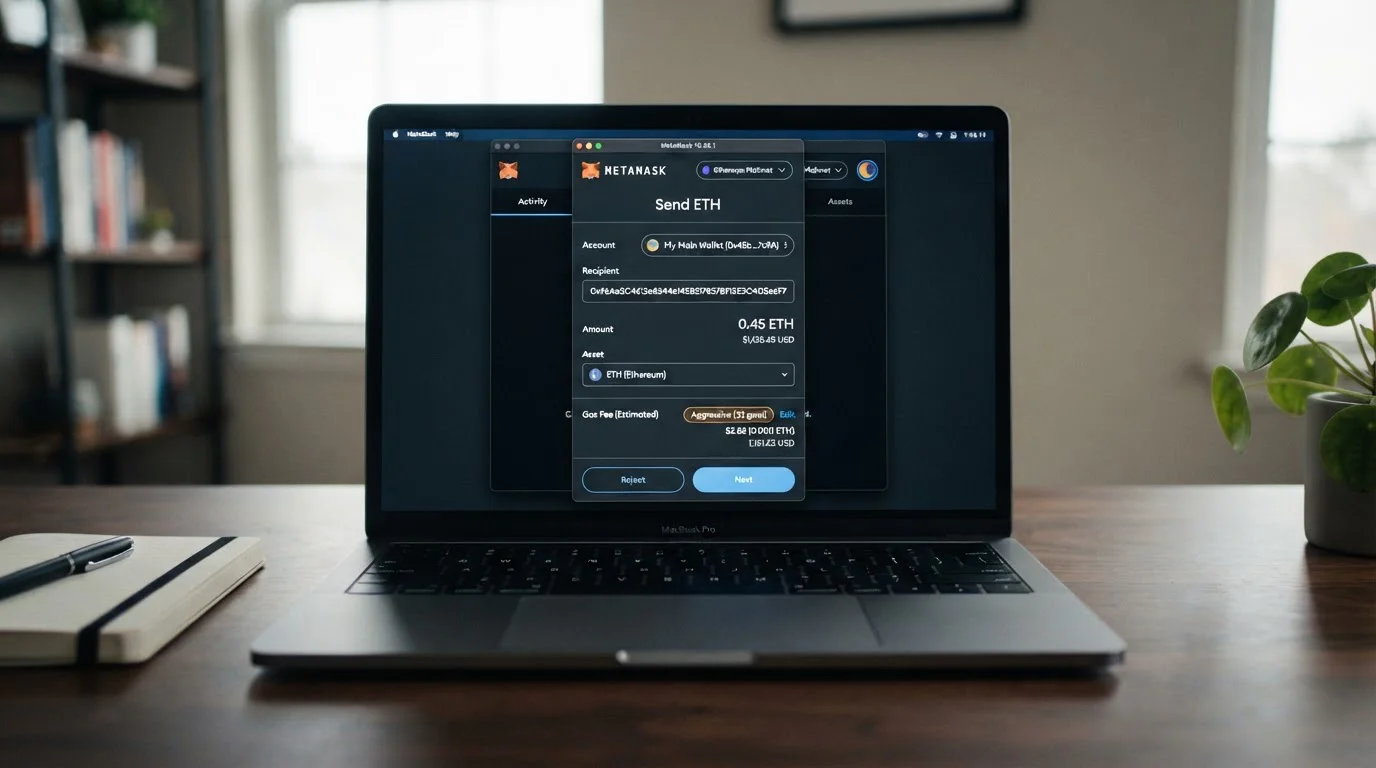
Log into the casino, open the cashier, and select Ethereum as the deposit method. The casino displays a deposit address (a long hexadecimal string starting with 0x). Copy it. Open MetaMask, click Send, paste the casino’s address into the recipient field, enter the amount in ETH, and confirm.
Double-check the address before confirming. Blockchain transactions are irreversible; if you send to the wrong address, the funds are gone. Some wallets and casinos show a QR code to reduce copy-paste errors.
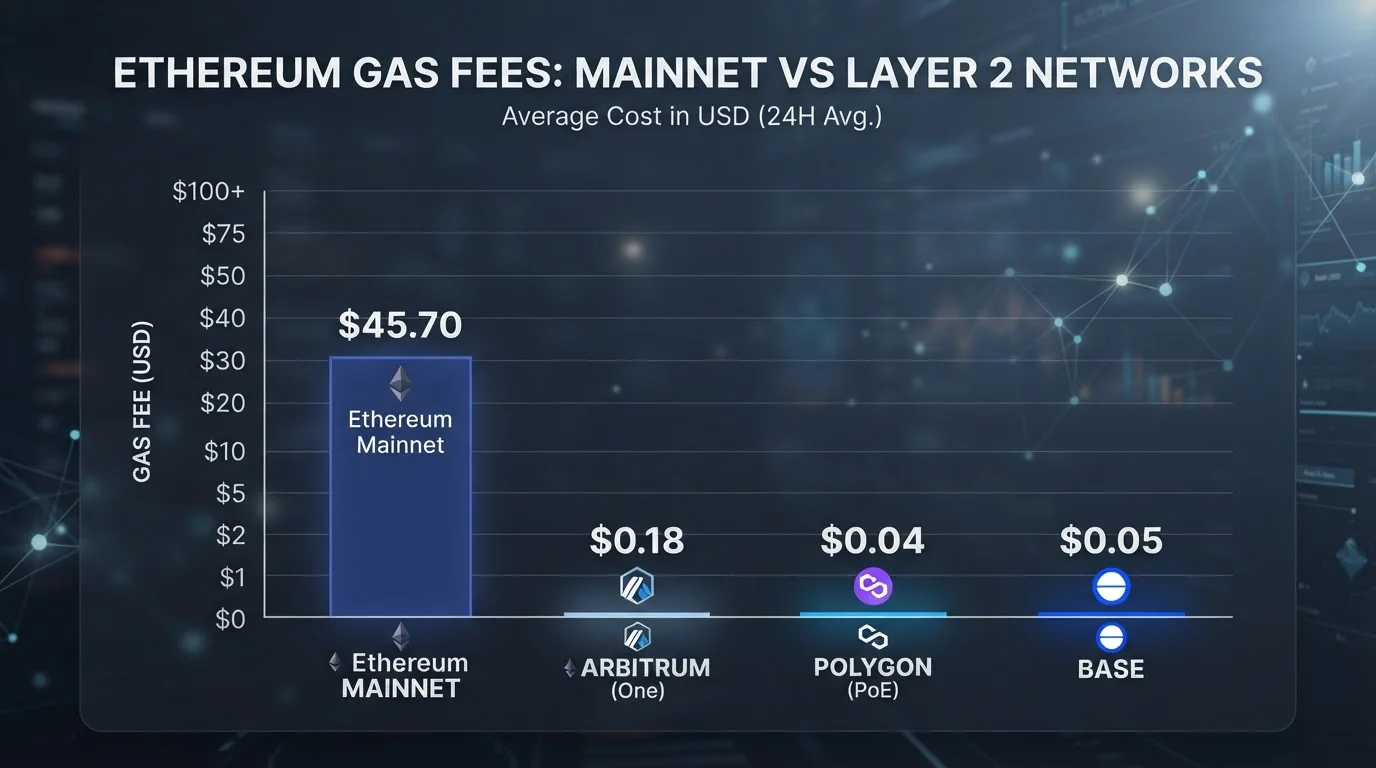
Gas fees appear as a separate line item in MetaMask before you confirm. On Ethereum mainnet post-Fusaka, a simple send costs $0.01–$0.10 during normal network congestion, $0.50–$3 during peak times (weekends, major NFT drops, DeFi liquidation cascades). Layer 2 networks like Arbitrum, Polygon, or Base reduce fees to $0.001–$0.01 — a 99% cut. If the casino supports Layer 2 deposits (check the cashier or FAQ), switch your MetaMask network to the relevant L2 before sending. A $50 deposit on mainnet might cost $0.10 in gas; the same deposit on Arbitrum costs under a cent.
Deposit confirms in 15–30 seconds on mainnet, 2–5 seconds on Layer 2. The casino credits your balance after one or two block confirmations. You’ll see the funds in your account before you’ve finished reading the terms.
How do I deposit with Ethereum at an online casino?
Copy the casino’s deposit address from the cashier, open your wallet (MetaMask or equivalent), paste the address into the Send field, enter the amount, confirm the gas fee, and send. Funds credit your casino account in 15–30 seconds on mainnet, under 5 seconds on Layer 2 networks like Arbitrum or Polygon.
Withdrawing Your Winnings in ETH
Navigate to the casino’s withdrawal section, select Ethereum, paste your wallet address, and enter the amount. The casino processes the transaction — timing varies from under 10 minutes (BitStarz auto-approval for small amounts) to 1–2 hours (manual review queue). Once the casino sends, the ETH arrives in your wallet after network confirmation (same 15–30 seconds on mainnet, 2–5 seconds on L2).
Some operators impose a minimum withdrawal (commonly $15–$300 depending on the platform; see the comparison table). Withdrawing below the minimum either fails or triggers a higher percentage fee. KYC checks fire at certain thresholds — typically $2,000–$10,000 USD equivalent per transaction, though exact triggers vary by operator and aren’t always disclosed upfront. If you hit the threshold, expect to upload photo ID and proof of address before the withdrawal processes.
Network fees for withdrawals are either covered by the casino (common for crypto-native operators) or deducted from your withdrawal amount (some hybrid platforms pass the cost through). Check the fee structure in the cashier before requesting a payout.
How long do ETH withdrawals take at crypto casinos?
Most crypto casinos process ETH withdrawals in 10 minutes to 2 hours. BitStarz reports an 8-minute median for amounts under its auto-approval threshold. BC.Game and Stake commonly clear payouts within an hour. Once the casino sends the transaction, network confirmation adds 15–30 seconds on mainnet or 2–5 seconds on Layer 2.
How do I set up a crypto wallet for casino deposits?
Install MetaMask (browser extension or mobile app), create a new wallet, and securely store the 12-word seed phrase offline. Buy ETH from an Australian exchange like Swyftx, CoinSpot, Coinbase, or Binance, then withdraw the ETH to your MetaMask address. You can now send ETH from MetaMask to any casino by copying the casino’s deposit address and pasting it into MetaMask’s Send function.
Ethereum Casino Bonuses and Promotions

Welcome bonuses at ETH casinos follow the same structure as fiat offers — match percentage on your first deposit, often split across two to four deposits, with a cap and a wagering requirement. The devil lives in the rollover terms. A 200% bonus sounds generous until you discover it carries 60x wagering on deposit plus bonus, which turns a $100 deposit into $30,000 of required turnover before you can withdraw a dollar.
The tolerance ceiling across this field sits at 40x wagering on deposit plus bonus. Anything above that is a trap designed to convert your deposit into house revenue rather than actual bonus value. Stake’s 10x wagering on select promotions is the industry floor, but it comes with tighter game weighting (table games and live dealer often excluded or contributing 5–10% instead of 100%) and stricter max-bet caps during the rollover period.
Crypto-specific boosts — where depositing in ETH adds 10–25% on top of the standard match — have become more common as operators compete for crypto traffic. JustCasino.io’s 20% daily cashback (up to $100) runs automatically without opt-in; that’s more valuable than a one-time welcome bonus if you’re a regular player, since cashback has no rollover requirement and credits as withdrawable funds.
Free spins bundled with welcome packages typically range from 50 to 500 spins tied to specific slots. Read the game list before claiming; “200 free spins” locked to a low-RTP title nobody plays is worse than 50 spins on a provider you’d choose anyway. Wagering on free-spin winnings commonly mirrors the deposit-bonus rollover (40x), and max-bet caps during wagering ($5–$10 AUD equivalent) mean you can’t shortcut the rollover by slamming high-stakes spins.
One structural wrinkle: most offshore casinos calculate wagering in USD or EUR even if your account displays AUD. A $5 max-bet cap might be enforced as $5 USD, which translates to roughly $7.50 AUD at current exchange rates. Violating the cap — even accidentally — voids the bonus and any associated winnings. Check the terms for the currency used in cap enforcement before you start spinning.
Can I claim bonuses when depositing with Ethereum?
Yes. Most operators offer the same welcome bonuses and promotions whether you deposit with ETH, BTC, or fiat. Some casinos add a crypto-specific boost (10–25% extra) when you deposit in cryptocurrency. Always check the wagering requirements — 40x or below is the tolerance ceiling; anything higher is a red flag.
Ethereum vs Other Payment Methods
ETH sits between Bitcoin and fiat on the speed-cost-privacy triangle. Faster than Bitcoin, cheaper than cards, more private than bank transfers, but not the absolute winner on any single axis.
ETH vs Bitcoin
Bitcoin transactions confirm slower (10–30 minutes for one confirmation vs. 15–30 seconds for ETH) and cost more during congestion periods. Bitcoin’s median mainnet fee in 2026 hovers around $0.50–$2.00 per transaction; Ethereum post-Fusaka lands at $0.01–$0.10 for simple sends. Layer 2 networks don’t exist for Bitcoin in the same plug-and-play form — Lightning Network requires channel management and isn’t widely supported by offshore casinos yet.
ETH’s smart-contract functionality enables provably fair games and on-chain bonus logic; Bitcoin is a payment rail, not a smart-contract platform. If you’re only moving money in and out, Bitcoin works. If you care about provably fair verification or want access to DeFi-adjacent casino features, ETH is the only viable option in this offshore field.
Bitcoin holds value more stably than ETH over multi-year periods, but for casino purposes (deposit, play, withdraw within days or weeks), the volatility difference is noise. Both can swing 5–10% in a session; if that’s unacceptable, deposit in stablecoins like USDT instead.
ETH vs Fiat (Cards and Bank Transfers)
Cards and bank transfers take 1–5 business days for withdrawals, compared to 10 minutes to 2 hours for ETH. Fiat deposits trigger gambling merchant codes that some Australian banks flag or block; ETH deposits are wallet-to-wallet transfers that bypass the banking system entirely. No chargeback risk for the casino with crypto, which is why operators process crypto payouts faster than fiat — there’s no 180-day dispute window to hedge against.
Privacy: fiat deposits leave a paper trail linking your bank account to the offshore casino. ETH deposits are pseudonymous — the blockchain records the transaction, but the wallet address isn’t tied to your identity unless you’ve KYC’d at an exchange and the casino later subpoenas the exchange for your details. Realistically, that level of investigation doesn’t happen for recreational gambling; the practical privacy gain is that your bank statement won’t show “CRYPTO CASINO CURACAO” next to the transaction.
Fees: card deposits often carry 2–5% processing fees on the casino side (passed through as lower effective bonus value or withdrawal caps). Bank transfers in Australia can incur $10–$25 international wire fees depending on your bank. ETH mainnet costs $0.01–$0.10 per transaction; Layer 2 costs fractions of a cent. For punters depositing $50–$200 at a time, a $0.05 gas fee vs. a 3% card fee ($1.50–$6.00) is a meaningful difference.
Is Ethereum better than Bitcoin for online gambling?
Ethereum is faster (15–30 seconds vs. 10–30 minutes) and cheaper ($0.01–$0.10 vs. $0.50–$2.00 per transaction) than Bitcoin for casino deposits and withdrawals in 2026. ETH also supports provably fair games via smart contracts, which Bitcoin’s payment-only architecture doesn’t enable. Bitcoin holds value more stably long-term, but for short-term casino use, ETH’s speed and cost advantages outweigh volatility concerns.
What are gas fees and how much do they cost for casino deposits?
Gas fees are the cost of processing a transaction on the Ethereum network, paid to validators. On Ethereum mainnet post-Fusaka, a simple send costs $0.01–$0.10 during normal congestion, $0.50–$3 during peak times. Layer 2 networks like Arbitrum, Polygon, or Base cut fees by 99%, reducing costs to $0.001–$0.01 per transaction. A $50 deposit on mainnet costs roughly $0.05–$0.20 in gas; the same deposit on Arbitrum costs under $0.01.
What’s the difference between mainnet ETH and Layer 2 deposits?
Mainnet ETH transactions run on the Ethereum base layer and confirm in 15–30 seconds with fees of $0.01–$0.10. Layer 2 networks (Arbitrum, Polygon, Base) are scaling solutions built on top of Ethereum that bundle transactions for cheaper, faster processing — 2–5 second confirmations and fees under $0.01. Not all casinos support Layer 2 deposits; check the cashier to see which networks the operator accepts before sending.
Game Selection at Ethereum Casinos
Offshore ETH casinos run the same provider catalogues as fiat operators: NetEnt, Pragmatic Play, Evolution Gaming, Play’n GO. The game libraries in this guide range from 3,500 (Rolletto) to 16,500 (JustCasino.io), though counts inflate when operators list every slot variant separately. Stake’s 6,000+ titles and BitStarz’s 4,000+ offer genuine variety without the accounting tricks.
Pokies and Slots
Pokies dominate the lobbies. Megaways, cluster pays, cascading reels, bonus-buy features — the mechanics catalogue in 2026 mirrors what you’d find at any international operator. Pragmatic Play’s Gates of Olympus, NetEnt’s Starburst, and Big Time Gaming’s Bonanza sit alongside thousands of lesser-known titles. RTP figures aren’t always disclosed per game, and offshore operators aren’t required to publish them the way MGA or UKGC licensees are.
Crypto casinos sometimes offer “crypto-exclusive” slots from smaller studios that don’t distribute through traditional fiat channels. Quality varies; some are reskinned clones of proven mechanics, others are genuinely innovative but untested for RTP honesty. Provably fair slots (where you can verify the RNG via seed hashing) remain niche; most pokies at ETH casinos run the same server-side RNG as fiat platforms, with the operator publishing a third-party audit report from a lab like eCOGRA or iTech Labs.
Live Dealer Games
Evolution Gaming and Pragmatic Live supply the majority of live dealer tables at these operators. Blackjack, roulette, baccarat, and game-show variants (Crazy Time, Monopoly Live) run identically to fiat casinos. The main difference: crypto-native operators like BC.Game and Stake sometimes offer crypto-specific tables where betting limits are denominated in BTC or ETH rather than fiat.
Live dealer games typically contribute 5–10% toward bonus wagering compared to 100% for slots. If you’re clearing a welcome bonus, expect the bulk of your rollover to come from pokies rather than blackjack or roulette.
Provably Fair Games
BC.Game’s 50 BC Originals and Stake’s 24 Stake Originals are proprietary titles built on provably fair logic. You can verify each round’s RNG by checking the server seed (revealed after the round), the client seed (you provide), and the resulting hash. If the hash doesn’t match the outcome, the game was rigged.
Provably fair games include dice, crash, plinko, mines, and simplified slot variants. They’re faster than traditional slots (no animations or bonus rounds), and the transparency appeals to punters who’ve been burned by black-box RNG at shadier operators. The tradeoff: most provably fair games lack the production polish and feature depth of studio-developed slots. You’re playing for verifiable fairness, not cinematic graphics.
Legal Status and Licensing for Australian Players
No online casino — crypto or fiat — holds an Australian licence for real-money play. The Interactive Gambling Act 2001 makes it illegal for operators to supply online casino services to Australian residents, but the Act targets operators, not players. No Australian has been prosecuted for playing at an offshore casino, and there’s no criminal offence on the books for doing so.
The Interactive Gambling Act and Offshore Casinos
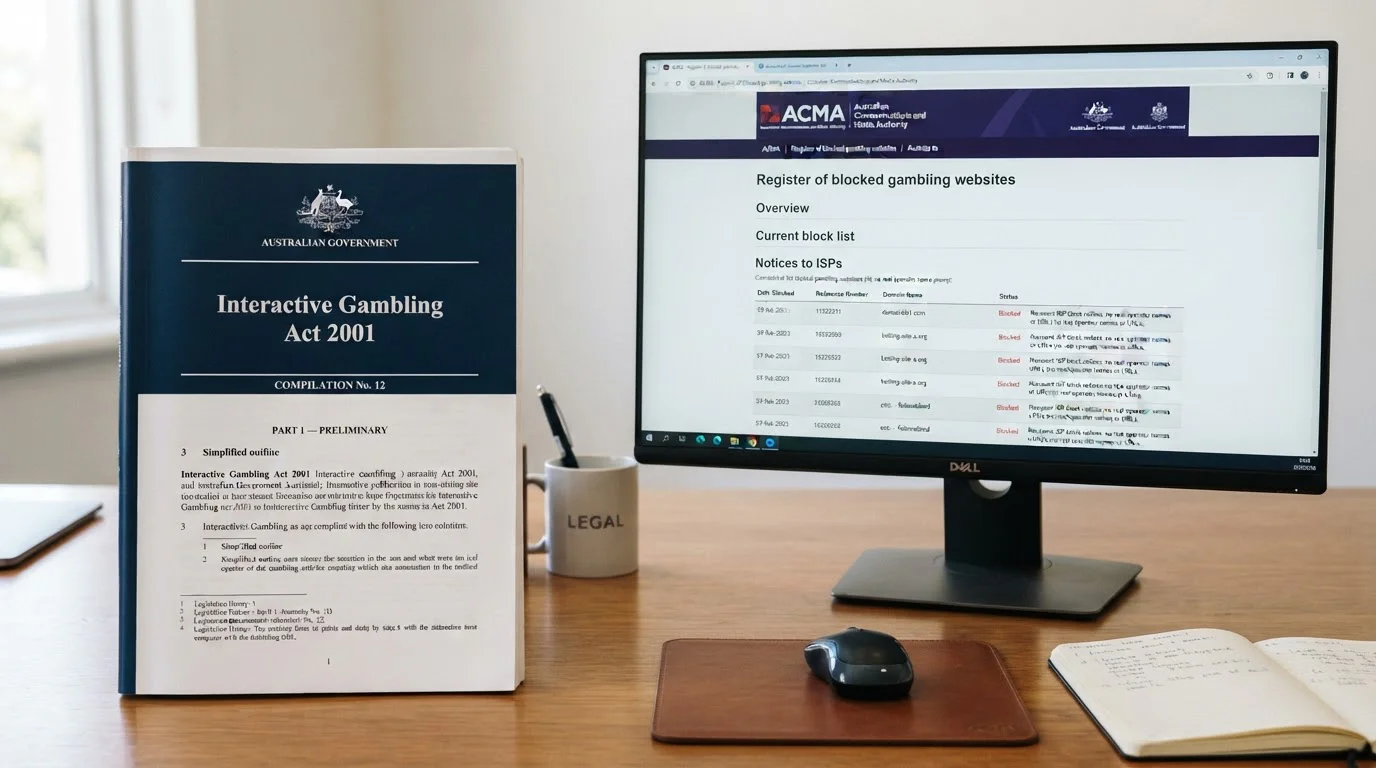
The IGA prohibits the provision of “interactive gambling services” (online casino games, online poker, in-play sports betting) to people in Australia. Operators caught serving Australians face penalties, domain seizures, and payment-processor blocks. The Act explicitly does not criminalize the player. You won’t be fined or charged for depositing ETH at a Curacao-licensed casino.
ACMA (Australian Communications and Media Authority) enforces the IGA by issuing ISP-level blocks on offshore casino domains. If you try to visit a blocked domain, you’ll hit a landing page saying the site is restricted under the IGA. The blocks are DNS-based and trivially circumventable via VPN, alternative DNS servers, or mirror domains. ACMA issues the blocks; actually accessing a blocked site isn’t a criminal act. The regulatory mechanism targets supply disruption, not player behaviour.
The practical legal position: offshore casinos operate in a regulatory grey area where the operator’s conduct is illegal under Australian law, but the player’s participation is not. The risk you carry is financial, not criminal. If an offshore operator folds without paying out, you have no recourse through Australian courts or consumer-protection agencies. Curacao arbitration exists in theory; enforcement in practice is a coin flip.
Curacao Licensing Explained
Curacao is the dominant offshore jurisdiction for crypto casinos. The regulatory framework underwent a major overhaul in December 2024, moving from a fragmented sub-licence model (where “master licence” holders sublicensed to hundreds of operators) to direct B2C licensing under a single Curacao Gaming Authority (CGA). Every operator now holds a licence directly from the CGA rather than leasing a sublicense from an intermediary.
On June 24, 2026, the CGA issued a directive requiring all crypto-accepting licensees to disclose cold-wallet and hot-wallet addresses publicly, implement enhanced AML transaction monitoring, and maintain detailed records of player wallet interactions. The rejection rate for new crypto casino licence applications hit 38% in 2026, up from roughly 15% under the old sub-licence regime. The reform tightened standards; whether enforcement follows through consistently remains to be seen over the next 12–24 months.
A Curacao licence means the operator has met baseline AML/KYC requirements, submitted financial guarantees, and committed to dispute-resolution procedures. It doesn’t mean you’re protected the way an MGA or UKGC licence would protect EU or UK players. Curacao’s enforcement track record is lighter, and arbitration outcomes skew toward operators. The licence is better than no licence; it’s not a substitute for domestic regulation.
Are Ethereum casinos legal for Australian players?
It’s not illegal for Australians to play at offshore Ethereum casinos. The Interactive Gambling Act 2001 criminalizes operators supplying online casino services to Australian residents, not players using those services. No Australian has been prosecuted for playing at an offshore casino. ACMA blocks some offshore domains at the ISP level, but accessing a blocked site isn’t a criminal offence — the blocks are administrative, not criminal law enforcement. Your risk is financial (no consumer protection if the operator folds) rather than legal.
How to Verify a Casino Licence
Every Curacao-licensed operator displays a clickable licence seal, usually in the footer. Click it. A legitimate seal links to a validation page on the CGA’s official register showing the operator’s name, licence number, and issue date. If the seal is a static image with no link, or the link leads to a generic landing page without operator details, it’s fake.
Cross-check the operator name on the licence seal against the name in the casino’s terms and conditions. Mismatches (seal shows Company A, T&Cs name Company B) indicate the operator is displaying someone else’s licence — a red flag. Check the issue date: licences issued pre-December 2024 are old sub-licences that should have been converted to CGA direct licences by now. If an operator is still showing a 2022 sublicense seal in 2026, they’re either non-compliant or haven’t updated their footer; either way, it’s worth questioning.
Anjouan licences (BC.Game) function similarly but with lighter regulatory oversight. Anjouan doesn’t publish a public licence register, so verification relies on the operator’s transparency. BC.Game publishes blockchain wallet addresses and provably fair seed tools, which offer more verifiable trust signals than a static licence seal.
Do I need to verify my identity (KYC) to play with Ethereum?
Most ETH casinos allow deposits and small withdrawals without KYC. Verification triggers at higher withdrawal thresholds — commonly $2,000–$10,000 USD equivalent, though exact figures vary by operator and aren’t always disclosed upfront. When KYC fires, expect to upload photo ID (passport or driver’s licence) and proof of address (utility bill or bank statement). Processing time adds 24–72 hours to your withdrawal.
Privacy and Security: KYC and No-KYC Options
Crypto casinos market themselves as “anonymous,” but the reality is conditional. Small deposits and withdrawals fly under the radar; anything above $2,000–$10,000 USD equivalent per transaction commonly triggers KYC. The threshold varies by operator, and most don’t publish the exact figure upfront — you find out when your withdrawal gets flagged.
BC.Game and Stake are crypto-native platforms that allow play without KYC for amounts below their internal trigger. BitStarz and Neospin, as hybrid fiat/crypto operators, impose KYC more aggressively since they’re integrated with traditional payment processors that demand identity verification under AML regulations. If anonymity is non-negotiable, stick to the crypto-only platforms and keep individual withdrawals under $2,000 USD equivalent.
Blockchain transactions are pseudonymous, not anonymous. Your wallet address is visible on-chain; if you’ve KYC’d at an Australian exchange (Swyftx, CoinSpot, Coinbase) to buy the ETH, those exchanges hold the link between your wallet address and your identity. The casino sees your wallet address, not your name — unless they later request KYC and you comply, or unless a regulator subpoenas the exchange for your details. For recreational gambling, that level of scrutiny doesn’t materialize. The practical privacy gain is that your bank and payment processors don’t see “OFFSHORE CASINO” on your statement.
Two-factor authentication (2FA) on your casino account is non-negotiable. Use an authenticator app (Google Authenticator, Authy), not SMS. Offshore operators aren’t required to reimburse account takeovers the way domestic banks are; if someone drains your balance, you’re relying on the operator’s goodwill rather than consumer-protection law.
Mobile Ethereum Gambling
Every operator in this guide runs on mobile browsers. Native apps are rare in the offshore crypto-casino space — Apple’s App Store and Google’s Play Store both prohibit real-money gambling apps that aren’t licensed in the user’s jurisdiction, and none of these platforms meet that bar for Australia. You’ll access the casino through Safari, Chrome, or Firefox on your phone, not through a standalone app.
MetaMask has mobile apps for iOS and Android that handle wallet functions identically to the desktop browser extension. You can deposit and withdraw from your phone as easily as from a laptop. Some casinos build “progressive web apps” that you can add to your home screen for app-like navigation, but the underlying tech is still a mobile web page.
Touch-optimized interfaces, real-time push notifications for withdrawals, and deposit flows built for mobile are standard across Stake, BC.Game, and BitStarz. Smaller operators sometimes lag on mobile UX — buttons sized for desktop cursors, tables that don’t reflow for narrow screens. Test the cashier and a few games on your phone before committing a large deposit if mobile is your primary device.
Responsible Gambling with Crypto
Volatility cuts both ways. ETH can swing 10% in a session, which means a $500 deposit might be worth $450 or $550 by the time you withdraw, independent of your gambling results. If you’re depositing crypto you can’t afford to lose — whether to price swings or to the house edge — you’re layering two forms of risk on top of each other.
Stake offers player-set loss limits, wager limits, and deposit limits alongside time-based session controls. Most other operators in this field provide basic self-exclusion (temporary or permanent account closure) but lack granular limit-setting tools. If you’re relying on the operator to enforce your gambling boundaries, check what controls actually exist before depositing. “Responsible gambling” as a footer link leading to a static page of hotline numbers isn’t the same as built-in deposit caps that block transactions when you hit your limit.
Crypto’s speed is a double-edged feature. Instant deposits remove the cooling-off period that a 1–3 day bank transfer imposes; if you’re chasing losses, ETH lets you reload your account in 30 seconds rather than waiting overnight. The friction of slower payment rails sometimes functions as accidental harm reduction. Removing that friction requires compensating with intentional self-control.
Australian support resources: Gambling Help Online (1800 858 858, gamblinghelponline.org.au) offers 24/7 phone and webchat counseling. If offshore gambling is becoming a problem, self-exclusion through the casino is a starting point, but it’s not enforceable across operators the way a domestic self-exclusion register would be. Blocking access at the financial level — removing your crypto wallet from your phone, deleting exchange accounts — is more effective than relying on willpower and site-level bans.
Crypto Casinos Australia 2026 — Bitcoin, Ethereum, Tether, Solana
Content created by the «Bankroll» team