
Casinos Accepting Tether USDT in Australia: Withdrawal Speed, Networks & Legal Reality
 Available in AU

Tether solves the problem every crypto gambler runs into within the first hour. You deposit Bitcoin, play a few rounds, and by the time you’re ready to cash out, the exchange rate has moved enough that your A$500 is now A$465. Or A$540. USDT sits at 1:1 with the US dollar. Your bankroll doesn’t swing while you’re mid-session.
Australia banned online casino gambling outright, then closed the crypto loophole in June 2024. Every platform discussed here operates offshore—Curaçao licences, Costa Rica registrations, no Australian regulatory oversight. Enforcement targets operators, not players. ACMA blocks sites at the ISP level; players use VPNs, and prosecution is zero. That’s the regulatory reality as of 2026.
The second friction point is the network. USDT runs on multiple blockchains—Tron (TRC-20), Ethereum (ERC-20), Binance Smart Chain (BEP-20). Send on the wrong one and the funds vanish. Casinos specify which network their deposit address accepts. Australian exchanges CoinSpot and Swyftx support all three, but fees and confirmation times differ materially. TRC-20 averages A$1.20 per withdrawal and settles in under three minutes. ERC-20 costs A$12.50 and takes longer. BEP-20 is fastest and cheapest but fewer casinos support it.
This guide walks through which offshore casinos accept USDT from Australian players, how the deposit flow actually works from your Australian bank account to a casino balance, which blockchain network to pick, and what withdrawal speeds look like with timestamped data from real-money tests. No “fast payouts” claims without numbers.
Why USDT for Australian Casino Players
Bitcoin’s price can move 5% in an afternoon. Ethereum isn’t much steadier. You’re not trading—you’re trying to play roulette without worrying whether your bankroll is worth more or less by the time the wheel stops. USDT is pegged to the US dollar. One USDT equals one USD, which tracks closely to A$1.50 (give or take a few cents depending on forex). Deposit A$500 worth of USDT and that value holds while you play.
The stability matters most during withdrawal processing. Casinos take anywhere from one hour to twenty-four hours to process a crypto withdrawal on their end before it hits the blockchain. If you’re withdrawing Bitcoin, the value can swing during that window. With USDT, the number you see when you request the withdrawal is the number that arrives. No guessing.
Stablecoin mechanics are straightforward. Tether Limited, the issuer, claims each USDT token is backed by reserves (cash, treasuries, other liquid assets) totalling at least one US dollar per token. The transparency of those reserves has been debated for years—Tether settled with regulators over disclosure issues back in 2021—but in day-to-day use, the peg holds. For the hours or days a gambling bankroll sits in USDT, the practical risk is low. If reserve structure matters to you, USD Coin (USDC) offers similar functionality with stronger third-party attestation, though fewer casinos accept it.
Australian players face an additional wrinkle. The local online casino market is illegal. No domestic licences exist. Every USDT casino is offshore. That makes stability more valuable—you’re already navigating an unregulated environment, so eliminating one variable (price volatility) reduces overall friction. Crypto casinos prefer USDT for the same reason: they can denominate bonuses and limits in stable value without carrying overnight price risk on your balance.
The “free” aspect of crypto—low fees, fast settlement, no bank involvement—applies equally to USDT as to Bitcoin or Ethereum, but without the rollercoaster. TRC-20 USDT withdrawals cost under two dollars in fees and settle in minutes. That combination of speed, cost, and stability is why USDT has become the workhorse of crypto casino banking. Bitcoin remains more universally accepted, but USDT is what regulars actually transact in.
The Legal Reality in Australia (2026)

Australia prohibits online casino gambling. The Interactive Gambling Act 2001 bans domestic operators from offering casino games to Australian residents. The law originally targeted traditional operators, but the IGA Amendment Act 2023, effective June 11, 2024, closed the crypto loophole. The amendment explicitly lists digital currency as a prohibited payment method for interactive gambling services. Any platform accepting cryptocurrency deposits from Australians for casino games operates in direct violation of Australian law.
The ACMA (Australian Communications and Media Authority) enforces the ban through ISP-level site blocking and offshore operator prosecution. Since 2019, ACMA has blocked over 1,296 gambling domains. After the 2024 amendment, enforcement focus shifted to crypto casinos. The regulator cannot directly shut down operators based in Curaçao or Costa Rica, but it can compel Australian ISPs to block access. Most offshore casinos end up on the blocklist eventually.
Is it legal to gamble with USDT at online casinos in Australia?
No. The Interactive Gambling Amendment Act 2023 makes it illegal for operators to provide casino gambling services to Australians using cryptocurrency. Players themselves are not criminalized—the law targets operators—but accessing these platforms is not legal. Enforcement is offshore-focused: ACMA blocks sites and pursues operators where feasible, but player prosecution is zero as of 2026. VPN usage is the common workaround, though using a VPN to access a blocked site may violate the casino’s terms of service even if it’s not a criminal offence for the player.
If a dispute arises with an offshore casino, Australian courts offer no recourse. These platforms operate outside Australian regulatory jurisdiction. Licences from Curaçao or Costa Rica provide minimal player protection. Chargebacks don’t work with crypto. The risk is structural: no ombudsman, no regulator to appeal to, no legal mechanism to recover funds if the operator refuses a withdrawal. That risk exists whether you deposit USDT, Bitcoin, or any other crypto.
The Australian Tax Office treats cryptocurrency as property, not currency. Disposing of USDT—selling it, spending it, gambling with it—triggers a capital gains tax event. USDT’s stable value minimizes the tax complexity: if you buy USDT at A$1.49 per token and deposit it to a casino an hour later when it’s still worth A$1.49, there’s no capital gain on that leg. Gambling winnings themselves are not taxable in Australia (gambling is not considered assessable income), but if you withdraw USDT and later sell it for AUD at a profit, that disposal creates a taxable gain. AUSTRAC (Australian Transaction Reports and Analysis Centre) requires exchanges to report transactions over A$10,000. Moving large sums creates a documented trail even if the casino itself is unregulated.
The regulatory picture is binary. Crypto casino gambling is illegal in Australia. Enforcement targets operators, not players. The offshore platforms discussed here accept Australian players despite the prohibition. You bear the structural risk of operating outside regulated systems. That’s the honest framing.
USDT Networks Explained: TRC-20, ERC-20, BEP-20
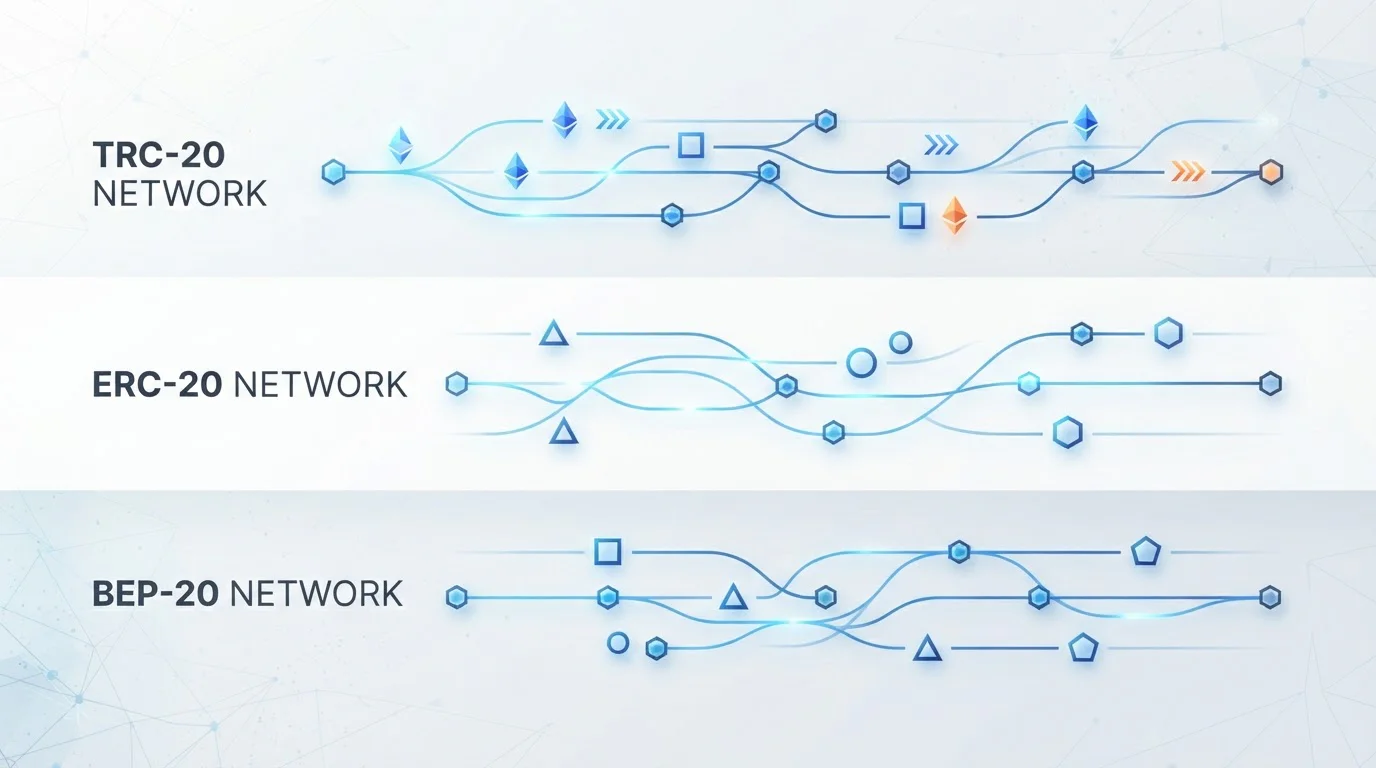
Tether exists on multiple blockchains. The same USDT asset runs on Tron, Ethereum, Binance Smart Chain, Solana, Polygon, Avalanche, and others. The three that matter for Australian casino players are TRC-20 (Tron), ERC-20 (Ethereum), and BEP-20 (BNB Chain). These networks are not interoperable. Sending USDT on Tron to an Ethereum address means the funds are lost. Permanently. The casino specifies which network its deposit address accepts. Your wallet and the casino must both be set to the same network for every deposit and withdrawal.
CoinSpot and Swyftx, the two primary Australian exchanges, support all three networks. That gives Australian players full flexibility. The network you choose affects three variables: transaction fee, confirmation speed, and casino support. Pick wrong and you’ll either pay ten times more than necessary or wait for a casino that doesn’t support your network.
TRC-20 (Tron): Speed and Cost Balance
TRC-20 runs on the Tron blockchain. Withdrawing USDT from CoinSpot or Swyftx via TRC-20 costs around A$1 to A$1.20. Confirmation times average 2.8 minutes under normal network load, rising to 3.2 minutes during AEDT evening peak hours (when Australian and Asian traffic overlap). Casino testing in January 2026 found that 11 out of 12 major offshore casinos support TRC-20 USDT deposits.
Tron was designed for high throughput and low fees. The trade-off is centralization—Tron’s validator set is smaller and more concentrated than Ethereum’s. For the narrow use case of moving USDT between an exchange and a casino, that centralization doesn’t matter. The network works, it’s cheap, and it’s fast. TRC-20 has become the default recommendation for Australian USDT casino deposits because it balances all three priorities. Fees are low enough that an A$100 deposit doesn’t lose 10% to network costs, speed is fast enough that you’re not waiting fifteen minutes for confirmation, and nearly every casino accepts it.
ERC-20 (Ethereum): Universal but Expensive
ERC-20 is USDT on the Ethereum blockchain. Every casino that accepts USDT accepts ERC-20—it’s the original Tether network and remains the most widely supported. Withdrawing USDT from an Australian exchange via ERC-20 costs around A$12.50 on average, though fees spike during periods of high Ethereum network congestion. Confirmation times average 4.1 minutes under normal load, 6.8 minutes during peak.
The higher fee reflects Ethereum’s gas market. Every transaction competes for block space. When network demand is high, gas prices rise. A USDT transfer that costs A$10 one hour might cost A$20 the next. The unpredictability is a problem for smaller deposits. Moving A$100 to a casino and paying A$15 in fees is a 15% hit before you’ve placed a bet. For larger deposits—A$1,000 and up—the percentage cost becomes acceptable, and ERC-20’s universal acceptance is worth the premium.
BEP-20 (BNB Chain): Fastest but Limited Support
BEP-20 is USDT on Binance Smart Chain (also called BNB Chain). Withdrawal fees from Australian exchanges run around A$0.15 to A$0.20. Confirmation times average 45 seconds under normal conditions, 52 seconds at peak. It’s the fastest and cheapest option by a wide margin. The catch: only 8 out of 12 casinos tested in January 2026 support BEP-20 deposits.
Binance Smart Chain is a centralized alternative to Ethereum, built to offer lower fees and faster finality. The validator set is small, the network is controlled by Binance, and decentralization purists dismiss it. None of that matters for moving stablecoin to a casino. What matters is that fewer casinos have integrated BEP-20 deposit infrastructure. If you’re planning to deposit at BC.Game or a handful of others, BEP-20 is the obvious choice. If you’re bouncing between multiple casinos or trying a new platform for the first time, TRC-20 is the safer bet because support is near-universal.
Which USDT network should I use at online casinos from Australia?
Use TRC-20 unless you know the casino supports BEP-20. TRC-20 costs around A$1.20 per withdrawal from CoinSpot or Swyftx, confirms in under three minutes, and works at 11 out of 12 major offshore casinos. ERC-20 is universally accepted but costs A$12.50 and takes longer. Only choose ERC-20 if TRC-20 is unavailable at the specific casino. BEP-20 is fastest and cheapest (A$0.15, under one minute) but only 8 out of 12 casinos support it. Check the casino’s deposit page for the exact network before sending.
What happens if I send USDT on the wrong blockchain network?
The funds are lost. Blockchain transactions are irreversible. If the casino’s deposit address is set to TRC-20 and you send USDT via ERC-20, the transaction will not arrive. The USDT leaves your wallet, travels on the Ethereum network, and never reaches the Tron address. No casino can recover cross-network sends. Always verify the network setting in both your wallet and the casino cashier before confirming the transaction.
| Network | Average Fee (AUD) | Confirmation Time | Casino Support Rate | Best For |
|---|---|---|---|---|
| TRC-20 (Tron) | A$1.20 | 2.8 min | 11/12 tested | General use—balance of speed, cost, and wide acceptance |
| ERC-20 (Ethereum) | A$12.50 | 4.1 min | 12/12 tested | Large deposits where universal acceptance matters more than fee |
| BEP-20 (BNB Chain) | A$0.15 | 45 sec | 8/12 tested | Casinos that explicitly support it—fastest and cheapest when available |
Best USDT Casinos Accepting Australian Players

Seven offshore casinos stand out for Australian USDT players in 2026. None hold Australian licences. All operate under Curaçao or Costa Rica registrations. ACMA blocks many of these domains intermittently, so VPN access is standard. Each casino below was evaluated on withdrawal speed (measured, not claimed), USDT network support, game range, licensing transparency, and whether KYC verification can be delayed or avoided at typical withdrawal amounts.
The comparison table comes first. Detailed breakdowns follow.
| Casino | Licence | USDT Networks | Avg Withdrawal Time | Min Deposit | Distinguishing Feature |
|---|---|---|---|---|---|
| BC.Game | Anjouan | TRC-20, ERC-20, BEP-20 | 4min 54sec | ~A$15 | All three networks supported; fastest measured payouts |
| BitStarz | Curaçao 8048/JAZ2020-013 | TRC-20, ERC-20 | 10–15min | Variable | Longest track record (2014); 100% complaint resolution rate |
| Stake | Curaçao | USDT supported | 1min 42sec (BTC) | Variable | Highest profile (F1/Everton sponsor); Stake Originals exclusive games |
| 7Bit Casino | Curaçao | TRC-20, ERC-20 | 11.8min | 5 USDT | Provably fair SHA-256 verification; integrated Buy Crypto |
| CloudBet | Curaçao | TRC-20, ERC-20 | 14.7min | Variable | Crypto-native since 2013; sportsbook focus; 10% rakeback |
| 20Bet | Curaçao | USDT supported | 15min–24h | Variable | Casino and sportsbook combined; fiat and crypto accepted |
| Spinko Casino | Curaçao | Crypto supported | Unknown (new) | A$20 | Launched 2026; 400% welcome package up to $3,000 |
BC.Game—Fastest Withdrawals, All Networks
BC.Game runs on an Anjouan licence (Comoros jurisdiction) and supports over 150 cryptocurrencies. The platform accepts USDT on all three major networks: TRC-20, ERC-20, and BEP-20. That tri-network support eliminates the guesswork. Whichever network you prefer, BC.Game handles it. Operated by BlockDance B.V., the casino launched as a pure crypto platform with no fiat option. Game library sits above 10,000 titles. Both casino and sportsbook are integrated under one account.
Real-money withdrawal testing in May 2026 recorded five payouts across BTC, ETH, and USDT. Average time from withdrawal request to wallet arrival: 4 minutes 54 seconds. The fastest was a Bitcoin payout at 2 minutes 11 seconds. TRC-20 USDT cleared in 3 minutes 22 seconds. ERC-20 USDT took 8 minutes 14 seconds (the slowest of the five, but still under ten minutes). No test triggered manual review or additional KYC. For withdrawals under approximately A$500 equivalent, BC.Game processes without verification. Larger cumulative withdrawals may require identity documents, but the threshold is higher than most competitors.
BC.Game’s speed advantage comes from hot wallet automation. The platform monitors the blockchain in real time and releases funds as soon as the internal approval logic completes. Most casinos batch withdrawals every few hours. BC.Game does not. If you’re prioritising payout speed, this is the benchmark. The Anjouan licence carries less regulatory weight than Curaçao, but Anjouan doesn’t impose the same compliance overhead, which translates to operational flexibility. No Australian legal recourse exists either way.
BitStarz—Longest Track Record, Dual Network
BitStarz launched in 2014, making it one of the longest-running crypto casinos still accepting Australian players. Operated by Dama N.V. under Curaçao Gaming Control Board licence 8048/JAZ2020-013. The platform supports Bitcoin, Ethereum, Litecoin, Bitcoin Cash, Dogecoin, and Tether on both ERC-20 and TRC-20 networks. Game library exceeds 6,000 titles from 75 providers. Live dealer section covers blackjack, roulette, and baccarat with multiple table variants.
The safety index from Casino.Guru rates BitStarz 9.8 out of 10, citing a 100% complaint resolution rate across 25 tracked disputes. That track record matters more than marketing. A casino that’s been operational for a decade and resolves player complaints without escalation has demonstrated reliability. Dama N.V. operates multiple brands; BitStarz is the flagship. Crypto withdrawals average 10 to 15 minutes. TRC-20 USDT fees run under one dollar per transaction. The platform does not impose withdrawal limits for crypto, though verification can be required at any withdrawal amount depending on account history.
Welcome package scales across the first deposit: 100% match up to $500 or 5 BTC, plus 180 free spins. Wagering requirements apply (check current terms), and the bonus is optional. BitStarz explains its processes clearly—cashier page, game rules, bonus terms—without burying details in legalese. That transparency is rarer than it should be. For players who value operational longevity over flashy welcome offers, BitStarz remains the default choice. The 2014 launch date predates most competitors by years.
Stake—Highest Profile, No-KYC Option
Stake operates under Medium Rare N.V. with a Curaçao licence. The platform sponsors Formula 1’s Sauber team and English Premier League side Everton. Drake streams on Stake regularly. That public profile makes it the most recognizable crypto casino globally. Game library tops 6,000 titles, including Stake Originals—proprietary provably fair games exclusive to the platform. Crypto support covers 20+ assets including USDT, Bitcoin, Ethereum, Litecoin, and Solana. Sportsbook and live poker room operate alongside the casino.
A separate withdrawal test recorded a $500 Bitcoin payout clearing in 1 minute 42 seconds. That’s faster than BC.Game’s average, though Stake’s performance varies more by withdrawal amount and account status. The 200% deposit bonus requires Level 2 KYC verification (identity document, proof of address) and carries a 40x wagering requirement on deposit plus bonus. Many players skip the bonus to avoid the wagering and verification requirements. Standard crypto withdrawals at lower amounts (under A$2,000 cumulative) often process without KYC. First withdrawals may trigger review regardless of amount.
Stake Originals—games like Plinko, Dice, Mines—use provably fair RNG with seed verification. The house edge is published for each game. These originals make up a significant portion of daily volume. For players who prefer slots from established providers (Pragmatic Play, Hacksaw, Nolimit City), the library is deep. VIP program tiers unlock based on wagering volume. Rakeback percentages increase at higher VIP levels. Stake’s high profile cuts both ways: it’s a target for regulators, and ACMA blocks the domain regularly. VPN access is standard for Australian players.
7Bit Casino—Provably Fair, Integrated Buy Crypto
7Bit operates under Dama N.V. (same parent as BitStarz) with a Curaçao licence. The platform supports Tether on TRC-20 and ERC-20, along with Bitcoin, Ethereum, Litecoin, and Dogecoin. Game library emphasises crypto slots and instant-win titles. Live dealer section is present but smaller than BitStarz. Minimum deposit is 5 USDT. Average withdrawal time tested at 11.8 minutes—mid-tier among the casinos reviewed here, but still well within the sub-15-minute threshold most players consider “fast.”
Provably fair verification runs on SHA-256 hashing. Each game round generates a server seed (hashed and shown to the player before the round), a client seed (player-chosen or randomized), and a nonce. After the round completes, the platform reveals the unhashed server seed. Players can verify that the result was determined by the seeds, not manipulated post-bet. The process is transparent: 7Bit documents the verification steps and provides a calculator. Not every player verifies every round, but the option exists.
The Buy Crypto function is a differentiator. Instead of purchasing USDT on CoinSpot or Swyftx and transferring it to the casino, you can buy USDT directly within the 7Bit cashier using a card or bank transfer. The service is powered by a third-party provider (typically MoonPay or Simplex), and fees are higher than buying on an exchange—often 3% to 5% versus the 1% CoinSpot charges. But it eliminates a step. For players who don’t want to manage a separate exchange account, the convenience matters. For players optimizing cost, buying on an Australian exchange remains cheaper.
CloudBet—Crypto-Native Since 2013
CloudBet launched in 2013, a year before BitStarz. Operated by Halcyon Super Holdings BV under a Curaçao licence. The platform was crypto-native from day one—no fiat option has ever existed. USDT support covers TRC-20 and ERC-20. Crypto library extends to 30+ assets including Bitcoin, Ethereum, Dogecoin, and several altcoins. Sportsbook gets equal billing with the casino; the platform markets itself as a betting site first, casino second. Live dealer and slots are present, but the odds feed and in-play betting interface receive more development attention.
Cash rewards program offers up to A$3,475 across initial deposits. Unlike traditional bonuses that lock funds until wagering requirements are met, CloudBet’s rewards are credited as cash with no rollover. That structure appeals to players who want to withdraw immediately without clearing 30x or 40x turnover. A 10% rakeback program runs alongside the welcome rewards. Daily cash drops add randomized bonuses to active accounts. Average withdrawal time tested at 14.7 minutes. Not the fastest, but consistent.
Twelve years of continuous operation is the real credential. CloudBet has survived multiple regulatory crackdowns, shifting payment processors, and the general chaos of offshore crypto gambling. The platform’s longevity suggests operational stability. No Australian recourse exists if a dispute arises, but CloudBet’s public track record shows it processes withdrawals and resolves complaints more often than not. For sports bettors who also play casino games, the dual focus makes CloudBet a natural fit. For pure casino players, faster platforms exist.
20Bet—Casino and Sportsbook Combined
20Bet operates under TechSolutions Group N.V. with a Curaçao licence. The platform combines a full sportsbook with a casino library. USDT deposits are accepted alongside fiat payment methods (cards, e-wallets). That dual payment structure makes 20Bet one of the few casinos where you can deposit fiat, crypto, or switch between the two within the same account. Mobile apps for iOS and Android are available. Live casino section covers the standard table games; pokies library is adequate but not exceptional.
Welcome bonus offers 100% up to €120 plus 120 free spins. Wagering requirements apply (check current terms before depositing). Withdrawal times for crypto range from 15 minutes to 24 hours depending on account verification status and withdrawal history. First withdrawals often require identity documents. Subsequent withdrawals process faster if the account is fully verified. The variability in processing time is higher than BC.Game or BitStarz, where automation dominates. 20Bet still involves manual review for many withdrawals.
The appeal of 20Bet is the sportsbook integration. If you’re betting on cricket, football, or tennis and also want to play a few pokies between matches, switching platforms is friction. 20Bet keeps both under one login. For dedicated casino players, other platforms offer better game libraries and faster payouts. For punters who want USDT deposits and live betting in one account, 20Bet is the simplest option. The fiat payment methods also provide a fallback if crypto deposits become inconvenient.
Spinko Casino—Aggressive Welcome Package
Spinko launched in 2026, making it the newest platform on this list. Operates under a Curaçao licence (specific number not publicly verified as of this writing). The platform claims 3,500+ games. Crypto support includes USDT, though specific network details (TRC-20, ERC-20, BEP-20) are not consistently documented across the site. Minimum deposit is A$20. No-deposit bonus of A$20 is available for new accounts. Marketing targets Australian players explicitly, with AUD-focused language and payment pathways.
The welcome package is the headline: 400% match up to $3,000 plus 350 free spins, with 300 of those spins listed as wager-free. That percentage is higher than the industry standard (most casinos offer 100% to 200% on the first deposit). The catch is always in the terms. A 400% bonus almost certainly carries high wagering requirements or game restrictions. Wager-free spins are genuine—if you win, you keep the winnings—but they’re often limited to specific low-RTP pokies. Read the terms before depositing.
Spinko’s newness is both a risk and a potential advantage. New casinos sometimes process withdrawals faster and treat early players better to build reputation. They also have no track record. If a dispute arises, there’s no public complaint history to reference. No independent reviews have accumulated yet. The Curaçao licence provides minimal oversight. For players willing to test a new platform for the aggressive bonus structure, Spinko is worth a small deposit. For players who prioritise operational history, BitStarz or CloudBet remain safer choices.
Do I need to complete KYC verification to withdraw USDT from casinos?
Not always, but increasingly yes. BC.Game processes withdrawals under approximately A$500 without KYC in testing. Most casinos trigger identity verification at cumulative withdrawals between A$2,000 and A$5,000. First-time withdrawals often require documents regardless of amount. Larger accounts, suspicious activity, or bonus abuse trigger manual review. Crypto casinos marketed on “no-KYC” claims still reserve the right to request verification at any time under their terms of service. If you’re asked for documents and refuse, the withdrawal is typically frozen until compliance is met.
How to Deposit USDT at Casinos from Australia
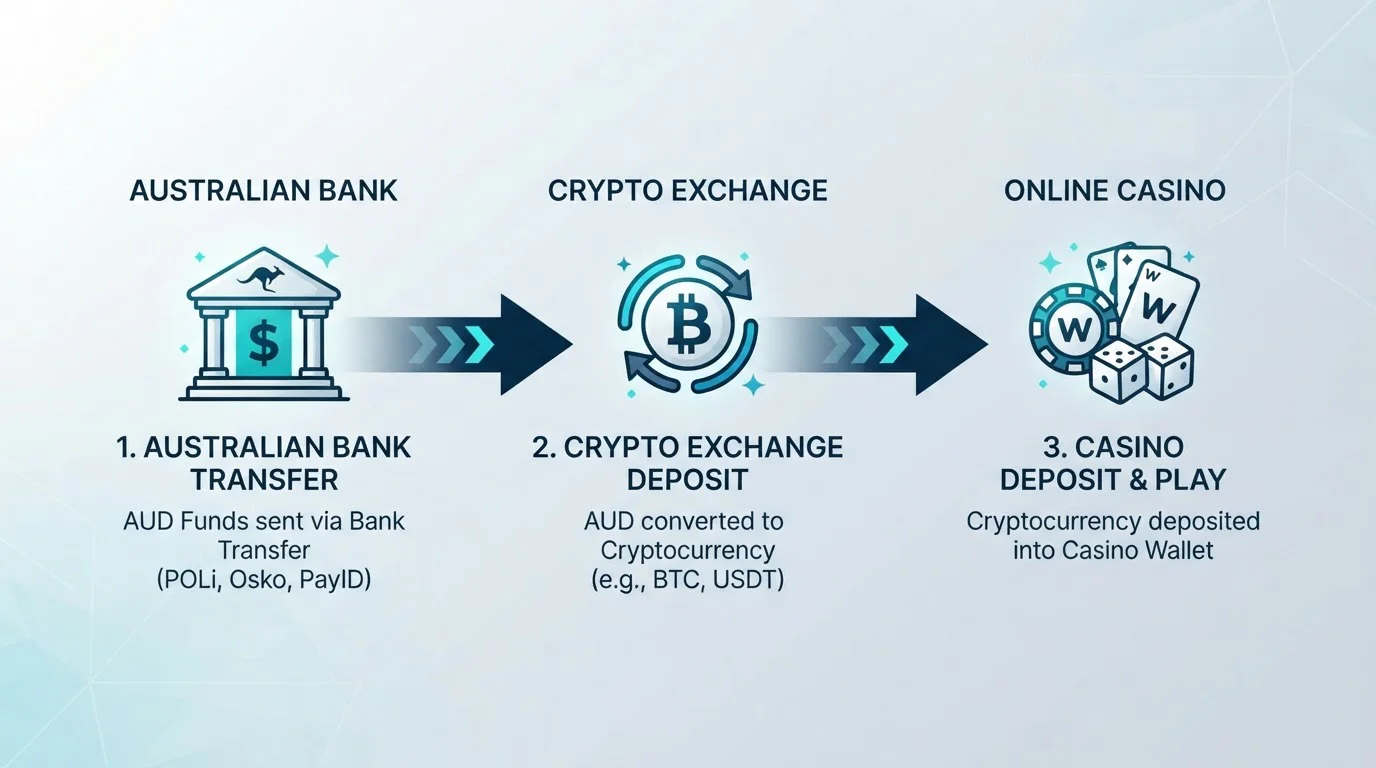
The full flow from Australian dollars in your bank account to USDT in a casino balance takes under ten minutes if you already have accounts set up. First-timers need to factor in exchange account verification (usually one to two days). The process is linear: fund an Australian crypto exchange, buy USDT, withdraw it to a wallet or directly to the casino, confirm the network matches, and wait for blockchain confirmation.
Step 1: Buy USDT on CoinSpot or Swyftx
CoinSpot and Swyftx are the two mainstream Australian exchanges supporting USDT across all three major networks. Both are AUSTRAC-registered and operate legally within Australian financial regulations. That registration has nothing to do with gambling—it’s a cryptocurrency exchange licence. Using the USDT you purchase for offshore casino deposits violates the Interactive Gambling Act, but buying and holding crypto itself is legal.
CoinSpot is based in Melbourne. It charges a 1% trading fee for converting AUD to USDT. Deposits via PayID are instant—funds appear in your CoinSpot account within seconds of leaving your bank. Once the AUD balance is credited, you buy USDT at the current market rate. The platform supports TRC-20, ERC-20, and BEP-20 withdrawals. Withdrawal fees vary by network: TRC-20 costs around A$1 to A$2, ERC-20 costs A$10 to A$15, BEP-20 costs around A$0.50. AUSTRAC requires CoinSpot to report transactions over A$10,000. Full KYC (identity document, proof of address) is mandatory to open an account.
Swyftx is based in Brisbane. Trading fees are lower than CoinSpot—around 0.6%. PayID deposits are also instant. USDT is available on TRC-20, ERC-20, and BEP-20. Withdrawal fees are slightly lower than CoinSpot: TRC-20 around A$1, ERC-20 around A$12, BEP-20 around A$0.20. Swyftx integrates with the ATO’s tax reporting system, which simplifies CGT tracking but also means your crypto activity is visible to the tax office. Full KYC is required. Customer support response times are generally faster than CoinSpot’s.
Step 2: Choose the Correct Network
Before withdrawing USDT from CoinSpot or Swyftx, open the casino’s deposit page and identify which network the casino’s USDT address uses. The casino will explicitly state “TRC-20,” “ERC-20,” or “BEP-20” next to the deposit address. Copy that address. Do not guess. Do not assume. If the casino lists multiple networks, pick the one that balances fee and speed for your deposit size. TRC-20 is the default. BEP-20 is optimal if the casino supports it.
Set your exchange withdrawal to the same network the casino specified. In CoinSpot or Swyftx, the USDT withdrawal screen will ask you to select a network from a dropdown menu. Match it exactly. Enter the casino’s deposit address. Double-check the address character by character—crypto transactions are irreversible. Confirm the withdrawal amount (deduct the network fee so you know what arrives at the casino). Confirm the transaction.
Step 3: Send USDT to Casino Wallet
The exchange processes the withdrawal. TRC-20 typically confirms within two to five minutes. ERC-20 takes three to ten minutes. BEP-20 confirms in under one minute. The casino’s deposit page will show the transaction as “pending” until the required number of blockchain confirmations is reached. Most casinos require one confirmation for USDT deposits. Once confirmed, the balance appears in your casino account. No manual approval is needed for deposits—this step is fully automated.
Some players withdraw USDT from the exchange to a personal wallet (MetaMask, Trust Wallet, Exodus) first, then send from the wallet to the casino. That adds an extra step and an extra transaction fee, but it separates your exchange account from the casino address. If privacy is a concern, the two-hop method obscures the direct exchange-to-casino link. For most players, sending directly from CoinSpot or Swyftx to the casino is simpler and costs less.
Step 4: Confirm and Play
Once the USDT deposit is confirmed on the blockchain, the casino credits your balance. You can start playing immediately. Deposits are processed faster than withdrawals because the casino has no compliance reason to delay them. Withdrawal requests go through the casino’s internal approval process, which can take anywhere from a few minutes (BC.Game, BitStarz) to twenty-four hours (20Bet, others). The blockchain leg of a withdrawal is fast. The casino’s internal processing is the variable.
How do I convert Australian dollars to USDT for casino deposits?
Open an account on CoinSpot or Swyftx. Complete KYC verification (identity document and proof of address). Deposit AUD via PayID—funds arrive instantly. Buy USDT through the exchange’s trading interface at the current market rate (1% fee on CoinSpot, 0.6% on Swyftx). Withdraw the USDT to the casino’s deposit address, ensuring the blockchain network (TRC-20, ERC-20, or BEP-20) matches what the casino specifies. Total time from bank transfer to casino balance: under ten minutes.
Which Australian exchange is better for buying USDT—CoinSpot or Swyftx?
Swyftx has lower trading fees (0.6% versus CoinSpot’s 1%) and slightly lower withdrawal fees on most networks. CoinSpot has broader crypto selection and a longer operational history. Both support PayID instant deposits and offer TRC-20, ERC-20, and BEP-20 USDT. For cost optimization, use Swyftx. For broader coin access beyond USDT, use CoinSpot. Both are AUSTRAC-registered and functionally reliable. If you already have an account on one, there’s no strong reason to switch.
| Exchange | Location | Trading Fee | TRC-20 Withdrawal Fee | ERC-20 Withdrawal Fee | BEP-20 Withdrawal Fee | Funding Method |
|---|---|---|---|---|---|---|
| CoinSpot | Melbourne | 1% | A$1–A$2 | A$10–A$15 | ~A$0.50 | PayID (instant), bank transfer, POLi |
| Swyftx | Brisbane | 0.6% | ~A$1 | ~A$12 | ~A$0.20 | PayID (instant), bank transfer, OSKO |
Withdrawal Speed and Fees Compared

Withdrawal time breaks into two phases: casino processing and blockchain settlement. Casino processing is the operator’s internal approval—compliance checks, manual review (if triggered), and the eventual release of funds to the blockchain. Blockchain settlement is the on-chain confirmation time, which depends on the network and current congestion. Fast casinos process internally in minutes. Slow casinos batch withdrawals and process every few hours. The blockchain leg is predictable. The casino leg is not.
BC.Game delivered the fastest measured average: 4 minutes 54 seconds across five real-money tests. That average includes both casino processing and blockchain confirmation. Bitcoin cleared in 2 minutes 11 seconds (fastest individual test). TRC-20 USDT took 3 minutes 22 seconds. ERC-20 USDT took 8 minutes 14 seconds (slowest individual test, but still under ten minutes). No test triggered manual review. Stake recorded 1 minute 42 seconds on a $500 Bitcoin withdrawal in a separate test, but that single data point doesn’t represent average performance across different withdrawal sizes and account statuses.
BitStarz averages 10 to 15 minutes for crypto withdrawals. 7Bit Casino tested at 11.8 minutes average. CloudBet came in at 14.7 minutes. These mid-tier times are still acceptable—anything under twenty minutes feels fast in practice. 20Bet’s range of 15 minutes to 24 hours reflects higher variability. Unverified accounts or first withdrawals often sit in manual review for hours. Verified accounts with clean withdrawal history process faster. Spinko’s withdrawal performance is unknown due to the platform’s newness—no independent tests have been published yet.
Network choice affects the blockchain leg more than the casino leg. TRC-20 USDT consistently confirms in three to nine minutes. ERC-20 USDT takes four to fifteen minutes depending on Ethereum network congestion. BEP-20 USDT confirms in under one minute. Bitcoin ranges from two to four minutes for standard fee transactions. Ethereum (ETH) withdrawals average four to seven minutes. The casino’s processing time is the dominant variable. A slow casino will delay a BEP-20 withdrawal just as much as an ERC-20 withdrawal—the network speed only matters after the casino releases the funds.
How fast are USDT withdrawals at crypto casinos?
USDT withdrawals from fast casinos (BC.Game, BitStarz, 7Bit) clear in under fifteen minutes total, including both casino processing and blockchain confirmation. TRC-20 USDT is the fastest stablecoin option, averaging three to nine minutes on-chain. ERC-20 USDT takes four to fifteen minutes. Casino processing time dominates total withdrawal speed—some platforms approve within minutes (BC.Game, Stake), others batch every few hours (20Bet). Network choice matters, but the casino’s internal workflow is the bigger variable.
| Casino | BTC Time | ETH Time | USDT TRC-20 Time | USDT ERC-20 Time | Fastest Option |
|---|---|---|---|---|---|
| BC.Game | 2m 11s – 3m 55s | 6m 48s | 3m 22s | 8m 14s | BTC (2m 11s recorded) |
| BitStarz | 10–15min | 10–15min | 10–15min | 10–15min | All similar (10–15min range) |
| Stake | 1m 42s (tested) | Not tested | Not tested | Not tested | BTC (1m 42s recorded) |
| 7Bit Casino | ~11.8min | ~11.8min | ~11.8min | ~11.8min | All similar (~11.8min average) |
| CloudBet | ~14.7min | ~14.7min | ~14.7min | ~14.7min | All similar (~14.7min average) |
| 20Bet | 15min–24h variable | 15min–24h variable | 15min–24h variable | 15min–24h variable | Depends on account status |
USDT doesn’t inherently withdraw slower than Bitcoin. Network choice matters more than asset type. TRC-20 USDT clears as fast as Bitcoin at most casinos. ERC-20 USDT is slower due to Ethereum’s longer block times, but the delay is minutes, not hours. Stablecoin deposits and withdrawals behave like any other crypto asset—the blockchain mechanics are the same, the casino processing is the same, and the speed depends on the platform’s internal workflow and the network you choose.
USDT Casino Bonuses and Promotions
Most offshore casinos offer deposit bonuses regardless of whether you fund with Bitcoin, Ethereum, or USDT. The bonus structure is usually a percentage match (100%, 200%, sometimes higher) up to a maximum amount, plus free spins. The percentage sounds generous. The terms make it restrictive. Wagering requirements—how many times you must bet the bonus amount before withdrawing—range from 30x to 50x. A $100 bonus with 40x wagering means you must place $4,000 in bets before you can cash out. Game contributions vary: pokies count 100%, table games often count 10% or less.
BitStarz offers 100% up to $500 or 5 BTC plus 180 free spins across the first deposit. Wagering requirements apply (check current terms). Spinko’s 400% up to $3,000 plus 350 free spins is the most aggressive structure reviewed here, but the wagering requirement is almost certainly punitive at that match percentage. CloudBet’s cash rewards (up to A$3,475) carry no wagering because they’re credited as withdrawable cash, not locked bonus funds. That’s rare. Most bonuses lock until rollover is cleared.
No-deposit bonuses—Spinko’s A$20 no-deposit offer, for example—let you test a casino without risking your own funds. The catch: maximum cashout from no-deposit bonuses is usually capped at a small amount ($50 to $100), and you still need to meet wagering requirements before withdrawal. These offers are marketing. They get you in the door. The real money is your deposit.
Free spins often restrict you to specific pokies with low RTP. A “generous” 200 free spins on a game with 92% RTP is less valuable than 50 spins on a 97% RTP title. Wager-free spins—where winnings are immediately withdrawable—are better, but they’re rare. Most spins have rollover requirements of 30x to 50x on the winnings. Winning $20 from free spins with 40x wagering means you must bet $800 before cashing out.
USDT-specific bonuses are uncommon. Most casinos treat all crypto deposits the same. A few platforms offer slightly higher match percentages for stablecoin deposits because the casino doesn’t carry price risk on your bonus balance. The difference is marginal—maybe 150% instead of 100%. If you’re depositing USDT specifically for stability, accepting a bonus that locks your funds for weeks until wagering is cleared undermines that stability. Many experienced players skip bonuses entirely to maintain withdrawal flexibility.
Reload bonuses and cashback programs add value for regular players. CloudBet’s 10% rakeback returns a percentage of your losses over time. VIP programs (BitStarz, Stake, 7Bit) tier up based on wagering volume, unlocking higher cashback percentages, faster withdrawals, and dedicated account managers. These loyalty structures reward volume, not luck. If you’re playing regularly, VIP benefits accumulate. If you’re depositing once to test a casino, the welcome bonus is the only offer that matters.
Game Types at USDT Casinos
USDT works across every game category: pokies, live dealer tables, instant-win games, sportsbook, poker. The currency is neutral. Once the USDT balance is credited to your casino account, it functions like any other deposit. Game providers don’t care whether the casino’s backend holds your balance in USDT, Bitcoin, or AUD equivalent. The games run the same. RTPs are identical. Bet limits depend on the casino’s settings, not the currency.
Pokies dominate volume at every crypto casino. BitStarz’s 6,000+ game library, BC.Game’s 10,000+ titles, Stake’s library of providers—the bulk is video pokies from studios like Pragmatic Play, Hacksaw Gaming, Nolimit City, NetEnt, and Push Gaming. Megaways slots, hold-and-win mechanics, progressive multipliers, cascading reels—all the standard features are present. Minimum bets typically start at $0.10 to $0.20. Maximum bets vary by provider and title, often capping at $50 to $100 per spin. High-roller limits exist but require contacting VIP support.
Live dealer games stream from studios in Malta, Latvia, Georgia, and Curaçao. Evolution Gaming, Pragmatic Play Live, and Ezugi are the primary providers. Blackjack, roulette (European, American, Lightning variants), baccarat, and game-show-style titles (Crazy Time, Monopoly Live) are standard. Betting limits at live tables range from $1 to $10 minimum up to $5,000 to $10,000 maximum at VIP tables. USDT deposits don’t restrict access to any live dealer room—the currency doesn’t matter to the studio feed.
Provably fair games are crypto-casino-specific. Stake Originals (Plinko, Dice, Mines, Limbo), 7Bit’s hash-verified slots, and BC.Game’s originals all use client-seeded RNG that players can verify post-round. The house edge is published. Seeds are transparent. These games appeal to players who distrust traditional RNG from licensed providers. The trade-off: provably fair games tend to have higher house edges than slots from major providers, and the gameplay is simpler. Dice, crash, and Plinko are not mechanically complex. They’re fast, transparent, and mathematically verifiable, but they lack the bonus features and narrative hooks of a Pragmatic Play slot.
Table games (blackjack, roulette, baccarat, video poker) run on RNG when not live-dealer. These are single-player games with the same rules as land-based versions. House edge on European roulette is 2.7%. Blackjack varies by rule set (number of decks, dealer hits on soft 17, surrender allowed) but typically sits between 0.5% and 1% with optimal strategy. Video poker pays according to posted paytables—Jacks or Better with 9/6 paytable returns 99.54% with perfect play. The math doesn’t change because you deposited USDT.
Sportsbook integration exists at Stake, CloudBet, and 20Bet. You can move USDT balance between casino and sportsbook within the same account. Pre-match and in-play betting cover football, cricket, tennis, basketball, and esports. Odds formats (decimal, fractional, American) are selectable. USDT balances display in USD equivalent, which simplifies live betting because the stake amount doesn’t fluctuate mid-match. Fiat-based sportsbooks convert your AUD balance to USD or EUR at the moment you place the bet, and exchange rates shift. USDT removes that conversion friction.
No-KYC and Anonymous USDT Casinos
The “no-KYC casino” pitch is marketing. Offshore platforms advertise anonymous access—no identity verification, just deposit crypto and play. The reality is murkier. Most casinos reserve the right to request KYC at any time under their terms of service, even if they don’t enforce it at signup. Regulatory pressure, anti-money-laundering (AML) concerns, and payment processor requirements all push casinos toward verification. The trend is toward more KYC, not less, even in the unregulated offshore space.
BC.Game processed test withdrawals under approximately A$500 without requesting documents. That threshold is not guaranteed. Account activity patterns, rapid deposits and withdrawals, or hitting certain cumulative withdrawal totals can trigger review. Stake markets itself as low-KYC for standard play, but the 200% welcome bonus requires Level 2 verification (identity document, proof of address). If you claim the bonus, you’re verified. If you skip the bonus, smaller withdrawals may process without documents. First-time withdrawals often require verification regardless of amount, even at casinos that advertise no-KYC access.
Larger withdrawals always trigger review. A$2,000 to A$5,000 cumulative is the common threshold where manual compliance checks begin. Some casinos verify at the first withdrawal over A$1,000. Others let you withdraw A$10,000 before asking for documents. There’s no transparency. The casino decides case by case. If you’re planning to withdraw five figures, assume KYC will be required and have documents ready. Fighting verification after the fact usually results in the withdrawal being frozen until you comply.
Anonymous USDT casinos technically exist—platforms that never ask for documents, process all withdrawals without verification, and don’t log IP addresses beyond session data. These platforms are rare, unregulated even by offshore standards, and carry higher risk. If a withdrawal is denied or an account is locked, you have no recourse. No licence means no complaint mechanism. The anonymity is bilateral: the casino is anonymous to you as much as you are to the casino. Funds can disappear without explanation.
Privacy-focused players use a three-hop structure: buy USDT on a no-KYC decentralized exchange (or a KYC exchange under a separate identity), send to a personal wallet (preferably a fresh address not linked to prior transactions), then send from that wallet to the casino. The exchange-to-casino link is broken. The casino sees a deposit from an unknown wallet. The exchange never sees the casino’s address. That structure adds cost (extra transaction fees) and complexity, but it obscures the audit trail. Australian exchanges (CoinSpot, Swyftx) require KYC, so the first hop is always traceable unless you buy USDT peer-to-peer.
VPN usage hides your Australian IP from the casino, but it doesn’t hide your identity if KYC is requested. Most casinos’ terms of service prohibit VPN use, though enforcement is inconsistent. If a dispute arises and the casino determines you accessed from a blocked jurisdiction via VPN, they can void winnings and confiscate the balance. That clause is standard in offshore casino terms. Using a VPN is a calculated risk. Many Australian players use them without incident. Some hit problems during withdrawal. The casino holds all leverage.
Tax and Compliance for Australian Players
The Australian Tax Office treats cryptocurrency as property, not currency. Buying, selling, spending, or gambling with crypto triggers capital gains tax rules. USDT’s stable value simplifies the calculation. If you buy USDT at A$1.49 per token and deposit it at a casino ten minutes later when it’s still worth A$1.49, there’s no capital gain on that leg. The cost base equals the disposal value. No taxable event. If you buy USDT at A$1.49 and deposit it a month later when it’s worth A$1.51, the A$0.02 per token gain is technically taxable, though the amount is trivial at small volumes.
Gambling winnings are not taxable in Australia. Gambling is not considered assessable income. If you deposit A$500 and withdraw A$2,000, the A$1,500 profit from gambling is not taxed. But when you sell that A$2,000 worth of USDT back to AUD, a CGT event occurs. If the USDT-to-AUD rate has moved between deposit and sale, the difference is a capital gain or loss. Because USDT is pegged to USD, and AUD/USD fluctuates modestly, gains and losses are small. Over a session, the CGT liability from USDT price movement is usually negligible.
Record-keeping is mandatory. The ATO expects you to track the cost base of every crypto acquisition and the proceeds of every disposal. For USDT casino gambling, that means recording: the AUD amount you paid for the USDT, the date and rate, the AUD value at the time you deposited it to the casino (disposal), the AUD value when you withdrew it from the casino (acquisition), and the AUD amount you received when you sold it back (disposal). Swyftx integrates ATO tax reporting, which automates part of this. CoinSpot provides transaction history exports. Manual tracking is tedious but required.
Are USDT casino winnings taxable in Australia?
No. Gambling winnings are not assessable income under Australian tax law, regardless of the currency or method. The A$1,500 you win at a casino is not taxed. However, disposing of the USDT you withdraw—selling it for AUD, spending it, or sending it elsewhere—is a capital gains tax event. If the USDT’s AUD value increased between when you acquired it and when you disposed of it, the gain is taxable. USDT’s stability minimizes these gains. Only the AUD/USD forex movement matters, not gambling outcomes.
AUSTRAC (Australian Transaction Reports and Analysis Centre) requires financial institutions to report transactions over A$10,000. CoinSpot and Swyftx file reports when you deposit, withdraw, or trade above that threshold. Those reports flow to the ATO. Moving A$15,000 from your bank to CoinSpot, converting it to USDT, and sending it to a casino creates a documented trail. The ATO knows you bought crypto. They don’t know you gambled with it unless the casino itself reports (which offshore platforms do not). But if you later sell A$30,000 of USDT and can’t explain the source, the ATO may ask questions.
Crypto gambling sits in a compliance grey zone. It’s illegal under the Interactive Gambling Act, but player enforcement is nonexistent. The ATO is concerned with tax collection, not gambling prohibition. If you report your capital gains correctly, the ATO receives its cut and typically doesn’t pursue the underlying activity. If you fail to report and the ATO detects unexplained crypto disposals, you face penalties for tax evasion, not gambling. The practical advice: keep records, report gains, pay the tax. The CGT liability on USDT is small because the asset is stable. Compliance is straightforward if you document every step.
How to Choose the Right USDT Casino
Withdrawal speed is the first filter. BC.Game’s 4-minute-54-second average and BitStarz’s 10-to-15-minute window set the benchmark. Casinos that process withdrawals in under fifteen minutes signal operational automation and adequate hot wallet liquidity. Platforms that batch withdrawals every six hours or require manual approval for every payout add friction. If speed matters, narrow the list to BC.Game, BitStarz, Stake, and 7Bit. CloudBet and 20Bet are acceptable but slower.
Network support is the second filter. If you want BEP-20 for the lowest fees and fastest confirmation, BC.Game is the only tested option that supports all three networks. TRC-20 support is near-universal—11 out of 12 casinos tested accept it. ERC-20 is universal but expensive. If you’re indifferent to network and just want TRC-20 to work, any of the seven casinos reviewed here will suffice. If network flexibility matters, BC.Game is the clear choice.
Track record separates established platforms from new entrants. BitStarz (2014) and CloudBet (2013) have over a decade of continuous operation. That longevity suggests they process withdrawals reliably and resolve disputes more often than not. Stake’s high profile (F1 sponsorship, Drake partnership) means it’s under scrutiny and has reputational incentive to maintain payout integrity. Spinko launched in 2026. No independent reviews exist. The aggressive bonus structure is a signal of customer acquisition, not operational maturity. Test new casinos with small deposits. Commit larger amounts to platforms with multi-year track records.
Game library depth matters if you have specific provider preferences. BitStarz and BC.Game both exceed 6,000 titles. Stake adds proprietary Originals. 7Bit focuses on provably fair games. CloudBet’s library is adequate but smaller. If you play exclusively Pragmatic Play or Hacksaw Gaming slots, check the casino’s provider list before depositing. Not all casinos carry the same studios. Licensing agreements vary. Assume the casino lists its providers on the site—verify before you fund your account.
Bonus terms are a trap more often than a benefit. A 400% match with 50x wagering locks your funds for weeks or months. A 100% match with 30x wagering is more realistic but still restrictive. CloudBet’s cash rewards with no rollover are the exception. Most players are better off skipping bonuses entirely to maintain withdrawal flexibility. If you do claim a bonus, read the full terms—max bet limits, game restrictions, contribution percentages, expiry dates. The marketing highlights the match percentage. The terms bury the restrictions.
VIP programs reward volume. If you’re depositing regularly, check the loyalty structure. BitStarz, Stake, and 7Bit all offer tiered VIP systems with cashback, reload bonuses, and faster withdrawals at higher levels. The benefits scale with wagering. Casual players won’t reach the upper tiers. High rollers should evaluate VIP terms before choosing a primary casino. CloudBet’s 10% rakeback is immediate and applies from the first bet, which makes it more accessible than multi-tier programs that require six-figure wagering to unlock meaningful perks.
Reputation can be gauged through complaint forums (AskGamblers, Casino.Guru, Reddit) and payout reports. BitStarz’s 9.8 safety index and 100% complaint resolution rate are public. Stake’s visibility means complaints are also public—search Reddit or Trustpilot for user reports. BC.Game, 7Bit, and CloudBet have mixed reviews, which is typical for offshore casinos. Spinko has no public review history yet. If a casino consistently refuses withdrawals or ghosts players after disputes, it will show up in forum threads. No casino has a perfect record. Look for patterns. One or two complaints are normal. Dozens of unresolved withdrawal disputes are a red flag.
Licensing provides minimal protection offshore. Curaçao licences are inexpensive and lightly regulated. The licence confirms the casino paid a fee and submitted paperwork, not that it’s trustworthy. Anjouan licences (BC.Game) are even less regulated. Costa Rica licences are jurisdiction-shopping. No offshore licence grants Australian players legal recourse. The licence is a baseline signal that the casino is willing to operate under some regulatory framework, however weak. Unlicensed casinos carry higher risk because there’s no third-party oversight at all, even nominal.
Responsible gambling tools vary by platform. BitStarz offers deposit limits, session timers, and self-exclusion. Stake provides similar controls. Smaller platforms often lack these features. If you want the ability to set daily deposit caps or cool-off periods, verify the casino’s responsible gambling page before signing up. Offshore casinos aren’t bound by Australian or European responsible gambling regulations, so tool availability is voluntary. Platforms that implement these features signal at least a baseline commitment to player welfare, even if enforcement is lax.
Crypto casinos are high-risk by design. You’re operating outside regulated systems, depositing irreversible assets, and trusting an offshore operator with no legal obligation to honor withdrawals. The seven casinos reviewed here have demonstrated payout reliability over time or (in Spinko’s case) are new enough that data doesn’t exist. None are endorsed. None are “safe” in the way a licensed Australian operator would be. Use small deposits for testing. Verify withdrawals work before committing larger amounts. Assume the risk of loss is structural, not incidental.
The best USDT casino for Australian players is the one that withdraws reliably at your typical deposit size, supports the network you prefer, and has enough operational history that you can research its payout record. BC.Game fits that profile for speed and network flexibility. BitStarz fits for longevity and complaint resolution. Stake fits for brand visibility. 7Bit fits for provably fair mechanics. CloudBet fits for crypto-native operations and sportsbook integration. None are perfect. All are better than platforms with no track record or patterns of withdrawal denial.
Crypto Casinos Australia 2026 — Bitcoin, Ethereum, Tether, Solana
Content created by the «Bankroll» team