
$5 PayID Casino No Deposit Bonus Australia 2026: Separating Marketing from Reality
 Available in AU
Five dollars won’t buy a decent pint in most Australian pubs these days. Yet somehow, in the online casino world, a five-buck note still gets marketed as the key to a bankroll — especially when paired with PayID’s instant transfer promise and the magic words “no deposit required.”
Australian players searching for this combination are chasing an intersection that barely exists. The offshore casino market serves up plenty of $5 minimum deposit deals. It offers a handful of $5–$10 no-deposit bonuses. PayID acceptance is widespread. But finding all three in one package — a true $5 no-deposit bonus at a casino that accepts PayID for both deposits and withdrawals — is like hunting for a licensed poker room in Sydney. Possible, but you’ll spend more time looking than playing.
This article exists to separate the marketing fiction from the operational reality. Which offshore operators come closest to delivering the deal. What the wagering requirements and max cashout caps look like when you do the maths. How PayID actually works at offshore casinos (instant deposits, yes; instant withdrawals, not quite). And what the Interactive Gambling Act means for your ability to claim these bonuses and withdraw winnings without an Australian licence anywhere in sight.
The Reality Behind $5 PayID Casino No-Deposit Bonuses in Australia
The short answer: the product barely exists as advertised. The slightly longer answer: you’re searching for the intersection of three things — ultra-low deposit thresholds, PayID acceptance, and no-deposit bonus availability — and the offshore Australian market rarely delivers all three simultaneously.
ReefSpins offers a genuine A$5 free chip with PayID support. That’s the only exact match found in September 2026 research. Everything else is either a $5 minimum deposit WITH a match bonus, or a $5–$10 no-deposit bonus (usually free spins, not cash) at casinos that accept PayID but don’t align the bonus amount with the search term. Joe Fortune offers $10 no-deposit, not $5. Ozwin offers 100 free spins no-deposit but the value isn’t denominated in dollars. OzzyBet offers 30 free spins with lower wagering but again, not a $5 cash figure.
The phrase “$5 PayID casino no deposit bonus Australia 2026” is a stack of separate wishes rather than a single product on the shelf. You’re looking for ultra-low risk (no deposit), ultra-convenient payment (PayID), and ultra-low threshold ($5 exactly) — a combination offshore operators don’t package because the economics don’t work. A $5 no-deposit bonus with 40x wagering requires $200 in turnover. At 96% RTP on pokies, the expected house take is $8. The operator gives you $5 and expects to collect $8 back through the wagering requirement. That’s why these bonuses exist: they’re not gifts, they’re structured incentives that generate revenue regardless of individual session variance.
Do $5 no-deposit bonuses that accept PayID actually exist in Australia?
Yes, but the exact intersection is rare. Most offshore casinos accepting Australian players offer either $5 deposit minimums (with or without match bonuses) or $5–$10 no-deposit offers (usually free spins). PayID acceptance is common across both categories. The challenge is finding a $5 no-deposit bonus denominated in cash (not free spins) at a casino with full PayID support for deposits and withdrawals. ReefSpins’ A$5 free chip is the only confirmed exact match as of September 2026. Other operators listed below come close: OzzyBet’s 30 free spins, Fair Go’s 20 spins, Ozwin’s 100 spins. All accept PayID. None offer precisely $5 cash no-deposit. If you’re willing to accept $10 no-deposit (Joe Fortune) or free spins instead of cash (most others), the supply opens up. If you insist on $5 cash, no deposit, PayID-supported, your options shrink to one.
Offshore Casinos Offering $5 No-Deposit Bonuses with PayID Support

The table below compares seven offshore operators that accept PayID and offer bonuses at or near the $5 threshold. Some are true no-deposit offers (free spins or free chips awarded on registration). Others require a $5 minimum deposit to unlock the bonus. The distinction matters: a no-deposit bonus lets you test the casino without risking your own money, while a $5 deposit bonus requires upfront cash even if the amount is minimal.
| Operator | Licence | No-Deposit Bonus | Wagering | Max Cashout | PayID Minimum Deposit |
|---|---|---|---|---|---|
| Ozwin | Curaçao (Deckmedia N.V.) | 100 free spins (Cash Bandits 3) | 60x winnings | $180 AUD | $10 AUD |
| OzzyBet | Curaçao | 30 free spins (Royal Piggy) | 40x winnings | 5x winnings | $20 AUD |
| Fair Go | Curaçao (Deckmedia N.V.) | 20 free spins (Megaquarium) | 60x winnings | $200 AUD | $5 AUD |
| Red Stag | Curaçao (Deckmedia N.V.) | 33 free spins (Cool Bananas) | 60x winnings | $160 AUD | $5 AUD |
| Ripper | Curaçao (Deckmedia N.V.) | 20 free spins (Eggstravaganza) | 60x winnings | $100 AUD | $5 AUD |
| ReefSpins | Curaçao | A$5 free chip | 40x bonus | $100 AUD | Not disclosed |
| Joe Fortune | Curaçao | $10 free chip | 35x–40x bonus | $100–$150 AUD | $5–$10 AUD |
The operators above split into two groups. Four are run by Deckmedia N.V., a Curaçao-licensed entity that operates a stable of Australian-focused offshore brands (Ozwin, Fair Go, Red Stag, Ripper). They share the same RTG game library, similar bonus structures, and coordinated marketing. The others (OzzyBet, ReefSpins, Joe Fortune) are independent operators with their own game suppliers and bonus policies. None holds an Australian licence because Australia doesn’t issue online casino licences for real-money play directed at Australian residents. The Interactive Gambling Act prohibits it. Every operator here is offshore.
Ozwin Casino — 100 Free Spins, $180 Max Cashout
Ozwin sits in the Deckmedia stable alongside Fair Go, Red Stag, and Ripper. Launched in 2020, it runs on a Curaçao eGaming licence and serves the Australian market with an RTG-exclusive pokie library of around 200 titles. The no-deposit offer is 100 free spins on Cash Bandits 3, claimed with bonus code CASHBAND100. Wagering sits at 60x on winnings, meaning whatever you win from those 100 spins must be wagered 60 times before withdrawal. Max cashout caps at $180 AUD — highest spin-bonus cap among the Deckmedia brands but still well below the cashout limits on deposit match bonuses.
PayID deposits start at $10 AUD, not $5. Withdrawals via PayID clear same-day in most cases once the manual approval stage completes (typically 30 minutes to a few hours). The welcome package for depositors stretches to 400% up to $4,000 AUD across multiple deposits — a high-percentage match but with the usual 30x–40x wagering strings attached. Ozwin’s main appeal for Australian players is the Deckmedia reputation (operational since the mid-2010s across multiple brands) and the RTG library, which skews heavily toward high-volatility pokies with bonus-buy features. The no-deposit 100 spins are a volume play: you get more spins than competitors, but the per-spin value is tiny (usually $0.01–$0.10), so total value hovers around $1–$10 in winnings before wagering. Named in ACMA enforcement material, meaning the site is blocked at ISP level in Australia. Access via VPN or mirror domains.
OzzyBet — 30 Free Spins, Lower Wagering
OzzyBet launched in 2026 as a multi-provider offshore casino targeting the Australian market. Curaçao-licensed, though the specific sublicense entity isn’t disclosed in public footers. The no-deposit offer is 30 free spins on Royal Piggy: Hold The Spin, claimed with code OZZYWIN. Wagering is 40x on winnings — lowest among the operators reviewed here — with max cashout capped at 5x free-spin winnings. Translation: if your 30 spins generate $10 in winnings, you must wager $400 to clear it ($10 × 40x), and the maximum you can withdraw is $50 (5x $10).
PayID deposits start at $20 AUD. The operator markets 12-minute average cashouts for Australian players, though that figure likely aggregates crypto and PayID payouts without separating the approval bottleneck. The game library claims 16,500 titles across pokies, live dealer, and table games — significantly broader than the RTG-only Deckmedia brands. OzzyBet’s differentiator is the 40x wagering on no-deposit spins versus the 60x standard elsewhere. That matters in expected-value terms: $10 in winnings at 40x wagering requires $400 turnover, producing an expected loss of $16 at 96% RTP (4% of $400). At 60x, the same $10 in winnings requires $600 turnover and an expected loss of $24. The lower multiplier doesn’t make the bonus free money, but it shifts the expected-value math slightly less negative. Too new (launched 2026) to have a long payout track record. Licensing transparency is thin compared to Deckmedia brands.
Fair Go Casino — 20 Free Spins, Highest Cashout Cap
Fair Go is the oldest Deckmedia brand targeting Australia, operational since the mid-2010s and running on the same Curaçao licence as Ozwin, Red Stag, and Ripper. The no-deposit offer is 20 free spins on Megaquarium, claimed with code MEGA20. Wagering is 60x on winnings, max cashout $200 AUD — the highest fixed cashout cap among all no-deposit offers reviewed here. That $200 ceiling matters if variance works in your favour: a lucky spin sequence could generate $50 in free-spin winnings, and you’d still be allowed to cash out the full $200 after meeting wagering, whereas most competitors cap at $100–$160.
PayID deposits from $5 AUD, making it the lowest PayID minimum among Deckmedia brands (Ozwin requires $10). Withdrawals process same-day via PayID once manual approval clears. The RTG library is identical to Ozwin and Red Stag: around 200 pokies, skewed toward high-volatility titles. Fair Go uses the .au domain (fairgo.com.au) despite holding no Australian licence — a branding choice that creates market association without regulatory backing. Previously named in ACMA enforcement actions; site blocked at ISP level, accessible via VPN or mirrors. The main reason to pick Fair Go over other Deckmedia brands: the $200 max cashout on no-deposit spins and the $5 PayID deposit minimum. Everything else (library, wagering, ownership) is functionally identical across the Deckmedia stable.
Red Stag Casino — 33 Free Spins, Same-Day Withdrawals
Red Stag is another Deckmedia N.V. brand, Curaçao-licensed, operational since the mid-2010s. The no-deposit offer is 33 free spins on Cool Bananas, claimed with code CB33POKIES. Wagering is 60x on winnings, max cashout $160 AUD — mid-tier cap, higher than Ripper’s $100 but lower than Fair Go’s $200. PayID deposits from $5 AUD, withdrawals same-day once approval completes. RTG-exclusive library identical to Fair Go and Ozwin.
Red Stag’s positioning within the Deckmedia stable is unremarkable. It offers neither the highest spin count (Ozwin’s 100), nor the highest cashout cap (Fair Go’s $200), nor the lowest PayID minimum (Fair Go’s $5, though Red Stag also does $5). The welcome package stretches to $4,500 AUD + 350 free spins across multiple deposits, slightly more generous than Fair Go’s $2,000 package but with the same wagering multipliers. The 33 free spins is an odd middle ground — more than Fair Go’s 20, fewer than Ozwin’s 100. The $160 cashout cap is likewise mid-range. If you’re picking within the Deckmedia ecosystem, Fair Go’s $200 cashout or Ozwin’s 100-spin volume make more sense unless you have a specific attachment to the Red Stag branding.
Ripper Casino — 20 Free Spins, Established AU Brand
Ripper is the fourth Deckmedia N.V. brand on this list, Curaçao-licensed, mid-2010s vintage, same RTG library as the others. No-deposit offer: 20 free spins on Eggstravaganza, code TOOEASY, 60x wagering, $100 max cashout. PayID from $5 AUD, same-day withdrawals. Welcome package up to $7,500 AUD + 20 free spins across deposits.
Ripper’s $100 max cashout is the lowest among Deckmedia brands. The 20 free spins matches Fair Go’s count but Fair Go’s $200 cashout cap makes it the better choice for no-deposit players. Ripper’s welcome package is larger in headline terms ($7,500 vs. Fair Go’s $2,000) but the wagering requirements scale proportionally. The “TOOEASY” bonus code is the only marketing hook distinguishing Ripper from its siblings. If you’re optimizing for no-deposit value within Deckmedia, Ozwin (100 spins, $180 cap) or Fair Go (20 spins, $200 cap) outrank Ripper’s 20 spins with a $100 ceiling. Ripper makes sense only if the other Deckmedia domains are blocked and you need a mirror with a different name.
ReefSpins — $5 Free Chip, Game Flexibility
ReefSpins is the only operator on this list offering a true $5 cash bonus rather than free spins. Established in 2023, Curaçao-licensed (specific entity not disclosed), the no-deposit offer is an A$5 free chip credited automatically on registration with no bonus code required. Wagering is 40x on the bonus amount — $5 × 40 = $200 total turnover required before cashout. Max cashout caps at $100 AUD. PayID deposits are accepted but the minimum isn’t disclosed in public sources.
The free-chip format matters because it’s not locked to a single pokie. Free spins at other operators force you onto one game (Cash Bandits 3, Royal Piggy, Megaquarium). ReefSpins’ $5 chip lets you pick from the broader pokie library, plus keno and scratch cards in most cases. Table games and live dealer are typically excluded from wagering or contribute at 5%–10%, making them impractical for clearing the bonus. The $5 cash amount is the exact search-query match users are hunting for. The catch: $5 at 40x wagering requires $200 turnover; at 96% RTP that’s an expected loss of $8, meaning the “free” $5 bonus costs $8 in expected value. Max cashout at $100 means even if you run hot and build the $5 into $300, you walk away with $100.
ReefSpins operates multiple mirror domains (reefspins2.com, reefspins3.com) indicating ACMA blocking and domain rotation. Newer brand (2023) with limited payout track record compared to Deckmedia’s multi-year Australian presence. Game library size not disclosed. Licensing transparency thin. The $5 free chip is the draw; everything else about ReefSpins is operationally opaque.
Joe Fortune — $10 No-Deposit Bonus as Close Alternative
Joe Fortune doesn’t meet the strict $5 threshold but appears on this list because it’s the closest alternative when true $5 offers are scarce. Established in 2017, Curaçao-licensed, the no-deposit offer is a $10 free chip (code varies by promotion, typically site-displayed). Wagering is 35x–40x on the bonus amount, max cashout $100–$150 AUD depending on the specific offer terms. PayID, POLi, and Neosurf accepted; AUD native pricing. Deposit minimum $5–$10 AUD.
Joe Fortune runs an RTG and Betsoft library — smaller than multi-provider casinos like OzzyBet (16,500 games) but larger than pure-RTG operators like Ozwin (200 titles). The curated library sits around 300–500 titles. Welcome package up to $5,000 AUD across deposits. The $10 no-deposit is double the search-query amount, but the 35x–40x wagering is competitive: $10 × 35 = $350 turnover required, expected loss $14 at 96% RTP. That’s better expected value than a $5 bonus at 40x ($8 expected loss) if you scale for the bonus size, but in absolute terms you’re still wagering more.
Joe Fortune’s appeal is longevity (operational since 2017, survived multiple ACMA blocking cycles) and Australian-specific banking (PayID, POLi, Neosurf all integrated). The $10 no-deposit isn’t $5, but it’s a verified offer at a PayID-accepting casino with a longer operational track record than newcomers like OzzyBet or ReefSpins. If ReefSpins’ $5 chip doesn’t suit (opaque licensing, thin reputation) and you’re willing to accept $10 instead, Joe Fortune is the fallback.
Which specific offshore casinos accept PayID deposits and offer bonuses at the $5 threshold?
Seven offshore operators meet the criteria with varying degrees of exactness. ReefSpins offers a genuine A$5 free chip (no deposit required) with PayID support — the only precise match. Joe Fortune offers $10 no-deposit (not $5) with PayID. The Deckmedia quartet (Ozwin, Fair Go, Red Stag, Ripper) offers 20–100 free spins no-deposit with PayID support, but the bonus value isn’t denominated in cash dollars. OzzyBet offers 30 free spins with PayID, lowest wagering (40x) among competitors. All seven accept PayID for deposits; withdrawal support varies by operator but is generally present. The distinction: ReefSpins is the only $5 cash no-deposit with PayID. The others are close alternatives — free spins instead of cash, $10 instead of $5, or $5 deposit required rather than no deposit.
How PayID Works at Australian Offshore Casinos
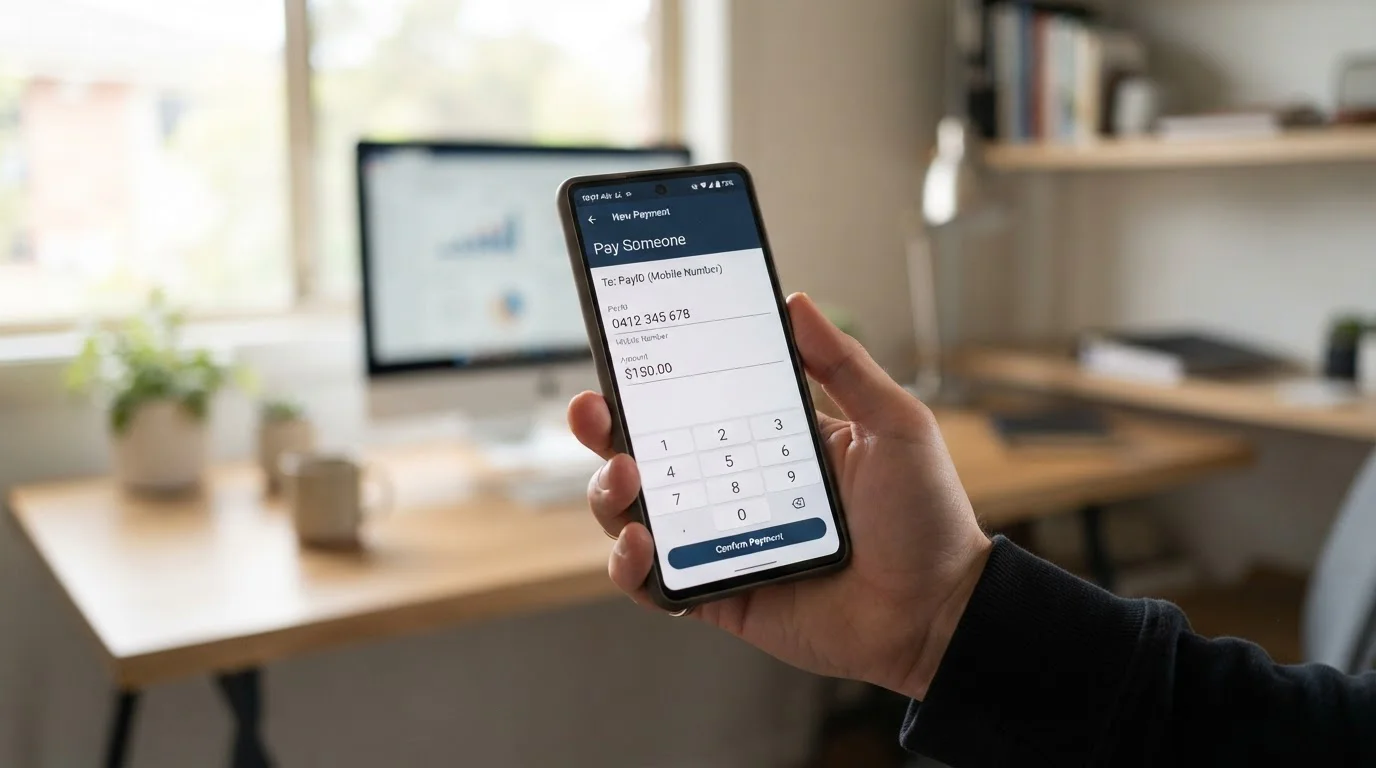
PayID is Australia’s instant bank transfer system, built on top of the New Payments Platform (NPP) that launched in 2018. It lets you link a mobile number, email address, or ABN to your bank account so other people can send you money without knowing your BSB and account number. When you pay an offshore casino via PayID, your bank sends an instant transfer directly to the casino’s Australian bank account. The casino never sees your banking credentials — only the completed transaction amount, timestamp, and your name as registered with your bank.
PayID is not a payment processor or a third party sitting between you and your bank. It’s Australian banking infrastructure. The same security and authentication standards that apply to any bank transfer apply here: FaceID, fingerprint, or PIN confirmation through your bank’s app. The key advantage over credit cards: the casino cannot initiate any transfer from your account. Money flow is one-directional unless you request a withdrawal. Your bank’s full authentication stack protects every payment.
Deposits: Instant NPP Transfers
Depositing at an offshore casino via PayID takes six steps and completes within 60 seconds in most cases. Go to the cashier in your casino account, select PayID from the payment methods list. The casino displays their PayID handle — usually an email address or phone number — and the exact deposit amount to send. Open your banking app (CommBank, Westpac, ANZ, NAB, ING, Macquarie, Bendigo, Up, Revolut Australia all support PayID outbound transfers). Go to Pay Anyone or New Transfer, select PayID as the transfer type, enter the casino’s PayID handle. Enter the exact amount shown and confirm with your bank’s authentication. Funds land in your casino balance within 60 seconds. No codes to enter, no confirmation emails to wait for. Bonus auto-applies if you’re claiming a welcome offer.
The critical rule: always transfer the exact amount shown in the casino cashier. Some operators use the amount itself to match your deposit to your account. Sending a different amount can delay crediting while support manually reconciles the transaction. PayID transfers are instant at the banking layer (NPP real-time clearing), but the casino’s internal systems still need to match the incoming payment to your player account. Most do this automatically within seconds. A handful of operators require manual matching if you send an off-amount.
Withdrawals: Manual Approval + Real-Time Transfer
PayID withdrawals work in reverse — the casino sends a bank transfer to your PayID-linked account. The transfer itself is instant once sent (NPP clearing again), but the bottleneck is casino approval time. Offshore operators process withdrawal requests manually to verify identity, check for bonus abuse, and confirm the withdrawal amount doesn’t exceed applicable limits (daily caps, max cashout on bonuses, etc.). That manual approval stage ranges from under 15 minutes (rare, seen at operators like Wild Tokyo in tested reviews) to 18–24 hours (more common at Deckmedia brands and budget operators).
Most PayID-accepting offshore casinos fall in the 30-minute to 2-hour approval window for PayID withdrawals specifically. Once approval clears, the NPP transfer is instant — funds appear in your bank account within seconds. The confusion in marketing: operators advertise “instant PayID withdrawals” when they mean the NPP transfer is instant, but they don’t separate that from the approval stage. A 2-hour payout isn’t a 2-hour NPP transfer; it’s a 1 hour 59 minute approval followed by a 1-minute NPP transfer. The NPP is instant. The casino approval is not.
First withdrawals take longer because identity verification (KYC) is mandatory before payout. Even if you claimed a no-deposit bonus and never deposited your own money, the casino will request ID (driver’s licence, passport), proof of address (utility bill, bank statement), and sometimes a selfie holding your ID before processing the first withdrawal. This is standard across all offshore operators serving the Australian market. Some accept verification documents upfront (upload at registration); others request them only when you withdraw. Either way, the first payout waits for KYC clearance. Subsequent withdrawals process faster if your account is fully verified.
Which Australian Banks Support PayID
PayID is supported by all major Australian banks and most smaller institutions that have upgraded to the New Payments Platform. Confirmed working in live tests: Commonwealth Bank (CommBank app), Westpac (including St. George, Bank of Melbourne, BankSA), ANZ, NAB, ING, Macquarie Bank, Suncorp, Bendigo Bank, Bank Australia, Up Bank, Revolut Australia. Some smaller credit unions and building societies that haven’t upgraded to NPP may not support PayID outbound transfers. If your bank’s app doesn’t show a PayID option when you go to Pay Anyone or New Transfer, check with your bank directly to confirm NPP support status.
The casino side: offshore operators accepting PayID hold Australian business bank accounts (usually with tier-2 or regional banks willing to service high-risk merchants). The casino registers their PayID handle (email or mobile number) with that account. When you send a PayID transfer, your bank looks up the handle in the national PayID directory, matches it to the casino’s BSB and account number, and sends the transfer via NPP real-time clearing. The casino’s bank account is Australian; the casino’s licence and operations are offshore. That split is how PayID functions in the grey-zone Australian online casino market.
Can I use PayID to deposit and withdraw at the same casino?
Yes, at all seven operators reviewed here. PayID works for both deposits and withdrawals at offshore casinos accepting Australian players. The deposit is instant (NPP real-time transfer, funds credited within 60 seconds). The withdrawal is instant at the NPP layer but delayed by manual casino approval (30 minutes to 24 hours typical). First withdrawals require identity verification (KYC) before processing — driver’s licence, proof of address, sometimes a selfie holding ID. Subsequent withdrawals are faster once your account is verified. The same PayID handle (your mobile number or email linked to your bank account) works for both directions. Deposit minimum via PayID ranges from $5 AUD (Fair Go, Red Stag, Ripper, Joe Fortune) to $20 AUD (OzzyBet). Withdrawal minimums typically sit at $10–$50 AUD depending on the operator.
How long does it take to withdraw winnings from a $5 no-deposit bonus via PayID?
Withdrawal time splits into two stages: casino approval and NPP transfer. The NPP transfer is instant (seconds once the casino sends it). Casino approval for PayID withdrawals ranges from 30 minutes to 24 hours depending on the operator. OzzyBet advertises 12-minute average cashouts. Deckmedia brands (Ozwin, Fair Go, Red Stag, Ripper) typically process same-day. Newer operators like ReefSpins don’t disclose specific PayID withdrawal times. First withdrawals take longer because identity verification (KYC) is mandatory — the casino requests ID (driver’s licence or passport), proof of address (utility bill or bank statement), and sometimes a selfie holding your ID before releasing funds. KYC can add 24–72 hours to the first payout if documents aren’t pre-uploaded at registration. Once verified, subsequent withdrawals process at the operator’s standard speed. Max cashout caps on no-deposit bonuses ($100–$200 AUD typical) mean you’re withdrawing small amounts even if you win, which sometimes triggers faster manual approval than large payouts.
Which Australian banks support PayID for casino deposits?
All major Australian banks support PayID: Commonwealth Bank (CommBank), Westpac (including St. George, Bank of Melbourne, BankSA), ANZ, NAB, ING, Macquarie Bank, Suncorp, Bendigo Bank, Bank Australia, Up Bank, and Revolut Australia. PayID runs on the New Payments Platform (NPP), which handles real-time clearing between Australian banks. If your bank upgraded to NPP (most did between 2018 and 2020), PayID works. Smaller credit unions and building societies that haven’t upgraded may not support PayID outbound transfers — check your banking app for a PayID option under Pay Anyone or New Transfer. If the option isn’t there, your bank hasn’t enabled NPP. PayID casino deposits work identically to any other PayID transfer: you send money to the casino’s PayID handle (usually an email or mobile number) via your bank app, the NPP clears it in real time, and your casino balance updates within 60 seconds.
Wagering Requirements and Max Cashout Reality

Wagering requirements are the mechanism that turns a “free” bonus into a revenue generator for the casino. They specify how many times you must wager the bonus amount (or winnings from free spins) before you can withdraw. A $5 bonus with 40x wagering means you must place $200 in total bets before any winnings become withdrawable. Max cashout caps how much you can withdraw even if you win more. A $5 bonus with a $100 max cashout means you forfeit anything above $100 regardless of how high your balance climbs during wagering.
The structure ensures the casino profits in aggregate even though individual players may win in individual sessions. Variance produces winners and losers, but the house edge compounded over the required turnover reliably converts bonus liabilities into revenue. The operators offering these bonuses aren’t being generous. They’re buying customer acquisition and bankroll velocity at a calculated cost.
How Wagering Requirements Work — Real-Dollar Calculation
Suppose you claim ReefSpins’ A$5 free chip with 40x wagering on the bonus amount. The bonus is $5. The wagering requirement is $5 × 40 = $200 total turnover. You must place $200 in bets (real money wagered, not winnings) before you can withdraw. Now layer on the house edge. At 96% RTP pokies (standard for most RTG and multi-provider libraries), every $100 wagered returns an expected $96. Over $200 in wagers, the expected loss is $8 (4% of $200). Your starting balance is $5 (the bonus). Expected cost of meeting the wagering requirement: $8. Expected final balance: -$3. The “free” $5 bonus has a negative expected value of $3.
That’s the baseline calculation. Real outcomes vary due to variance — you might hit a bonus round, win $50, clear the wagering, and cash out $100 (the max). Or you might dead-spin through $80 in turnover and bust before reaching $200. Expected value is a long-run average, not a session guarantee. But the structural economics are clear: the bonus costs more in expected loss than it’s worth in face value. The casino wouldn’t offer it otherwise.
The math gets worse with higher wagering multipliers. OzzyBet’s 30 free spins at 40x winnings: if those spins generate $10 in winnings, you need $400 turnover ($10 × 40). At 96% RTP, expected loss is $16. Your $10 in winnings costs $16 in expected loss to unlock. Ozwin’s 100 free spins at 60x winnings: if those spins generate $15 in winnings, you need $900 turnover ($15 × 60). Expected loss: $36. The bonus has deeply negative expected value unless variance runs heavily in your favour early in the wagering cycle.
One more variable changes the calculation: whether wagering applies to the bonus amount only or to deposit plus bonus. The operators reviewed here apply wagering to bonus only (for no-deposit offers) or free-spin winnings only (for free-spin bonuses). But deposit match bonuses at the same operators often apply wagering to deposit + bonus combined. A $100 deposit with a $100 match bonus at 35x on combined balance requires $7,000 turnover ($200 × 35), producing an expected loss of $280 at 96% RTP. That’s higher than your starting balance. Deposit bonuses with combined wagering have worse expected value than no-deposit or bonus-only wagering. Always check whether the multiplier applies to bonus only or deposit + bonus.
Max Cashout Caps and What They Mean
Max cashout is the ceiling on how much you can withdraw after meeting wagering requirements, regardless of your actual balance. ReefSpins’ $5 free chip has a $100 max cashout. If you turn that $5 into $300 through lucky spins and clear the $200 wagering requirement with $250 still in your account, you withdraw $100. The casino keeps the other $150. Fair Go’s 20 free spins have a $200 max cashout — highest among the no-deposit offers here. Ripper’s 20 spins cap at $100. Ozwin’s 100 spins cap at $180. OzzyBet’s 30 spins cap at 5x free-spin winnings (if you win $10 from spins, max cashout is $50).
Max cashout caps exist because variance occasionally produces outlier wins. Without a cap, a player could hit a 500x multiplier on a bonus spin, turn $5 into $2,500, clear the wagering, and withdraw the full amount. That’s statistically rare but not impossible. The casino limits downside by capping withdrawals at $100–$200. You keep the upside variance during wagering (higher balance makes it easier to clear turnover requirements), but the casino caps the payout on the tail.
The practical implication: treat max cashout as the realistic best-case outcome, not your balance. If you’re sitting at $300 after clearing wagering on a $5 bonus and the max cashout is $100, your effective win is $100 minus whatever you would have won if you’d deposited and played without a bonus. The bonus gave you a chance to play without risking your own money. It didn’t give you uncapped withdrawal rights.
Expected Value: Does a $5 Bonus Cost More Than It’s Worth?
Yes, in expected-value terms. A $5 bonus at 40x wagering requires $200 turnover. At 96% RTP, expected loss is $8. The “free” bonus costs $8 to unlock, leaving an expected final balance of -$3. A $10 bonus at 35x wagering requires $350 turnover. Expected loss: $14. Same negative expected value when scaled for bonus size. Free spins at 60x wagering on winnings produce even worse expected value: $10 in free-spin winnings requires $600 turnover, expected loss $24, net expected value -$14.
The bonus has positive expected value only if variance works heavily in your favour early in the wagering cycle — you hit a high-multiplier win, build a large balance cushion, and coast through the remaining turnover without drawing the balance down below the max cashout threshold. That happens in individual sessions. It doesn’t happen in aggregate. The operators offering these bonuses wouldn’t do so if the expected value were positive for players.
The transactional approach: calculate the expected cost before claiming. If the expected loss exceeds the bonus value (common with 40x–60x wagering), treat the bonus as a paid opportunity to test the casino, not free money. If you wouldn’t pay $8 cash to test ReefSpins’ pokie library, don’t claim the $5 bonus with $200 wagering. If you would pay $8 for that test, claim the bonus and accept the expected cost. That framing is more honest than “no deposit, no risk.” The risk is expected loss through wagering. The deposit requirement is waived, but the cost isn’t.
What are wagering requirements and how do they affect my $5 bonus?
Wagering requirements specify how many times you must wager the bonus amount (or free-spin winnings) before withdrawal. A $5 bonus at 40x wagering means $200 in total bets required ($5 × 40). A $10 free-spin win at 60x wagering means $600 in total bets ($10 × 60). At 96% RTP pokies, $200 turnover produces an expected loss of $8 (4% of $200). The “free” $5 bonus costs $8 in expected value to unlock. Wagering turns the bonus into a structured incentive: the casino gives you $5, you wager $200, the house edge collects $8 on average, leaving you with -$3 expected final balance. Individual sessions vary due to luck, but the long-run math favours the house. Lower wagering (40x) is better than higher (60x) — OzzyBet’s 40x is less punitive than Ozwin’s 60x — but neither has positive expected value. Max cashout caps ($100–$200 typical) limit how much you can withdraw even if variance runs in your favour.
What is the maximum I can cash out from a $5 no-deposit bonus?
Max cashout caps range from $100 to $200 AUD across the operators reviewed. ReefSpins’ $5 free chip caps at $100. Ripper’s 20 free spins cap at $100. OzzyBet’s 30 free spins cap at 5x free-spin winnings ($50 if you win $10 from spins). Red Stag’s 33 spins cap at $160. Ozwin’s 100 spins cap at $180. Fair Go’s 20 spins cap at $200 — highest among no-deposit offers here. Joe Fortune’s $10 no-deposit caps at $100–$150 depending on the specific promotion. The cap applies after you meet wagering requirements. If your balance is $300 after clearing turnover but max cashout is $100, you withdraw $100 and forfeit the excess. The cap exists to limit the casino’s downside when variance produces outlier wins. Treat max cashout as the realistic best-case outcome, not your balance during wagering.
Is a $5 no-deposit bonus actually free, or does it cost me money in the long run?
In expected-value terms, it costs you money. A $5 bonus at 40x wagering requires $200 turnover. At 96% RTP pokies, that’s an expected loss of $8, leaving -$3 expected value. A $10 free-spin win at 60x wagering requires $600 turnover and $24 expected loss, leaving -$14 expected value. The bonus is “free” only in the sense that you don’t risk your own deposit to claim it. The cost is the expected loss through wagering. Variance can produce winners in individual sessions — you hit a lucky spin, build a balance cushion, clear the turnover, and cash out the max. That’s possible. It’s not probable in aggregate. The casino offers the bonus because the expected-value math favours the house. If you’d pay $8 cash to test the casino’s pokie library for an hour, claiming a $5 bonus with $200 wagering is a rational trade. If you wouldn’t pay that, skip the bonus and deposit without strings if you want to play.
The Australian Legal Framework for Offshore PayID Casinos
Australia doesn’t license online casinos for real-money play directed at Australian residents. The Interactive Gambling Act 2001 (IGA), amended in 2017, prohibits Australian-based operators from offering online casino services (pokies, table games, live dealer) to Australians. Sports betting and lotteries are separately regulated and permitted under Australian licences. Online casino services are legal to operate offshore; the IGA targets operators offering services into Australia, not Australian players using offshore sites.
That split creates the grey zone. Every casino reviewed in this article is offshore — licensed in Curaçao, Kahnawake, Gibraltar, Malta, or (in Lucky Elf’s case, not reviewed here) by Canadian First Nations regulators. None holds an Australian licence because such licences don’t exist for online casinos. The Australian Communications and Media Authority (ACMA) enforces the IGA by directing ISPs to block offshore gambling domains (1,000+ domains blocked as of 2026) and by pressuring banks and card networks to decline offshore gambling transactions. PayID operates outside card-network control (it’s NPP infrastructure, not Visa/Mastercard), which is why it works for offshore casino deposits when credit cards are often declined.
The Interactive Gambling Act (IGA) — Operator Focus, Not Player Prosecution
The IGA’s enforcement focus is operators, not players. There is no provision in the Act that criminalizes Australians for using offshore online casinos. The offences target operators: offering prohibited interactive gambling services to Australian residents, advertising such services to Australians, processing payments for prohibited services. ACMA doesn’t prosecute individual players. It blocks operator domains at the ISP level and pursues operators through international cooperation frameworks (mostly ineffective, since offshore operators are beyond Australian jurisdiction once they stay offshore).
The practical risk for players isn’t legal prosecution. It’s the lack of Australian consumer protection. When you play at a Curaçao-licensed offshore casino, Australian consumer law doesn’t apply. Dispute resolution goes through the operator’s offshore regulator (Curaçao eGaming, Kahnawake Gaming Commission, etc.), which generally sides with the operator unless the violation is egregious. You have no access to Australian ombudsman services, no statutory cooling-off periods, no deposit-limit mandates, no unified self-exclusion registry. If the operator refuses to pay out, you can file a complaint with their offshore regulator, but enforcement is weak. Your primary safeguard is reputational vetting: stick to operators with long operational histories, visible licensing, transparent terms, and minimal non-payment complaints in review aggregators.
Offshore Licensing Explained (Curaçao, Kahnawake, Tobique)
Curaçao is the dominant offshore licence among the operators reviewed here. Curaçao eGaming (part of the Curaçao Ministry of Justice) issues master licences to operator entities (like Deckmedia N.V.), which then run multiple casino brands under that single licence. The licence itself is a business registration more than a regulatory framework — Curaçao doesn’t enforce player-protection standards, doesn’t audit RTP claims, and rarely intervenes in player disputes. The licence’s value to players is minimal beyond confirming the operator is registered somewhere. It’s not comparable to UKGC (UK Gambling Commission) or MGA (Malta Gaming Authority) licences, which impose strict compliance requirements, regular audits, and player-protection mandates.
Kahnawake Gaming Commission (KGC) is a Canadian First Nations regulator based in Kahnawake Mohawk Territory, Quebec. It’s been licensing online gambling operators since 1996 and is considered slightly more rigorous than Curaçao in terms of dispute resolution and compliance oversight. Kahnawake-licensed operators must maintain segregated player funds, submit to periodic audits, and respond to player complaints filed through KGC’s player dispute system. Still, KGC enforcement is limited compared to Tier-1 European regulators. It’s a step above Curaçao but not equivalent to UKGC or MGA.
Tobique Gaming Commission (TGC) is a Canadian First Nations regulator based in Madawaska Maliseet First Nation, New Brunswick. It’s newer and less known than Kahnawake. Lucky Elf (not reviewed in detail here due to lack of verified $5 no-deposit offer) holds a TGC licence. The regulatory framework is similar to Kahnawake: lighter oversight than European Tier-1 regulators but slightly more structured than Curaçao. The practical difference for players is marginal. None of these offshore licences provide the consumer protections of an Australian or European regulated market.
What Happens When There’s No Australian Consumer Protection
When you play at an offshore casino, you’re outside Australian consumer law. The operator’s terms govern the relationship, and those terms are typically one-sided. Common pitfalls: the casino can void bonuses and winnings if you breach terms (even unintentionally), cap withdrawals at amounts lower than your balance, refuse payouts pending additional verification requests, and close your account without detailed explanation. Australian consumer law would prohibit some of these practices. Offshore operators aren’t bound by it.
Dispute resolution goes through the operator’s licensing jurisdiction. Curaçao eGaming has a complaint process, but it’s slow and operator-friendly. Kahnawake Gaming Commission has a player dispute system that’s slightly more responsive. Tobique Gaming Commission is newer and less tested. In practice, most player disputes are resolved (or not) through the casino’s customer support. If support refuses to budge and the offshore regulator doesn’t intervene, you have limited recourse. You can’t sue an offshore operator in Australian courts without international legal complexity that exceeds the value of most disputes.
The primary safeguard is reputational vetting. Stick to operators with long track records (Deckmedia brands operational since mid-2010s, Joe Fortune since 2017), transparent bonus terms (wagering, max cashouts, game restrictions clearly disclosed), and visible licensing (entity name and licence number in footer, not just a logo). Avoid operators with widespread non-payment complaints in review aggregators (Trustpilot, AskGamblers, CasinoMeister). Read the withdrawal terms before depositing: max payout limits, withdrawal frequency caps, verification requirements. If the terms are vague (“at management’s discretion”) or hidden in sub-pages, that’s a red flag.
Are offshore PayID casinos legal for Australian players in 2026?
Offshore PayID casinos are not illegal for Australian players to use. The Interactive Gambling Act (IGA) targets operators offering online casino services into Australia, not Australian players using offshore sites. ACMA (Australian Communications and Media Authority) enforces the IGA by blocking offshore casino domains at ISP level and pressuring payment processors to decline gambling transactions, but it doesn’t prosecute individual players. The practical legal risk for players is zero. The practical consumer risk is significant: you’re outside Australian consumer law, disputes go through offshore regulators (Curaçao, Kahnawake) with weak enforcement, and you have no access to Australian ombudsman services or statutory protections. PayID works at offshore casinos because it runs on NPP (New Payments Platform) infrastructure, which is payment-method neutral and outside card-network control. All seven operators reviewed here are offshore-licensed (Curaçao primarily). None holds an Australian licence because Australia doesn’t issue online casino licences for local real-money play.
$5 Deposit Bonuses as a Realistic Alternative
If true $5 no-deposit bonuses are scarce (and they are), $5 minimum deposit bonuses are plentiful. Every Deckmedia brand (Ozwin, Fair Go, Red Stag, Ripper) accepts $5 PayID deposits and offers multi-tier welcome packages with match bonuses. Fair Go: $2,000 + 200 free spins across deposits. Red Stag: $4,500 + 350 spins. Ozwin: $4,000 + 100 spins. Ripper: $7,500 + 20 spins. Joe Fortune accepts $5–$10 minimum deposits with a $5,000 welcome package. Neospin and Winz (not reviewed in detail above due to lack of $5 no-deposit offers) accept $10–$20 PayID deposits with large welcome packages and, in Winz’s case, zero-wagering bonus options.
The trade-off: you risk $5 of your own money to unlock the bonus, but the bonus amounts are larger ($100–$500 match on first deposit typical) and the match percentage is higher (100%–400%). A $5 deposit with a 100% match gives you $10 starting balance. Wagering applies to deposit + bonus combined in most cases (35x–40x on $10 = $350–$400 turnover required), producing worse expected value than no-deposit bonuses with bonus-only wagering. But the higher starting balance gives you more playtime and a better statistical chance of hitting variance before busting.
The other difference: depositors are treated better than no-deposit claimants. Max cashout caps disappear or rise significantly once you deposit. Withdrawal limits are higher. Support responds faster. Verification requests are less frequent. Operators know that depositors are more likely to reload; no-deposit claimants are often one-time bonus hunters. That difference in treatment is rational from the operator’s perspective and pragmatic for players. If you want to test an offshore casino with minimal risk, a $5 deposit is a reasonable middle ground between no-deposit (zero cash risk, punitive terms, limited withdrawals) and full deposits (higher risk, better terms, real bankroll management required).
What is the difference between a $5 no-deposit bonus and a $5 minimum deposit bonus?
A $5 no-deposit bonus is awarded on registration without requiring a deposit. You claim it with a bonus code, play through the wagering requirement (40x–60x typical), and withdraw up to the max cashout cap ($100–$200 typical). Zero cash risk to claim, but the wagering requirement and max cashout make it difficult to profit. A $5 minimum deposit bonus requires you to deposit $5 of your own money to unlock the bonus (usually a match: 100% gives you $10 total, 200% gives you $15 total). Wagering applies to deposit + bonus combined (35x–40x on $10 = $350–$400 turnover typical), producing worse expected value than no-deposit bonuses. But max cashout caps are higher or absent, withdrawal limits are less restrictive, and depositors get better treatment (faster support, less frequent verification requests). The $5 no-deposit tests the casino with zero cash risk but punitive terms. The $5 deposit risks $5 but unlocks better terms and larger bonuses.
Red Flags and Risks to Watch For

The offshore Australian casino market is lightly regulated, which means players carry the due-diligence burden. ACMA blocks operators but doesn’t vet them. Curaçao licensing is a low bar (business registration more than consumer protection). Reputational vetting is your primary safeguard. Four red flags warrant skipping an operator outright.
Wagering Above 60x with Max Cashout Below $50
Wagering requirements at 40x–60x are standard across the offshore AU market. Anything above 60x crosses into predatory territory. A $5 bonus at 80x wagering requires $400 turnover, producing an expected loss of $16 at 96% RTP — three times the bonus value. Max cashout caps below $50 on $5–$10 bonuses are likewise punitive. If you hit variance and build the bonus into $200, a $50 cap forfeits most of your win. The operators reviewed here range from 40x–60x wagering with $100–$200 max cashouts. That’s standard, not generous. Avoid operators demanding 70x–80x wagering or capping cashouts at $30–$50 unless you’re explicitly testing a high-risk room knowing the terms are unfavourable.
Operators Without Visible Licensing or Regulatory Disclosures
A legitimate offshore operator discloses its licence in the site footer: entity name (Deckmedia N.V., for example), licensing jurisdiction (Curaçao eGaming), and ideally a licence number or verification link. If the footer says “licensed and regulated” without naming the jurisdiction or entity, that’s a red flag. If there’s no licensing disclosure at all, that’s a hard stop. Unlicensed operators have zero accountability. You have no dispute resolution path and no way to verify the operator’s identity or business registration. OzzyBet and ReefSpins disclose “Curaçao” without naming the specific licence entity — that’s thin but not a red flag if other reputation signals (long operational history, review aggregator presence) are positive. Complete absence of licensing disclosure is disqualifying.
Payout Delays and Non-Payment Complaints
Check Trustpilot, AskGamblers, and CasinoMeister for payout complaints before depositing. Isolated complaints are normal (players breach terms, misunderstand wagering, get flagged for bonus abuse). Patterns of non-payment are disqualifying. If an operator has 20+ recent complaints about refused withdrawals, delayed payouts beyond stated timelines, or closed accounts with balances confiscated, walk away. The Deckmedia brands (Ozwin, Fair Go, Red Stag, Ripper) have long operational histories and generally pay out, though ACMA blocking creates domain-rotation friction (site access via VPN or mirrors, payment processing occasionally disrupted). Joe Fortune likewise has a long track record. OzzyBet and ReefSpins are newer (2026 and 2023 respectively) with thin reputational data — not red flags yet, but not the established trust of multi-year operators either.
Bonus Forfeiture Terms and Hidden Restrictions
Read the bonus terms before claiming. Common traps: max bet limits during wagering (often $5–$10 per spin; exceeding it voids the bonus), restricted games (some pokies excluded from wagering or contribute at reduced rates), expiry timers (bonus forfeited if not cleared within 7–30 days), and prohibited play patterns (irregular betting, switching games mid-wagering, using specific features). These terms are disclosed in the fine print but rarely highlighted in marketing. Violating them — even unintentionally — voids the bonus and any winnings. The operators reviewed here have standard terms: max bet $5–$10 during wagering, pokies contribute 100%, table games excluded or contribute 5%–10%, bonus expiry 30 days typical. That’s industry-standard. Red flags: max bet limits below $5, bonus expiry under 7 days, vague “irregular play” clauses without definition, terms hidden in sub-pages rather than linked directly from the bonus offer.
Do I need to verify my ID to claim a $5 no-deposit bonus?
No at claim time, yes before first withdrawal. You can register, claim the no-deposit bonus, and play without uploading ID. But before the casino processes your first withdrawal (even if the winnings came entirely from a no-deposit bonus), they’ll request identity verification (KYC): driver’s licence or passport, proof of address (utility bill or bank statement less than 3 months old), and sometimes a selfie holding your ID. This is standard across all offshore operators. Some let you upload documents at registration (faster first payout); others request them only when you withdraw. Either way, you can’t withdraw without completing KYC. The verification process takes 24–72 hours at most operators if you submit clear documents. Blurry photos, expired IDs, or mismatched names (your casino account name must match the name on your ID and bank account) delay the process. Upload documents early if you want faster first payouts.
Pokies and Game Restrictions on $5 Bonuses
Every no-deposit and low-deposit bonus reviewed here restricts eligible games. Pokies (slots) contribute 100% toward wagering requirements — every $1 wagered counts as $1 toward clearing the bonus. Table games (blackjack, roulette, baccarat) contribute 5%–10% at best, often 0% (completely excluded). Live dealer games are excluded outright or contribute at 5%–10%. Video poker sits at 10%–25% contribution. Scratch cards and instant-win games contribute 100% at some operators, 0% at others.
The practical implication: $5 bonuses are pokies bonuses in all but name. If you prefer table games, the wagering requirement becomes unrealistic. A $5 bonus at 40x wagering requires $200 turnover on pokies. The same bonus with 5% contribution on blackjack requires $4,000 turnover ($200 ÷ 0.05). That’s not a clearable target for most players. Stick to pokies if you’re claiming these bonuses. Check the game restrictions in the bonus terms before playing — some specific pokies are excluded from wagering (usually progressive jackpot titles), and playing them during an active bonus can void winnings.
Free-spin bonuses lock you to a single pokie: Ozwin’s 100 spins work only on Cash Bandits 3, Fair Go’s 20 spins only on Megaquarium, OzzyBet’s 30 spins only on Royal Piggy. You can’t switch games until the spins are used and wagering begins. ReefSpins’ $5 free chip and Joe Fortune’s $10 chip let you pick from the broader pokie library, giving more flexibility but still excluding table games and live dealer from practical wagering.
—
That’s the real picture. The search term “$5 PayID casino no deposit bonus Australia 2026” describes a market intersection that barely exists. ReefSpins delivers the exact match: A$5 cash, no deposit, PayID support. The other six operators come close with free spins, $10 instead of $5, or $5 deposit minimums instead of no-deposit. All seven are offshore (Curaçao-licensed primarily). All accept PayID for deposits; most support PayID withdrawals. Wagering requirements sit at 40x–60x, max cashouts at $100–$200, and the expected-value math is negative once you calculate the turnover required. The bonuses aren’t free money. They’re structured tests of the casino’s platform with the house edge built into the wagering requirement.
If you claim one, go in knowing the cost. A $5 bonus at 40x wagering costs $8 in expected loss to unlock. That’s the price of testing the operator without depositing. If you’d pay $8 cash for that test, the trade is rational. If you wouldn’t, skip the bonus and either deposit without strings or walk away. The offshore Australian casino market doesn’t give away money. It sells access to pokies libraries with complex terms and offshore licensing. The best you can do is vet the operator’s reputation, read the bonus terms in full, calculate the expected cost, and decide whether the test is worth the price.
No Deposit Bonus Casinos Australia 2026 — PayID Offers
Content created by the «Bankroll» team